Advances in Engineering Advances in Engineering features breaking research judged by Advances in Engineering advisory team to be of key importance in the Engineering field. Papers are selected from over 10,000 published each week from most peer reviewed journals.

Significance
Partially filled pipes are a common mode of fluid transportation in many industrial applications. In most cases, it is gravity-driven and used to transport fluids with particulates, sediments, or slurries. Unlike full pipe and open channel flow, partially filled pipe flow has been sparsely studied despite its practical implications. Typically, efficient slurry transportation requires two critical considerations: the nature of the bulk fluid flow and the behavior of suspended particles. How these two aspects interact with each other is a particularly difficult question.
The Manning equation is widely used to predict the average velocity of gravity-driven fluids in open-channel flows based on the Manning coefficient parameter. This equation is useful in studying the flow of fluids possessing free surfaces and those driven by gravity. Nevertheless, despite the extensive study and application of the Manning equation, it still has several limitations (because it is derived for water flows), such as the lack of representative parameters of the particulates in multiphase flow situations, limiting its practical applications. On the other hand, existing research on slurry transportation has concentrated on full-bore pipes and the application of empirical equations to determine the velocity for pipeline operations. The studies are also based on critical velocity, the velocity at the boundary characterized by the transition from stationary partial slurry particles to moving slurry particles without deposition.
With the advancement of some nuclear facilities towards the post-operational clean-out phase of work, the improved efficiency of slurry transportation has been an area of significant interest. Unfortunately, studies of these non-Newtonian multiphase flows are limited due to various challenges mentioned previously. To address these issues, Dr. David Dennis from the University of Liverpool together with Mr. Christopher Cunliffe and Dr. Jonathan Dodds from the National Nuclear Laboratory (NNL) developed a new framework for investigating the transport behaviors and flow correlations of turbulent slurries in partially filled pipes. They aimed to accurately predict the settling and bulk flow behaviors of slurries in open pipes. The original research article is now published in the journal, Chemical Engineering Science.
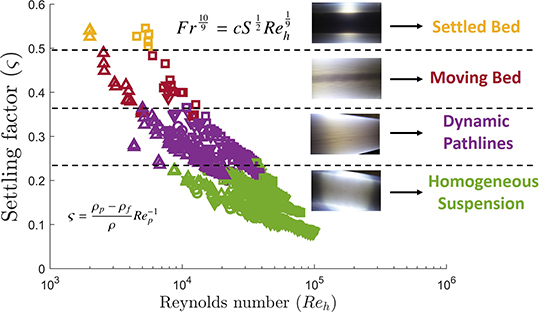
In their approach, the working fluids exhibited characteristics similar to those of nuclear waste slurries, thus relevant test materials for nuclear industries. A flow correlation, based on dimensional analysis, and a non-dimensional settling factor were proposed to describe the flow behavior at different flow conditions. The authors measured the settling regime, flow depth and flow rate of different non-colloidal suspensions in partially-filled conduits. The measurements were carried out over a wide range of Reynolds numbers (Re), pipe slopes (S) and Froude numbers (Fr). A simple framework for the prediction of the sedimentation regime is proposed and validated experimentally.
Results demonstrated that the newly developed Fr-Re-S-correlation (named “Fresco”) was more accurate than the Manning equation at predicting the bulk velocity because it considered the physical properties of the test materials. Unlike the Manning’s coefficient, the dimensionless coefficient was constant (to within experimental uncertainties) for all the tested working fluids and flow conditions. As such, a combination of the settling factor and the flow correlation was useful in accurately predicting the flow regime for various pipeline processes involving the multiphase flow of slurries, thereby greatly reducing the possibilities of solid transport failure.
In summary, the authors reported the prediction of both settling and flow behaviors of slurries in partially filled pipes. The presented framework proved effective for making accurate predictions of transport behavior of slurries as the predictions agreed well with the experimental results. With the increasing use of fluids with less favorable transportation properties, understanding the bulk behavior of non-colloidal suspensions representative of nuclear slurries is instrumental in the robust design and operations of pipelines to prevent potential negative commercial and environmental impact associated with the transportation of slurries like pipe blockages and failures. In a statement to Advances in Engineering, Dr. David Dennis explained that although Fresco is already being used to inform pipeline operations in existing nuclear facilities, the newly developed correlations are actually applicable to general fluid flow behavior and could therefore prove useful in a wide variety of applications.



Reference
Cunliffe, C., Dodds, J., & Dennis, D. (2021). Flow correlations and transport behaviour of turbulent slurries in partially filled pipes. Chemical Engineering Science, 235, 116465.