Advances in Engineering Advances in Engineering features breaking research judged by Advances in Engineering advisory team to be of key importance in the Engineering field. Papers are selected from over 10,000 published each week from most peer reviewed journals.

Significance Statement
Aluminum 6000 series alloys play a role in light weight structural applications owing to their attractive mechanical properties, superior corrosion resistance, and good weld ability. Among the aluminum alloys in industrial applications, AA6082 alloy is widely used. The material can be heat treated to attain unique degrees of precipitation.
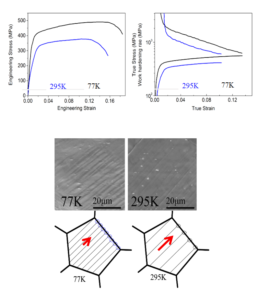
For all structural elements, mechanical properties are the most essential physical properties that dictate the range of practical applications. However, mechanical properties are dependent on material composition, crystal defects, phase structures, and particularly, temperature. Dr. Zebing Xu and Professor Hans Roven from the Norwegian University of Science and Technology in collaboration with Professor Zhihong Jia at Chongqing University in China reported that aluminum alloys had desirable properties at cryogenic temperature that made them candidates for cryogenic engineering applications. In their study, they found that a simultaneous improvement in strength and ductility of the peak-aged AA6082 aluminum alloy occurred at 77K, but not 295K. Their work is published in journal, Materials Science & Engineering A.
With the intention of studying the effect of pre-stretching at 77K and 295K, an AA6082 alloy was heat treated at 185 ᵒC to maximum hardness. The heat treatment was done because the peak-aged state is the most strain localizing condition. Rectangular tensile test pieces were machined from a plate mid-section of the T6-aged material. This implies that the tensile axis was parallel to the extrusion direction while the test piece width was in the normal direction. Three specimens were subjected to tensile tests at each test temperature.
In addition to these peak-aged pieces tensioned to fracture directly, other six samples were pre-strained at 295K and six others at 77K. Then, three specimens from every pre-straining test temperature were stored at room temperature for four to five and finally tensioned to fracture. The remaining pre-strained specimens were annealed and tensile tests done.
The different contrasts in the Electron Backscatter Diffraction maps obtained in the study corresponded to different grain alignment, indicating lamellar grains positioned parallel to extrusion axis. The alloys contained manganese and iron that formed temperature stable dispersoids that prevented recrystallization. Therefore, the hot extruded material formed a deformed fibrous grain matrix.
Parallel to the fractographic analyses, the deformed morphologies close to fracture of tensile samples provided the authors with more information about the deformation mechanisms. The areas observed were exposed to more strain as compared to the specimen gauge length.
This study successfully investigated the cryogenic behavior of an AA6082 aluminum alloy in the T6 temper condition using tensile tests. The associated characterization of texture, and microstructure and various engagement of several deformation studies were related to the characteristic mechanical behavior. Pre-stretching at the two test temperatures and tensile testing indicated a marked yield point at 77K, higher ductility and yield strength were recorded.
“The AlMgSi alloy shows impressive improvement in mechanical behavior at 77K, as compared to room temperature. The improvement is due to higher friction- and back stress of dislocations, which in turn create more homogeneous distribution of strain at the atom- to the micrometer scale. This is a big surprise, as the study was conducted in aging condition T6” Said Professor Hans Roven.




Journal Reference
Zebing Xu1, Hans J. Roven1, and Zhihong Jia2. Effects of cryogenic temperature and pre-stretching on mechanical properties and deformation characteristics of a peak-aged AA6082 extrusion. Materials Science & Engineering A, volume 679 (2017), pages 379-390.
[expand title=”Show Affiliations”]- Department of Materials Science and Engineering, NTNU, Norwegian University of Science and Technology, 7491 Trondheim, Norway.
- College of Materials Science and Engineering, Chongqing University, 400044, China.
Go To Materials Science & Engineering A