Advances in Engineering Advances in Engineering features breaking research judged by Advances in Engineering advisory team to be of key importance in the Engineering field. Papers are selected from over 10,000 published each week from most peer reviewed journals.

Significance
Recent technological advances, particularly in the energy world, have spurred significant interest in energy generation and efficiency, thereby pushing for better fabrication of novel and improved high temperature materials. For optimum operations, materials that can withstand harsh environments (high temperature and stresses) of energy generations are often required. Currently, thermal barrier coatings (TBCs) are a major component of such systems due to the fact that they enable high temperature capabilities; a characteristic attributable to a number of excellent properties they possess.
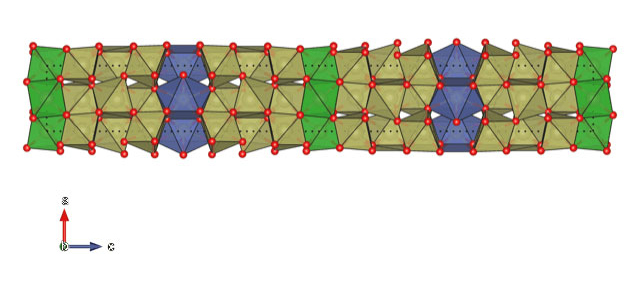
Presently, researchers assessing various attributes, such as: linear thermal expansion, thermal conductivity and chemical stability of hafnium tantalate (Hf6Ta2O17)- a prime candidate for applications as a TBC- have been published. In addition, the crystal structure of hafnium tantalate has recently been elucidated. This study enabled to fill a missing link that had hindered detailed information to be retrieved for materials such as hafnium tantalate. Therefore, now that the crystal structural information is available, it is imperative that scientists start to conduct more detailed analyses, based on atomic mechanisms regarding thermal expansion, thermal conductivity and chemical reactivity.
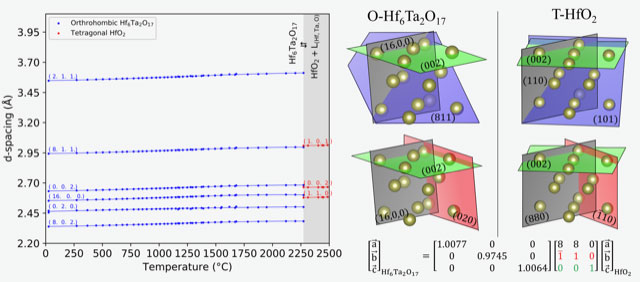
Recently, Professor Waltraud Kriven and her PhD candidate Scott J. McCormack from the Department of Materials Science and Engineering at University of Illinois at Urbana-Champaign, in collaboration with Dr. Richard Weber at Materials Development, Inc. conducted thorough studies to measure the anisotropic coefficients of thermal expansions for hafnium tantalate from room temperature up to its complete melting point. Additionally, they demonstrated how in-situ diffraction could be used to determine the orientation relationship and lattice variant deformation for the topotactic, peritectic transformation. Their work is currently published in the research journal, Acta Materialia.
The research team synthesized hafnium tantalate as a powder via the organic steric entrapment of cations, followed by preliminary characterization. The researchers then carried out high temperature X-ray diffraction where they used the quadrupole lamp furnace and conical nozzle levitator equipped with a CO2 laser system. These procedures demonstrated that the orthorhombic-hafnium tantalate and the tetragonal-HfO2 phases were related to each other via simple polyhedral rotations of a common crystallographic subcell.
The authors observed that the topotactic, peritectic transformation could be fully described by extracting the orientation relationship, lattice variant deformation and a motif (grouping) of cations that relates the two structures at the transformation temperature. Interestingly, the three factors were seen to allow for symmetry decomposition of the structure which in turn revealed that the orthorhombic-hafnium tantalate and the tetragonal-HfO2 structure were simply related by polyhedral rotations and loss of 1 mol of oxygen.
In summary, Professor Waltraud Kriven and her colleagues successfully measured the anisotropic coefficients of thermal expansion and the peritectic transformation of orthorhombic hafnium tantalate to tetragonal-HfO2 plus liquid, via in-situ, in air, X-ray powder diffraction from room temperature to complete melting in air, using a quadrupole lamp furnace and a conical nozzle levitator equipped with a CO2 laser. Altogether, a detailed analysis of atomic mechanisms focusing on the desired characteristics was presented and will provide a foundation upon which further work could be built upon.


Reference
Scott J. McCormack, Richard J. Weber, Waltraud M. Kriven. In-situ investigation of Hf6Ta2O17 anisotropic thermal expansion and topotactic, peritectic transformation. Acta Materialia, volume 161 (2018) page 127-137.
Go To Acta Materialia