Advances in Engineering Advances in Engineering features breaking research judged by Advances in Engineering advisory team to be of key importance in the Engineering field. Papers are selected from over 10,000 published each week from most peer reviewed journals.

SIGNIFICANCE
The bulk of hydrogen still comes from natural gas, which obviously limits its environmental value. As more governments and industries talk seriously about reducing emissions, the spotlight has shifted toward ways of generating hydrogen directly from renewable electricity. Among those, pairing photovoltaics with electrolysis is the option that feels the most grounded in existing technology. You take sunlight, convert it to electricity, and split water. On paper, it’s almost disarmingly simple. In practice, especially when scaled beyond a modest test setup, things start to behave less cleanly. One issue is that PV arrays never sit still electrically. Their operating point wanders as sunlight changes or as the panels heat up. Engineers normally handle this wandering with power converters running maximum-power-point tracking (MPPT), which continuously nudges the array toward its most productive point. That works beautifully for most solar applications. Electrolyzers, however, care about something slightly different. Their hydrogen output depends on current flow, not electrical power. So an algorithm optimized for power isn’t necessarily the one that delivers the most hydrogen. This mismatch becomes even more glaring when you look at the current requirements of modern electrolyzer stacks—currents so large that existing DC/DC converters simply aren’t built to handle them. Large installations often fall back on multi-stage AC coupling, and with that comes extra hardware, extra losses, and extra expense. Because of those complications, direct coupling (wiring the PV array straight into the electrolyzer) has drawn renewed attention. Removing converters avoids their efficiency losses and their current limitations, which is appealing. But there’s a catch: without any form of regulation, the PV voltage drifts wherever the sunlight pushes it. Electrolyzer stacks aren’t indifferent to voltage; running too far outside their recommended window shortens their lifetime. Earlier attempts at direct coupling did occasionally land near good operating points, but only in a passive way. They weren’t designed to favor hydrogen yield, and as a result, they often left quite a bit of performance on the table.
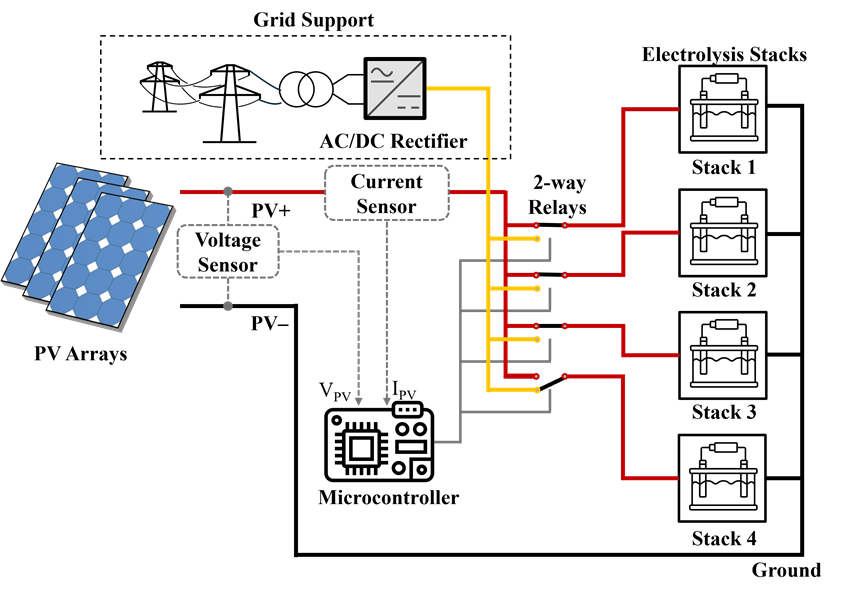
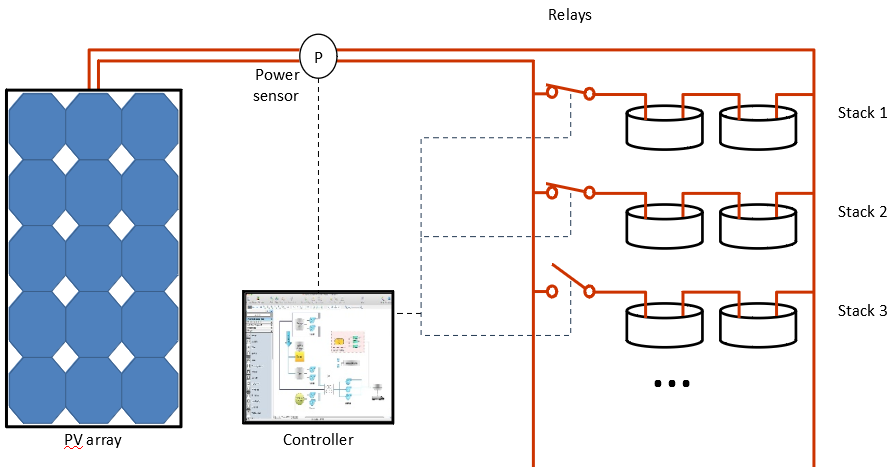
To this end, new research paper published in International Journal of Hydrogen Energy and led by PhD intern Kelvin Tan, and Professor Meng Tao from the School of Electrical, Computer, and Energy Engineering at Arizona State University, the researchers developed a load-matching photovoltaic–electrolyzer system that operates without any conventional power converter, relying instead on relay-based switching of electrolyzer stacks to adjust load impedance. Within this architecture they designed a maximum current point tracking (MCPT) algorithm that prioritizes hydrogen-producing current while maintaining voltages inside the electrolyzer’s preferred operating range. The algorithm consistently delivers more charge than classical MPPT and dramatically improves voltage compliance.
The authors approached the problem through a blended simulation–experimental framework in which the electrical behavior of a four-stack proton-exchange-membrane (PEM) electrolyzer system was coupled directly to a modeled 400-kW PV array. Instead of placing any power converter between the two subsystems, each stack could be switched on or off via relays, altering the overall load impedance seen by the PV source. By sweeping through combinations of connected stacks, the system generated families of operating points that depend on time-varying irradiance. These operating points, shown across power, current, and voltage domains, provided the foundation for identifying which combinations delivered either maximum power or maximum current at any given moment. The experiments unfolded in two phases. The first was a detailed simulation driven by irradiance data from Tucson, Arizona. To make the problem tractable while preserving the dynamics of a full day, the irradiance profile was compressed in time. Under this input, the MCPT algorithm was tested against the best available MPPT method developed previously by the group. Both algorithms respond by connecting or disconnecting stacks as sunlight strengthens or weakens. However, the MCPT algorithm applied additional logic: every prospective switch had to be evaluated for whether it increased current while still preserving voltages within a defined “safe” window. If a switch produced higher current but pushed the stack out of the acceptable voltage range, the algorithm reverted to the previous configuration.
The new approach created notable behavioral differences between the two algorithms where in early morning, when irradiance is low, MCPT tends to connect additional stacks earlier than MPPT, accepting a modest power penalty in exchange for higher current. In the afternoon, a symmetric pattern appears, with MCPT retaining a higher number of connected stacks for longer. Across the full day, these shifts accumulated into a clear trend: MCPT delivered roughly 2.5% more total charge than MPPT. The authors conducted voltage statistics and observed with its voltage-aware switching logic, MCPT kept the system within the electrolyzer’s recommended voltage range around 72% of the time which is substantially better than MPPT. Additionally, when they introduced an additional constraint that allow the system to begin the day with zero connected stacks further improved voltage compliance to roughly 94% was observed, albeit with a small reduction in total charge. In the second phase, a physical proof-of-concept system was assembled using a 290-Wp module and resistor–Zener assemblies tuned to mimic PEM stack behavior. Over both sunny and cloudy days, the MCPT algorithm demonstrated the same qualitative features observed in simulation: current was consistently prioritized, voltage remained stable within the optimal window, and the number of connected stacks adjusted responsively to rapid irradiance fluctuations. Even though real-world temperature variations created small impedance mismatches, the general consistency between simulation and experiment reinforced the credibility of the algorithm.
In conclusion, Kelvin Tan and Meng Tao successfully developed new MCPT algorithm that present a low-cost, converter-free route for scalable solar-driven hydrogen production. Indeed, the new study makes a strong case for rethinking how photovoltaic systems intended for hydrogen production should be controlled and engineered. Traditional PV‐electrolyzer integration is shaped by the logic of power electronics: regulate voltage, maximize power, and let the electrolyzer accept whatever current results. But as the authors show, this mindset becomes counterproductive once hydrogen yield becomes the metric of interest. A system that extracts slightly less electrical energy from the PV array can nonetheless generate more hydrogen if it maintains higher current over larger portions of the day. The MCPT algorithm places this insight into a practical form by recasting control decisions as current-maximizing moves that still respect voltage boundaries. It is noteworthy to mention the benefits of MCPT arise without adding any new hardware. Direct coupling retains its appeal because every removed converter translates into lower cost and higher reliability—factors that matter enormously when imagining hydrogen plants made of dozens or hundreds of megawatt-scale stacks. The algorithm also addresses a longstanding vulnerability in direct-coupled systems: voltage drift. Previous demonstrations often accepted wide voltage swings as an unavoidable feature of simplicity. By embedding voltage regulation directly into the switching logic, Tan and Tao create a version of direct coupling that behaves in a more disciplined, industrially acceptable manner. The improvement in voltage compliance—from less than half the day under MPPT to nearly the entire day under the revised MCPT which is substantial enough to influence decisions surrounding stack durability, replacement frequency, and overall lifecycle cost.
A broader implication lies in how PV arrays and electrolyzers might be co-designed. Instead of viewing power electronics as the universal interface, this work hints at a future in which electrolyzer geometry, number of stacks, and PV string configuration can be chosen jointly, with the load-matching algorithm acting as the glue. The approach scales naturally because it depends only on how many stacks the relays can address. This is appealing for gigawatt-level projects where current levels will far exceed what today’s converters can handle. In such environments, designing systems to deliver high current directly from the PV array could sidestep engineering bottlenecks that otherwise limit deployment speed. If integrated with new stack chemistries or high-current PEM designs, MCPT-like strategies could fundamentally change how future hydrogen farms are architected.


Reference
Kelvin Tan, Meng Tao, A maximum current point tracking algorithm for photovoltaic hydrogen production, International Journal of Hydrogen Energy, Volume 157, 2025, 150450,