 Advances in Engineering Advances in Engineering features breaking research judged by Advances in Engineering advisory team to be of key importance in the Engineering field. Papers are selected from over 10,000 published each week from most peer reviewed journals.

The Relationship between Intermolecular Interactions in the Solid State and Electroluminescent Efficiency
Significance
Over the years, bipyridine-based organometallic complexes have emerged as potential candidates for fabricating triplet emitters in phosphorescent organic light-emitting diodes (PHOLEDs). In particular, bipyridine-based Ir(III) complexes, exhibiting high photoluminescent quantum efficiency (PLQY) and enhanced organic light-emitting diode (OLED) performance, have recently attracted significant research attention. This can be attributed to the strong molecular interactions between the molecules and bipyridine ligands that present further performance improvement opportunities. With the increasing demands and applications of bipyridine-based Ir(III) complexes with high triplet energy, extensive research has been conducted to understand its photophysical properties and OLED characteristics. However, limited research on the photophysical properties and OLED characteristics of bipyridine-based platinum (II) complexes has been reported.
Pt(II) complexes can be potentially used as dopant materials for OLED devices because the resultant excimer emissions produce broad emission bands covering the visible region. Consequently, white emissions can be achieved by increasing the doping concentration of the Pt(II) complex in the emissive layer of OLED devices. Unfortunately, this method is costly and unsuitable for practical application. Moreover, the speculations that effective control of the substitutes present on the ligand framework provides a better means for obtaining white emission at a low doping concentration of Pt(II) complexes have not been experimentally verified. These assertions are based on the fact that excimer formation resulting in emissions at lower wavelengths is highly dependent on the strength of the molecular interactions.
On this account, Jisu Kang (Ph.D. student), Rena Zaen (Ph.D. candidate), and led by Professor Youngjin Kang from the Kangwon National University, in collaboration with Dr. Kyung Hyung Lee and Professor Jun Yeob Lee from Sungkyunkwan University and Professor Ki-Min Park from Gyeongsang National University, investigated the application of cyclometalated platinum (II) β‑diketonate complexes as single dopants for high-efficiency white OLEDs. The main aim of the study was to improve the photoluminescent quantum efficiency of the cyclometalated Pt(II) β-diketonate complexes. Their work is currently published in the journal, Crystal Growth and Design.
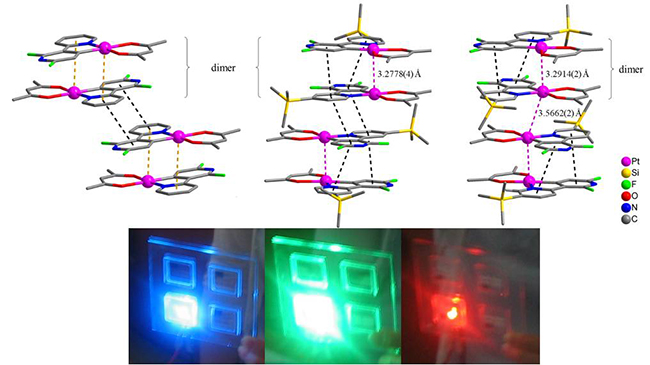
In brief, the authors commenced their work by synthesizing three different Pt(II) complexes containing β-diketonate, and 2′,6′-difluoro-2,3′-bipyridine ligands with bulky trimethylsilyl (TMS) group at the 4- or 5-position. Through Hirshfeld analysis, the relationship between intermolecular interactions in the solid-state and electroluminescent efficiency was investigated. Also, the emission properties and the formation of excimers under low doping concentrations were analyzed and compared for the three Pt(II) complexes.
The authors observed various molecular interactions that were dependent on the presence or absence of TSM and its position on the 2′,6′-difluoro-2,3′-bipyridine ligands. Incorporating TSM at 4- or 5- position of the ligand produced strong intermolecular interactions between the Pt(II) complexes. The resulting complexes exhibited blue to sky blue emissions at remarkably higher photoluminescent quantum efficiency of 0.6 – 0.8. Similarly, they formed excimers under low doping concentrations of the Pt(II) complexes. As a result, single-doped white organic light-emitting diodes (WOLED) were successfully fabricate using the three different Pt(II) complexes as single dopant materials. Interestingly, WOLEDs fabricated by substituting the Pt(II) complex with TSM at 5-positon as a single dopant provided the highest performance results than its counterparts.
In a nutshell, the study by Professor Youngjin Kang and colleagues reported a practical strategy based on proper ligand design incorporating a bulky group as a substituent for obtaining single dopants for fabricating high-performance WOLEDs. From the Hirshfeld analysis of the three different Pt(II) complexes, the intermolecular interactions in the square-planar platinum(II) β-diketonate complexes as well as the position and nature of the substituents were identified as crucial factors influencing the intermolecular interactions in the solid-state and formation of excimers. All the complexes produced strong interactions even at low doping concentrations to form excimers. Notably, substituting phenylpyridine with difluorinated bipyridine resulted in the fabrication of blue PHOLEDs and single-doped WOLEDs with a higher external quantum efficiency (12.3%) and color rendering index (88). According to the authors, the study would pave the way for the development of single dopants for various applications.

Reference
Kang, J., Zaen, R., Park, K., Lee, K., Lee, J., & Kang, Y. (2020). Cyclometalated Platinum(II) β-Diketonate Complexes as Single Dopants for High-Efficiency White OLEDs: The Relationship between Intermolecular Interactions in the Solid State and Electroluminescent Efficiency. Crystal Growth & Design, 20(9), 6129-6138.