Advances in Engineering Advances in Engineering features breaking research judged by Advances in Engineering advisory team to be of key importance in the Engineering field. Papers are selected from over 10,000 published each week from most peer reviewed journals.

Significance Statement
Functionalized nanometer-size cavities and pores are expected as intelligent catalysts, in which specific molecular recognition and transformation occurs under ambient conditions. Now, both inside and outside functionalized D3h symmetric cyclic porphyrin trimers have been synthesized by a simple reductive homocoupling reaction of a bischloropyridylporphyrin derivative. Although some prism-shape-porphyrin trimers have been constructed so far by coordination organized methodology of metal ions and ligands, most of the metal ions cannot be used to manipulate gest molecules within the cavities because their coordination sites are fully used to construct their skeletons. The novel cyclic porphyrin trimers represented in this paper have enabled to introduce various active metal complexes inside the ring, and therefore they will be versatile macrocyclic ligands for multicofacial heteromultinuclear complexes. A one-nanometer-space surrounded by active multimetalic complexes is really unique, and it is difficult to construct such a space by use of other method at present. Unique catalytic activities by use of multinuclear complexes, and host-guest chemistry in water by using hydrolyzed cyclic porphyrin trimers are interesting, and they are now under investigation in my group.
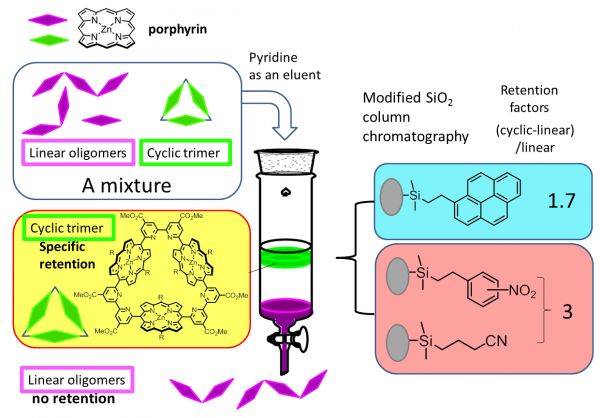
During purification process of cyclic porphyrin trimers from a mixture including the cyclic trimer and other linear oligomers, specific retention behavior was discovered only in the cyclic porphyrin arrays, but not in other linear ones, on modified silica-gel column chromatography. The purification methods to discriminate geometrical shapes between cyclic and linear oigomers are really useful to isolate them from their mixtures. If the separation methods can be applied to other oligomeric systems, a new cyclic compound, even which is one of minor components in its crude mixture, may be discovered.
Figure Legend: An extremely efficient separation of cyclic porphyrin trimers from mixtures of linear and cyclic arrays has been discovered on modified silica-gel column chromatography, using non-polar aromatics, such as pyrenyl, and polar residues, such as nitrobenzene and cyanopropyl, as functional groups. Two different mechanisms, host-guest interaction and dipole-dipole interactions, are contributed in the separation. These separation methods will allow new strategies to prepare other macrocycles. In cyclic porphyrin trimers purified by above methods, three porphyrinato and three 2,2’-bipyridyl groups are integrated, and up to six metal ions can be introduced inside the ring. Macrocyclic ligands presented here are categorized to a new metal ligand for multicofacial multinuclear complexes.
Journal Reference
Chemistry. 2015 Aug 10;21(33):11745-56.
Ohkoda Y, Asaishi A, Namiki T, Hashimoto T, Yamada M, Shirai K, Katagami Y, Sugaya T, Tadokoro M, Satake A.
[expand title=”Show Affiliations”]- Graduate School of Chemical Sciences and Technology, Tokyo University of Science, 1-3 Kagurazaka, Shinjuku-ku, Tokyo 162-8601 (Japan).
Abstract
The one-step synthesis of D3h -symmetric cyclic porphyrin trimers 1 composed of three 2,2′-[4,4′-bis(methoxycarbonyl)]bipyridyl moieties and three porphyrinatozinc moieties was achieved from a nickel-mediated reductive coupling of meso-5,15-bis(6-chloro-4-methoxycarbonylpyrid-2-yl)porphyrinatozinc. Although cyclic trimers 1 were obtained as a mixture that included other cyclic and acyclic porphyrin oligomers, an extremely specific separation was observed only for cyclic trimers 1 when using columns of silica gel modified with pyrenylethyl, cyanopropyl, and other groups. Structural analysis of cyclic trimers 1 was carried out by means of NMR spectroscopy and X-ray crystallography. Treatment of an η(3) -allylpalladium complex with a cyclic trimer gave a tris(palladium) complex containing three η(3) -allylpalladium groups inside the space, which indicated that the bipyridyl moieties inside the ring could work as bidentate metalloligands.
© 2015 WILEY-VCH Verlag GmbH & Co. KGaA, Weinheim.
Go To Chemistry