 Advances in Engineering Advances in Engineering features breaking research judged by Advances in Engineering advisory team to be of key importance in the Engineering field. Papers are selected from over 10,000 published each week from most peer reviewed journals.

Significance
Industrial applications for thermal spray coatings that are corrosion and wear resistant have been on the rise over the years. These coatings have proven beneficial and are replacing the toxic hard chrome plating. The new thermal spray coatings are typically carbides composed of tungsten in a cobalt or cobalt/nickel/Chromium-alloyed binder. During fabrication, their deposition demands the use of high velocity combustion thermal spray techniques, such as: HVAF and HVOF, for their relatively low deposition temperatures. However, thermal dissolution and decarburization of tungsten carbide (WC) still remains a significant obstacle in obtaining high-performance wear resistant coatings. As a result, mechanisms trying to elucidate on the aforementioned shortcoming have been proposed. Unfortunately, the exact formation mechanism of decarburization products such as metallic tungsten is yet to be established. In fact, the morphology of the observed metallic tungsten crystalline precipitates, so far, has been arbitrary.
Recently, a team of researchers at University of Surrey: Dr. Vasileios Katranidis, Professor Sai Gu, Dr. David C. Cox, Dr. Mark J. Whiting and Dr. Spyros Kamnis investigated circumstances surrounding metallic tungsten nucleation by presenting a closer examination on the three-dimensional morphological features of the tungsten carbide decarburization products. Particularly, they focused on the structure of metallic tungsten. Their research work is currently published in Journal of Thermal Spray Technology.
In brief, their experimental work commenced with the utilization of commercial agglomerate sintered powder of tungsten carbide to coat the selected substrates. They then employed HVOF coating deposition technique to deposit the coating. The coating was sprayed intentionally at an exceedingly long spray distance to exaggerate the decarburization effects. The researchers then used energy-dispersive X-ray spectroscopy (EDS) analysis to quantify and spatially discriminate against the decarburization products. Finally, plasma FIB-SEM was employed to probe the three-dimensional features of the microstructure and decarburization products.
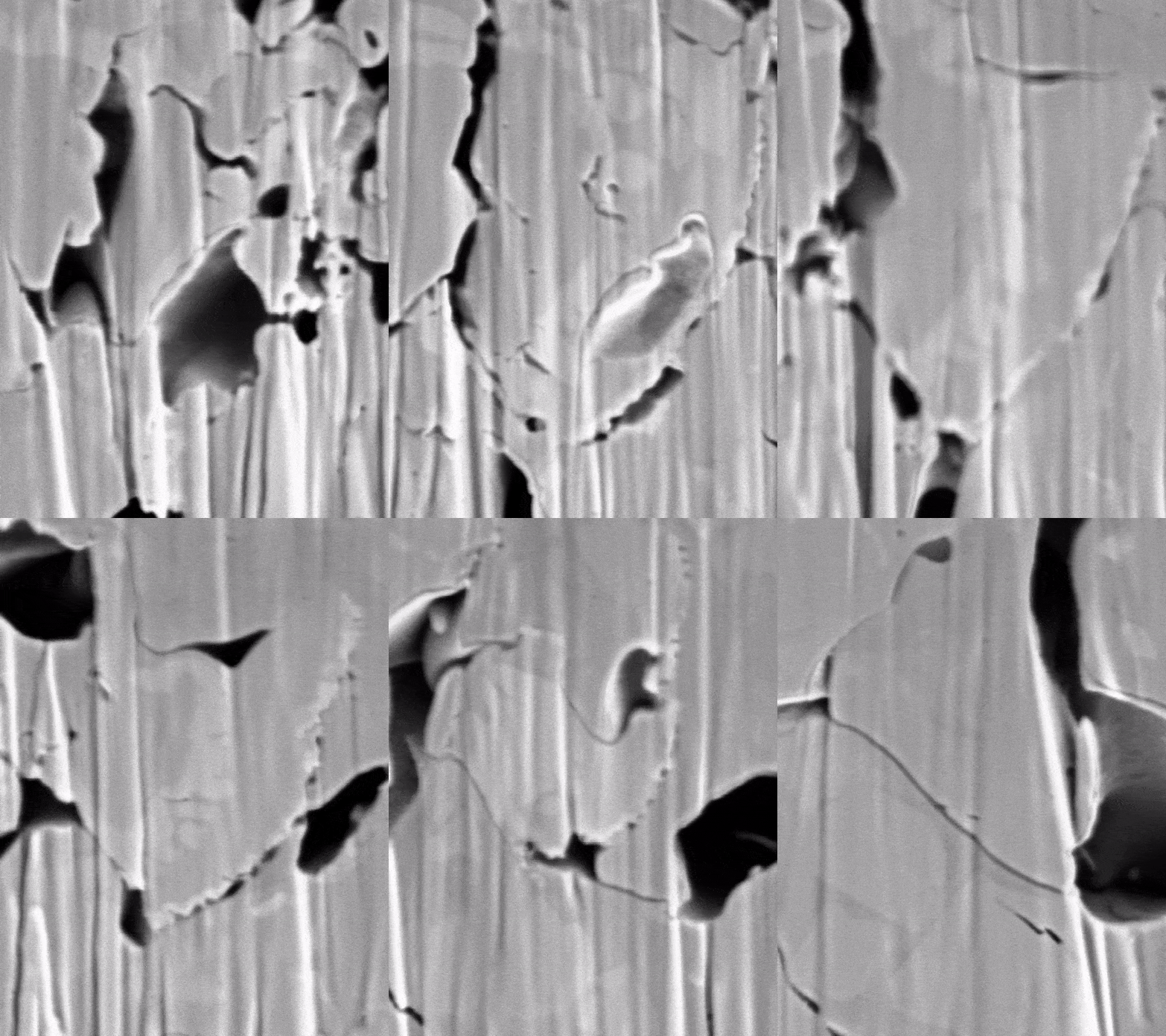
Progressive xenon plasma ion milling of the examined surface revealed microstructural features that would have been smeared away by conventional polishing. In addition, the authors observed that the metallic tungsten formed a shell around small splats that did not deform significantly upon impact. This observation suggested that its crystallization occurred during the in-flight stage of the particles.
In summary, Vasileios Katranidis and colleagues, identified new insights on the crystallization process of metallic tungsten during the thermal spray of the WC-Co particles by studying the three-dimensional morphology of WC decarburization products in the coating. Specifically, research work of University of Surrey scientists revealed a pathway that explains the occurrence of the metallic tungsten that is commonly observed in arbitrary shapes in such coatings. Tungsten-shells that have formed in-flight, break and deform into creased flakes upon the impact of adequately large particles. In turn, those flakes appear as long aspect ratio stringers in the two-dimensional SEM images that are typically used to study these coatings.





Reference
Vasileios Katranidis, Sai Gu, David C. Cox, Mark J. Whiting, Spyros Kamnis. FIB-SEM Sectioning Study of Decarburization Products in the Microstructure of HVOF-Sprayed WC-Co Coatings. Journal of Thermal Spray Technology (2018) volume 27: page 898–908
Go To Journal of Thermal Spray Technology (2018)