Advances in Engineering Advances in Engineering features breaking research judged by Advances in Engineering advisory team to be of key importance in the Engineering field. Papers are selected from over 10,000 published each week from most peer reviewed journals.

Significance
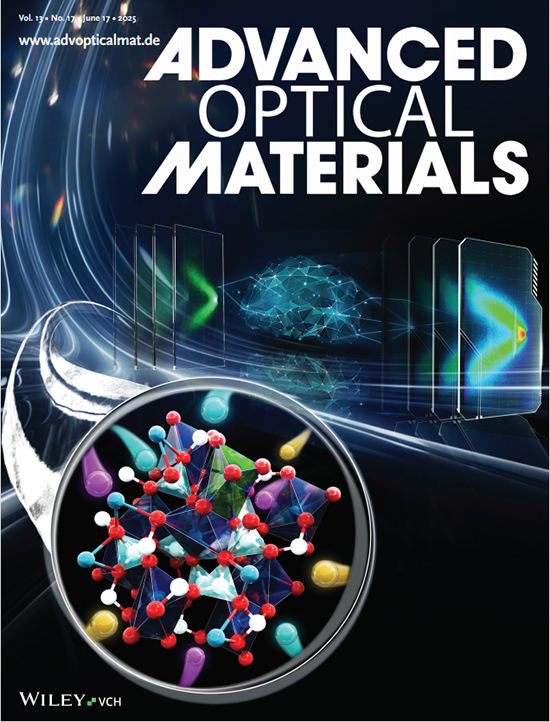
The capacity to perceive and reconstruct mechanical deformation across large and complex surfaces without physical contact represents a fundamental aspiration in structural health monitoring and materials engineering. Recently, multiple sensor modalities such as piezoelectric, piezoresistive, acoustic, and optical have emerged to detect strain, stress, and fracture evolution. However, these systems often entail complex signal processing, environmental calibration, and invasive placement which limit their real-time application such as in aerospace, civil infrastructure and microfabrication. Traditional non-contact optical methods, such as digital image correlation and laser Doppler vibrometry, although precise, remain highly sensitive to environmental perturbations and surface irregularities. Therefore, there is a need for new sensing media capable of autonomously encode mechanical stimuli into optical outputs that can be captured remotely and interpreted computationally. Mechanoluminescent (ML) materials can offer the solution to this challenge because these materials generate light directly under mechanical stimulation, converting deformation energy into photon emission without external power. Their self-illuminating nature circumvents the need for complex circuitry and enables visual mapping of mechanical states over extended areas. Since the initial discovery of ML in crystalline and polymeric systems, researchers have attempted to design compositions that balance high emission intensity with controlled afterglow duration—two parameters that strongly influence accuracy and temporal resolution in distributed sensing. Conventional ML compounds such as ZnS:Mn²⁺ or SrAl₂O₄:Eu²⁺ have demonstrated promising performance, however, a persistent trade-off between brightness and persistence hampers their use for quantitative strain mapping. Too brief an afterglow leads to incomplete signal capture, whereas overly prolonged emission causes temporal overlap between frames, distorting the reconstruction of dynamic fields. To this account, new research paper published in Advanced Optical Materials and conducted by Dr. Yantang Zhao, Dr. Xin Jing, Yongjie Ma, Dr. Peng He, and led by Professor Qiangqiang Zhang from the School of Civil Engineering and Mechanics at Lanzhou University alongside Professor Hui Li from the Harbin Institute of Technology, the researchers developed a ternary-doped SrAl₂O₄:(Eu²⁺, Dy³⁺, Nd³⁺) mechanoluminescent material and a flexible composite film that converts mechanical stress into quantifiable optical emission. They achieved simultaneous enhancement of brightness and afterglow control by precise tuning trap depths through multi-ion doping. The new system reconstructs full-field stress and fracture evolution directly from luminescent images and coupled with a deep-learning U-Net model.
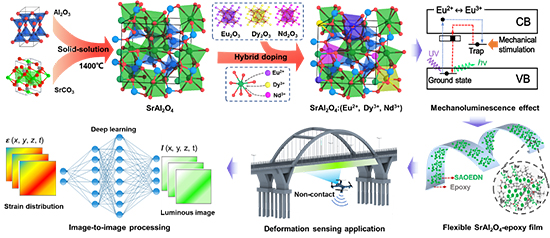
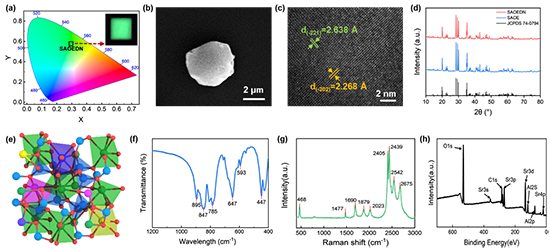
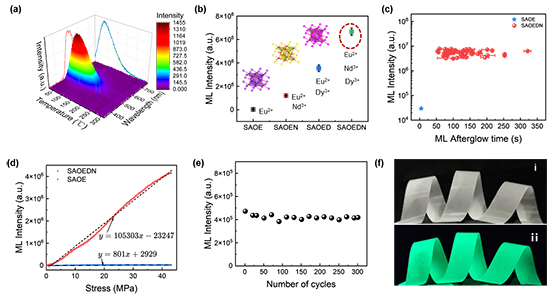
The research team prepared the compound SrAl₂O₄:(Eu²⁺, Dy³⁺, Nd³⁺), referred to as SAOEDN, through a high-temperature solid-state reaction involving stoichiometric SrCO₃ and Al₂O₃ precursors heated to 1400 °C under a mildly reducing H₂/N₂ atmosphere. This environment played an essential role in maintaining europium in its divalent state while introducing oxygen vacancies that function as electron traps. Controlled incorporation of Eu²⁺, Dy³⁺, and Nd³⁺ ions into the SrAl₂O₄ lattice allowed for deliberate manipulation of trap depth and emission centers, resulting in a bright green luminescence near 520 nm. The authors observed under microscopy that the particles exhibited a smooth, nearly spherical morphology with a mean diameter of roughly six micrometers and also high-resolution TEM showed ordered lattice fringes characteristic of monocrystalline grains, and XRD confirmed the retention of the monoclinic SrAl₂O₄ structure despite the presence of multiple dopants. Moreover, when the authors performed spectroscopic analysis they noticed the altered local environment of the lattice while FTIR and Raman spectra both displayed subtle shifts in the Al–O vibration bands, a signature of the local distortion surrounding the rare-earth dopant sites. These changes are consistent with the formation of new coordination geometries capable of stabilizing charge carriers. XPS data showed europium existing in both Eu²⁺ and Eu³⁺ states which indicate a dynamic redox process that enables reversible charge exchange during mechanoluminescent excitation. This mixed valence serves as the foundation of the material’s luminescent response to stress.
The optimized SAOEDN composition demonstrated a luminous intensity nearly two orders of magnitude higher than conventional SrAl₂O₄:Eu²⁺ and featured an adjustable afterglow lifetime ranging from approximately 50 s to 300 s. Hybrid rare-earth doping introduced a distribution of trap depths (0.2–0.88 eV), improving both energy capture and release efficiency. The luminescence intensity showed a linear dependence on applied mechanical load, establishing the material as an effective optical strain transducer. Consistent performance was maintained over 300 loading cycles, and the initial brightness could be fully restored after short UV irradiation.
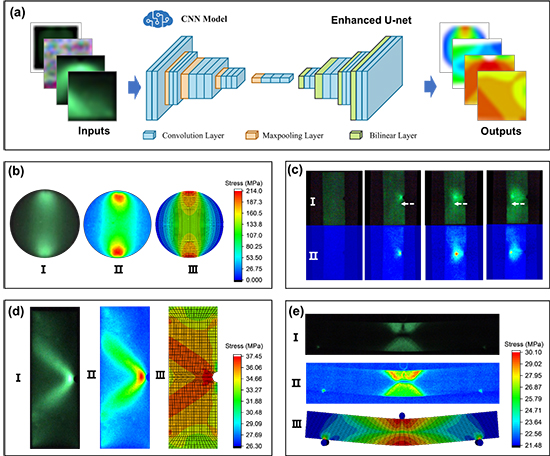
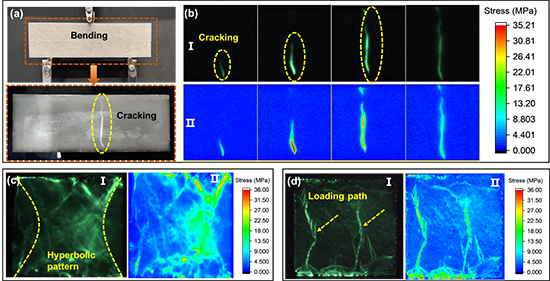
The authors afterward, embedded SAOEDN particles within a flexible epoxy matrix to form a thin mechanoluminescent film. The composite adapted well to uneven surfaces and emitted localized light patterns under mechanical deformation, accurately reflecting strain distribution. These luminescent images, captured with a CCD camera, were analyzed using a modified U-Net convolutional neural network trained on paired datasets of light patterns and finite-element stress simulations. The reconstructed maps closely matched simulated results across compression, tension, and bending tests. During fracture experiments on concrete beams, the film tracked crack initiation and propagation in real time with spatial precision near 0.004 mm² and temporal resolution of 0.1 s. The brightest emission consistently marked the crack tip, directly visualizing stress concentration and confirming the system’s capability for real-time, distributed, non-contact mechanical sensing.
In conclusion, Professor Qiangqiang Zhang and colleagues developed a new paradigm for distributed structural sensing. This dual-material and computational innovation establishes a self-powered, high-resolution platform for non-contact structural health monitoring. Indeed, the SAOEDN mechanoluminescent film transcends the limitations of traditional optical or electronic strain gauges by combining intrinsic self-luminescence with computational reconstruction. The rare-earth hybrid doping scheme represents a refined strategy for energy-level engineering within wide-bandgap hosts, achieving both high photon yield and controllable decay dynamics. By balancing these parameters, the authors effectively dismantle the conventional trade-off between brightness and afterglow that has constrained ML materials for decades. The integration of a deep-learning reconstruction model is equally transformative and instead of treating the emitted light as a qualitative signal, the researchers leverage convolutional networks to translate luminescent images into quantitative stress maps. This approach reframes the ML phenomenon—from a visual curiosity to a functional medium for real-time mechanical analytics. In doing so, it opens possibilities for adaptive monitoring systems where data acquisition and interpretation occur autonomously, guided by algorithms capable of learning from diverse mechanical histories. We believe there is wide implication of this innovation, and the flexible SAOEDN films could be deployed on bridges, aircraft fuselages, turbine blades, or biomedical implants to monitor mechanical integrity under variable conditions. Their optical readout can be captured remotely, even in dark or contaminated environments where contact sensors fail. Because the films are passive and energy-independent, they offer remarkable resilience against electromagnetic interference and power disruption—qualities essential for long-term monitoring of critical infrastructure. Moreover, the demonstrated capacity to track crack propagation in concrete exemplifies a future where materials themselves participate in their diagnosis, emitting light as a direct expression of stress or damage. Future research will focus on scaling production, ensure stability under extreme environments, and integrate such films with existing sensor networks. This will pave the way for vision—of autonomous, visually interpretable sensing—positions deep-learning-enhanced mechanoluminescence as a cornerstone technology for the next generation of smart materials and structural diagnostics.

Reference
Zhao, Yantang & Jing, Xin & Ma, Yongjie & He, Peng & Zhang, Qiangqiang & Li, Hui. (2025). Deep‐Learning Enhanced SrAl2O4: (Eu, Dy, Nd) Mechanoluminescence Film for Distributed Perception of Mechanical Deformation and Fracture. Advanced Optical Materials. 13. 10.1002/adom.202403516.