Advances in Engineering Advances in Engineering features breaking research judged by Advances in Engineering advisory team to be of key importance in the Engineering field. Papers are selected from over 10,000 published each week from most peer reviewed journals.

Significance
Cast iron is a group of iron-carbon alloys with a carbon content greater than 2%. This material has a slew of applications, particularly in the field of engineering; credit to its outstanding properties, such as: favorable castability, thermal conductivity and cost. Current technologies, however, persistently demand information about mechanical and fatigue performance, specifically in recently conceived components. Traditionally, such information is acquired either by prototype laboratory testing or through computer simulations.However, the employment of the latter is complicated in the case of cast iron since it has proven to be a very complexmaterial regarding its mechanical behavior, with various abnormalities being identified.
Based on experimental observations, the aforementioned phenomena have been hypothesized to originate from the two-phase microstructure of cast iron through the interaction between the embedded graphite phase and the surrounding matrix. Still, despite both experimental and theoretical research being conducted on the deformation behavior of cast iron, very few investigations have considered the behavior when subjected to cyclic load conditions. In fact, there lacks consistent experimental evidence of the micro-mechanisms causing the mentioned abnormalities, and a unified model of explanation of the cyclic elastoplastic constitutive behavior of cast iron.
In a recent publication from Sweden at Linköping University, Dr. Viktor Norman and Dr. Mattias Calmunger presented a study whose objective was to render a qualitatively general model with the aim of rationalizing the mechanical constitutive behavior of cast iron in uniaxial cyclic loading. They aspired to demonstrate that the abnormalities observed in the constitutive behavior could be qualitatively and quantitatively explained by the interaction behavior between the matrix and graphite constituents. Their work is currently published in International Journal of Plasticity.
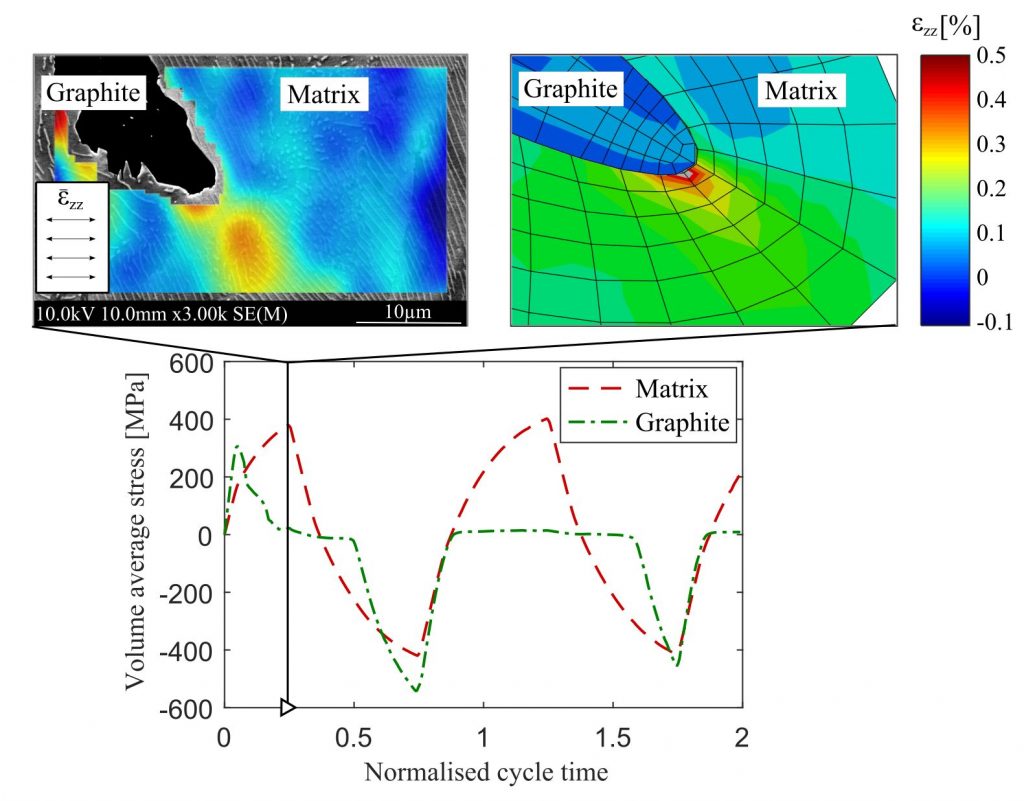
The researchers employed a micromechanical approach in order to relate the macroscopic mechanical behavior with the underlying microscopic behavior, which was experimentally validated using high-resolution digital image correlation of scanning electron microscopy images. For this purpose, a representative cast iron sample was studied i.e. a sample from cast iron commonly used material in heavy-vehicle diesel engines. To this end, the micro mechanisms responsible for the macroscopic behavior were identified and modelled in this investigation.
The authors reported that in initial tension, the absence of non-linearity mainly originated from the successive loss in load-carrying capacity of the graphite phase, which in subsequent cycling, resulted in the opening and re-contact of the matrix-graphite interface. All in all, the matrix-graphite interface was demonstrated to qualitatively and quantitatively explain the aforementioned anomalies of the hysteresis loop of cast iron.
In summary, the Norman-Calmunger study demonstrated that the complicated cyclic constitutive behavior of cast iron, involving a non-linear elastic regime, tension compression stress asymmetry, varying elastic modulus and an inflection in the tension-to-compression hardening curve, originated from the interaction behavior between the matrix and graphite constituents, using a micromechanical model. Overall, a greater understanding of the behavior of cast iron material was achieved by their study, representing a major step and of great value for future development of cast iron constitutive models.


Reference
V. Norman, M. Calmunger. On the micro- and macroscopic elastoplastic deformation behavior of cast iron when subjected to cyclic loading. International Journal of Plasticity, volume 115 (2019) page 200–215.
Go To International Journal of Plasticity