 Advances in Engineering Advances in Engineering features breaking research judged by Advances in Engineering advisory team to be of key importance in the Engineering field. Papers are selected from over 10,000 published each week from most peer reviewed journals.

Significance Statement
Our manuscript describes the application of catastrophes in the field of atom optics, in which various optical phenomena such as lenses and curved mirrors have been mimicked by harnessing optical and magnetic potentials to guide ultracold atoms. Such devices are naturally suitable for ultracold atomic beams, in which the atoms have negligible longitudinal velocity spread, and accordingly can be considered analogous to an optical beam. Like optical lenses and curved mirrors, the focusing they provide is geometry-dependent.However, focusing does occur abundantly in nature in a way that is less optimal than lens-like imaging, yet much more robust. Such are the optical caustics – like the bright curves of light at the bottom of swimming pools, or the cusp feature at the bottom of an empty cup. Unlike focusing with a lens, caustics are inherently immune to changes in the parameters of the system in which they occur. This is the reason bright curves of light appear nearly always in every pool, even though the shape and dimensions of the pools may vary significantly. Their robustness makes caustics a potentially powerful tool for control under imperfect conditions or limited controllability. This was demonstrated, for example, by focusing of electron flow [Science 315, 1252 (2007)], and high-harmonics generation with atto-second pulses [Nature Photonics 6, 170–173 (2012)].
We follow this line and demonstrate the potential of adding the universal phenomenon of caustics to the toolbox of atom optics. Following singularity theory, we present the evolution of atoms in the presence of a conserving potential as a topological mapping. This mapping can result in the occurrence of catastrophes, which are classes of structurally-stable singularity points at which the density diverges. Similarly, optical caustics are classified into different types of such catastrophes.
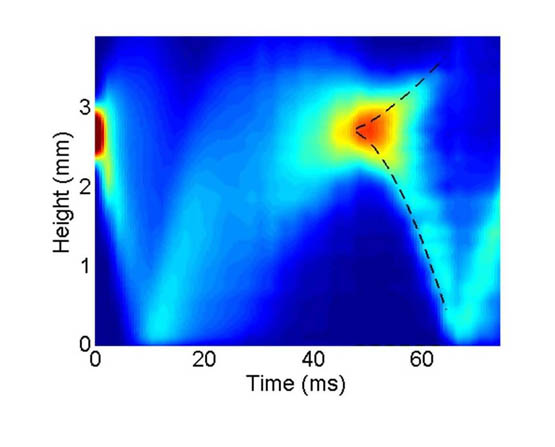
We demonstrate the two orders of catastrophes that can appear in the linear density of an atomic cloud,which are fold lines (first order) and a cusp point (second order). The image below shows our demonstration of a cusp point in an expanding, hot atomic cloud, reflected from an ptical barrier. By attaining this point, we in fact re-focus a cloud that has ‘exploded’ 50ms earlier. This focusing is field-free, i.e. arises from the free-propagation of the atoms under gravity, far away from any perturbing fields. Such focusing in the longitudinal direction cannot be achieved with lens-like potentials or curved mirrors, as such do not distinguish between fast and slow atoms that travel along the same path. To summarize, in this work we experimentally demonstrate the universal and fundamental behavior of this atomic system, link it to many other, drastically diverse physical systems, and offer a potentially powerful experimental tool.
Journal Reference
Phys. Rev. Lett. 112, 120403 – 2014.
Serge Rosenblum, Orel Bechler, Itay Shomroni, Roy Kaner, Talya Arusi-Parpar, Oren Raz, and Barak Dayan.
Department of Chemical Physics, Weizmann Institute of Science, Rehovot 76100, Israel.
Abstract
We experimentally demonstrate first-order (fold) and second-order (cusp) catastrophes in the density of an atomic cloud reflected from an optical barrier in the presence of gravity and show their corresponding universal asymptotic behavior. These catastrophes, arising from classical dynamics, enable robust, field-free refocusing of an expanding atomic cloud with a wide velocity distribution. Specifically, the density attained at the cusp point in our experiment reached 65% of the peak density of the atoms in the trap prior to their release. We thereby add caustics to the various phenomena with parallels in optics that can be harnessed for manipulation of cold atoms. The structural stability of catastrophes provides inherent robustness against variations in the system’s dynamics and initial conditions, making them suitable for manipulation of atoms under imperfect conditions and limited controllability.