Advances in Engineering Advances in Engineering features breaking research judged by Advances in Engineering advisory team to be of key importance in the Engineering field. Papers are selected from over 10,000 published each week from most peer reviewed journals.

Significance Statement
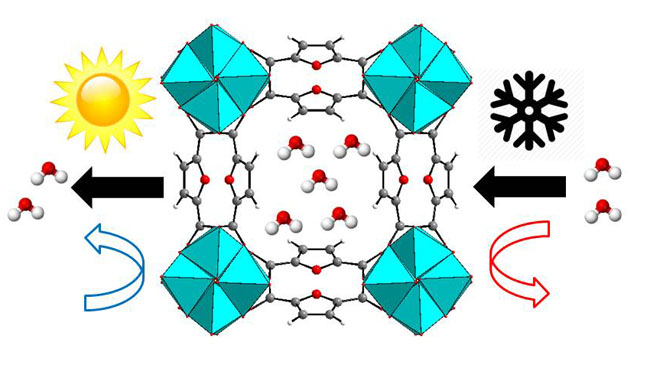
A new porous bio-sourced MOFs (Metal-Organic Frameworks) material has been recently developed that is extremely well suited for application in heat pumps. It shows a superior performance over commercial sorbents and may potentially contribute to considerable energy savings worldwide.
About 33 % of the energy consumption is used for heating and cooling of houses and buildings. A way to reduce this energy consumption is to rely on adsorption driven heat pumps and chillers, even using low-grade waste heat or sustainable solar energy in combination with environmentally working fluids such as water.
Metal organic framework are porous crystalline hybrid materials resulting from the association of inorganic sub-units and organic ligands, associated to a wide range of tunable compositions and porous features. This represents an almost unique way to design new materials with superior properties.
These metal organic framework water pairs possess higher energy efficiency and working capacity than benchmark materials and may operate with a lower driving temperature. The selected metal organic frameworks can be coated (without binder) directly on heat-exchanger surfaces for a fast response.
The described research has identified a new Aluminum based metal-organic framework with a sufficient stability against water, that shows a better performance compared with the other existing sorbents, including the commercial SAPO-34 material. It was rationally designed through a concerted effort of materials chemists, theoreticians and engineers. Its friendly composition (Al, bio-sourced linker), its green synthesis (water, low temperature), its easy scalability (ambient pressure, cheap chemicals) and robustness, associated with its unprecedented performance pave the way for the application of metal-organic frameworks in adsorption for heat pumps and chillers with a large energy savings potential.
Journal Reference
Adv Mater. 2015;27(32):4775-80.
Cadiau A1, Lee JS2,3, Damasceno Borges D4, Fabry P1, Devic T1, Wharmby MT5, Martineau C1, Foucher D1, Taulelle F1, Jun CH3, Hwang YK2, Stock N5, De Lange MF6, Kapteijn F6, Gascon J6, Maurin G4, Chang JS2,7, Serre C1.
[expand title=”Show Affiliations”]- Institut Lavoisier, UMR CNRS 8180, Université de Versailles St-Quentin en Yvelines, 45 Avenue des Etats-Unis, 78035, Versailles Cedex, France.
- Research Center for Nanocatalysts, Korea Research Institute of Chemical Technology (KRICT), Jang-Dong 100, Yuseong, Daejeon, 305-600, Republic of Korea.
- Department of Chemistry, Center for Bioactive Molecular Hybrid, Yonsei University, Seodamoonku, Seoul, 120-749, Republic of Korea.
- Institut Charles Gerhardt Montpellier, UMR CNRS 5253, Université Montpellier 2, 34095, Montpellier cedex 05, France.
- Institut für Anorganische Chemie, Christian-Albrechts-Universität zu Kiel, Max-Eyth-Straße 2, 24118, Kiel, Germany.
- Catalysis Engineering-Chemical Engineering Department, Delft University of Technology, Julianalaan, 136, 2628, BL Delft, The Netherlands.
- Department of Chemistry, Sungkyunkwan University, Suwon, 440-476, Republic of Korea.
Abstract
A new hydrothermally stable Al polycarboxylate metal organic framework (MOF) based on a heteroatom bio-derived aromatic spacer is designed through a template-free green synthesis process. It appears that in some test conditions this metal organic framework outperforms the heat reallocation performances of commercial SAPO-34.
© 2015 WILEY-VCH Verlag GmbH & Co. KGaA, Weinheim.
Go To Adv Mater.