Advances in Engineering Advances in Engineering features breaking research judged by Advances in Engineering advisory team to be of key importance in the Engineering field. Papers are selected from over 10,000 published each week from most peer reviewed journals.

Significance
Since their discovery, carbon fiber reinforced polymers have found vast applications across numerous fields owing to their excellent specific strength, specific stiffness, corrosion and fatigue resistance properties. For example, they have been used in aircraft for reducing weight. To date, several methods have been developed to produce carbon fiber reinforced polymer laminates. However, fiber waviness that may be caused by large residual stresses in the curing process of laminates has remained a common challenge in producing high-performance fiber-reinforced polymers considering that it significantly reduces the materials’ strength and stiffness. To this end, it is imperative to develop nondestructive fiber waviness detection technology.
Presently, eddy current testing technology has been widely used in inspecting conductive materials. Recent efforts have been devoted towards extending this technique in studying the fiber waviness in carbon fiber reinforced polymer. Despite the good progress, there is still room to improve the efficiency and effectiveness of these methods in terms of operation simplicity, sensitivity to variation of fiber direction and reduction of the disturbance caused by the inhomogeneity of the materials.
In a recent paper, Professor Zhiwei Zeng, Jingjing Wang, and Xiaohua Liu from Xiamen University in collaboration with Junming Lin and Yonghong Dai from the Work Station of Academicians, Fujian Province (Eddysun) developed an eddy current probe-based method for detecting fiber waviness in unidirectional carbon fiber reinforced polymer. Specifically, the probe consisted of orthogonal excitation and reception rectangular coils. Experiments were conducted to examine the resolution of testing fiber direction and validate the feasibility of perpendicular rectangular coils in detecting fiber waviness in unidirectional carbon fiber reinforced polymer. The work is published in the journal, Composite Structures.
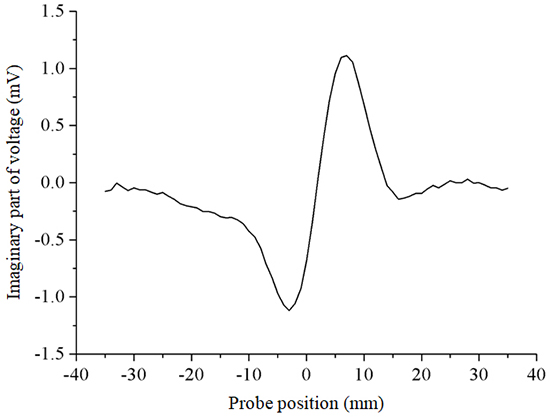
The excitation coil was placed along the designed fiber direction. When the actual fiber direction was identical to the designed fiber direction, the eddy current was parallel to the fiber direction and there was no magnetic flux passing through the reception coil. As the fiber waviness changed the direction of the eddy current, a magnetic field component normal to the reception coil was generated thus producing an output signal voltage. The results obtained by both numerical simulations and experiments validated the proposed method. The resolution of testing fiber direction was as small as 0.5°. The two peaks in the scanning signal approximately correspond to the edges of the waviness zone, which showed the potential of detecting fiber waviness based on scanning signal variation.
In a nutshell, a new method for detecting fiber waviness defects in carbon fiber reinforced polymer laminates, using the electrical anisotropy property of carbon fiber reinforced polymer, is presented. With a significantly good resolution of testing fiber direction, the fiber waviness in the prepared sample was successfully detected. Therefore, as highlighted by Professor Zhiwei Zeng in a statement to Advances in Engineering, this is a promising method for detecting fiber waviness defects in carbon fiber reinforced polymers for enhanced mechanical performance.


Reference
Zeng, Z., Wang, J., Liu, X., Lin, J., & Dai, Y. (2019). Detection of fiber waviness in CFRP using eddy current method. Composite Structures, 229, 111411.