 Advances in Engineering Advances in Engineering features breaking research judged by Advances in Engineering advisory team to be of key importance in the Engineering field. Papers are selected from over 10,000 published each week from most peer reviewed journals.

Significance Statement
Devices and systems working with oils, for instance, oil pumps, engines and oil pipelines are significantly affected by oil adhesion. The situation is even worse when the oil in these systems freezes and adhesion to surfaces increases. Serious problems such as accidents, instrumentation malfunction and clogging, are prone to occur at such a time. It therefore becomes necessary to explore any possible avenues to lessen frozen oil adhesion.
Oleophobicity is an important factor for oil adhesion, which suggests that super-oleophobic surfaces can be used to minimize oil adhesion. Therefore, researchers led by professor Boxin Zhao from the University of Waterloo in Canada developed electrically conductive superoleophobic micropillars for minimizing oil adhesion by passing a direct current through the developed microstructure. The authors employed conductive polymer composites of silver fakes owing to their excellent process-ability and variable resistance. Their work is published in peer-reviewed journal, Applied Surface Science.
The authors molded a mixture of polydimethylsiloxane and a curing agent in a micropillar mold and then transferred them into an oven after degassing. They peeled the specimen from the mold after curing for one hour. They obtained five samples with varying silver flake loadings by mixing epoxy with different percentages of silver flakes.
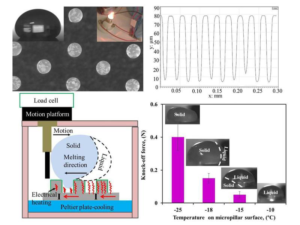
The authors adopted the sessile drop system in order to assess oleophobicity as well as the self-cleaning properties, receding angle, contact angle and roll-off angle. They observed that when the concentration of the silver flakes increased, the contact angle decreased to a certain extent. The smallest contact angle recorded was 1410 indicating that the contraction of the silver flakes was not critical for oleophobicity.
Electrical resistance being critical to the micropillars was also determined. The relationship between the flakes loading and electrical resistance was analyzed comprehensively. The authors recorded that, with increasing flake concentration, a significant drop of the resistance was observed.
To evaluate how the micropillars were effective for surface un-freezing, they applied a direct current and a remarkable reduction of the adhesive forces by 60% was recorded when electrical resistance increased from 7.5-877 ohms after a direct current was applied. A continuous application of the direct current decreased the frozen oil adhesion to about 0.05N and reaching zero after heating the surface up to -100.
This study managed to develop electrically conductive super-oleophobic micropillars to reduce oil adhesion at low temperatures and eliminating frozen oil from surfaces. The self-cleaning attributes, as well as superoleophobicity, was obtained from micropillars and the embedded layer of trichloro 1H, 1H, 2H, 2H-perfluorooctyl silane on their surfaces.




Reference
Zihe Pan1,2, Tianchang Wang1,2, Yikang Zhou1,3, Boxin Zhao1,2. Development of electrically conductive-superoleophobic micropillars for reducing surface adhesion of oil at low temperatures. Applied Surface Science, volume 389 (2016), pages 623–631.
[expand title=”Show Affiliations”]- Department of Chemical Engineering, University of Waterloo, 200 University Avenue West, Waterloo, Ontario N2L3G1, Canada
- R&D Center for Membrane Technology and Department of Chemical Engineering, Chung Yuan Christian University, Chung-Li, Taoyuan 320, Taiwan.Waterloo Institute for Nanotechnology, University of Waterloo, 200 University Avenue West, Waterloo, Ontario N2L3G1, Canada
- Institute of Optoelectronic Technology, Beijing Jiaotong University, Number 3, Shangyuancun, Haidian District, Beijing 100044, People’s Republic of China
Go To Applied Surface Science
