 Advances in Engineering Advances in Engineering features breaking research judged by Advances in Engineering advisory team to be of key importance in the Engineering field. Papers are selected from over 10,000 published each week from most peer reviewed journals.

Significance
The development of electrochemical power sources is detouring into the unfamiliar territory of engineering mixed-reactant fuel cells (MRFCs). Unlike the conventional separate-reactant fuel cell (SRFC) where fuel and oxidant are fed separately then kept apart in the cell by an ion-selective membrane (ISM), mixed-reactant fuel cells use a single mixed stream of fuel plus oxidant and circumvent the need for ISMs. Although the fuel/oxidant mixture in an MRFC is thermodynamically unstable the existence of a slow fuel-oxidant thermochemical reaction plus strategic electrochemical selectivity allows the mixed-reactant system to function like a separate-reactant fuel cell.
By sacrificing ISMs mixed-reactant fuel cells generally have lower energy efficiency than separate-reactant fuel cells. This deficiency is attributed to the degree of selectivity of the electrodes against their counter-electrode reactions, meaning the electrodes are not fully selective for the desired oxidation of the fuel (at the anode) and reduction of the oxidant (at the cathode). Mixed-potentials are then set up at either or both electrodes, lowering the overall electric cell performance relative to separate-reactant systems. The desirable selectivity of electrode reactions in MRFCs can be approached through either physical or chemical means. The former involves suppressing the transport of reactants to their counter electrodes while the latter employs intrinsically selective electrocatalysts. Both methods may be used alone or together but neither is fully effective. The consequent low energy efficiency of MFRCs relative to SRFCs may be compensated by the simplicity of the fuel cell stack and its “balance of plant” which includes the hardware and controls needed for its operation.
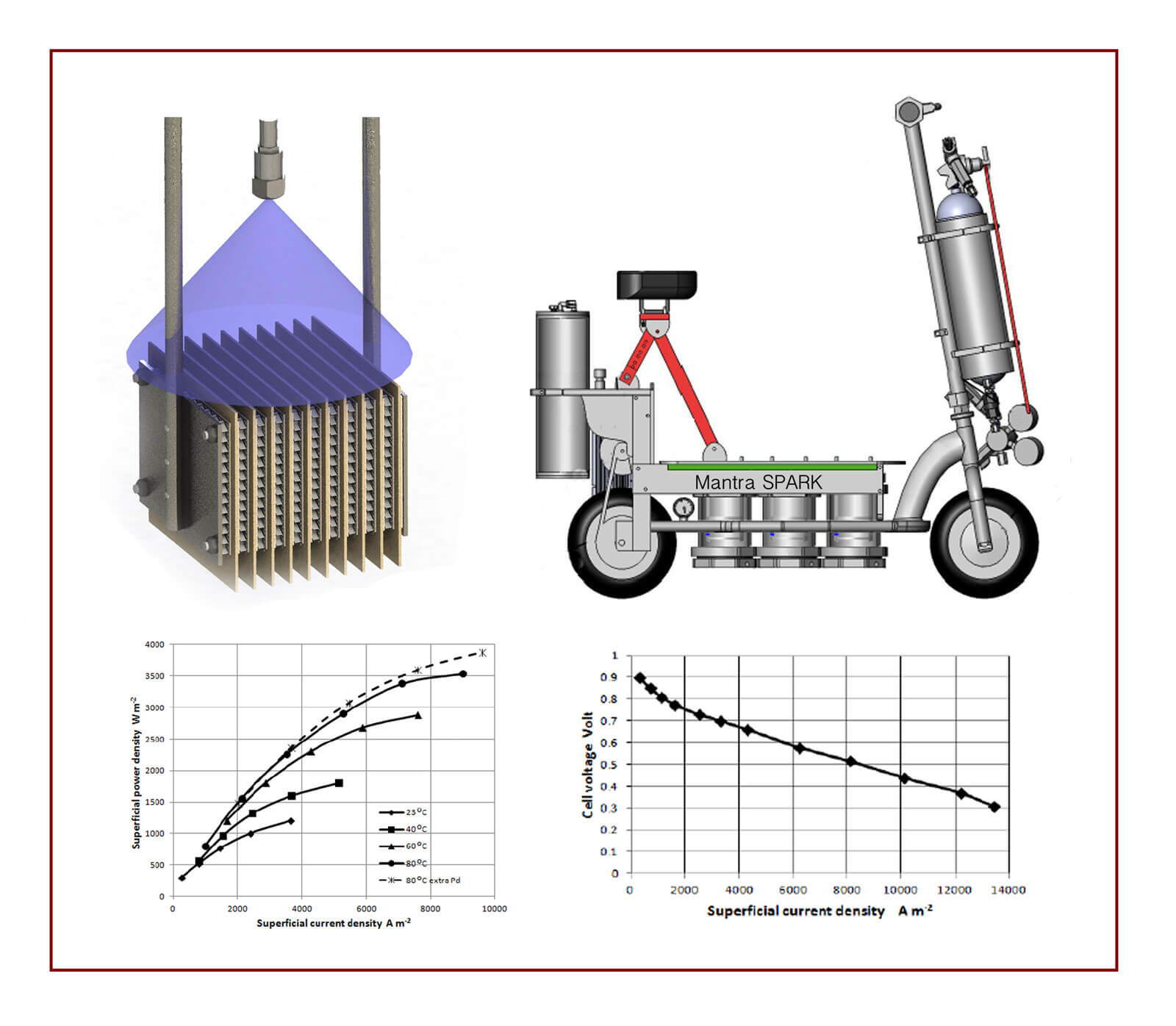
In a recent paper published in the Journal of Power Sources, a group of researchers for Mantra Energy Alternatives Ltd. in Vancouver B.C.: Piotr Forysinski, Colin Oloman, Sona Kazemi, Tirdad Nickchi and Ashwin Usgaoar describe the development and testing of an MRFC stack operating in the flow-by mode with a two-phase liquid/gas mixture of fuel and oxidant. Capillary effects are used to prevent inter-cell shorts and suppress the transport of reactants to their respective counter-electrodes. The design of the MRFC cells and stack takes account of the reaction stoichiometry, capillary pressures, electrocatalysts, electrolyte and separator properties, inter-electrode spacing and characteristics of the expanded metal inter-cell fluid distributors. A novel feature of the set-up is the use of a spray nozzle to deliver the fuel/oxidant mixture to the stack. As a proof of the concept, the operation of the fuel cell is demonstrated in an electric scooter, fabricated in-house with three parallel 100 W MRFC stacks driving a 240 W DC motor.
Alkaline solutions of formate salts (KOH + KHCO2) and oxygen gas are used as the fuel and oxidant to develop the mixed-reactant fuel cell. Despite their low energy density the formates have excellent properties for this application, i.e.: high solubility in water, low toxicity, low combustion hazard and fast electro-oxidation kinetics. A side but potentially important feature of formates is that they are easily made by the electrochemical reduction of carbon dioxide.
In laboratory tests the authors recorded high values of the performance metrics in single cells, such as a (superficial) power density of 4,000 W m-2 at a current density of 10,000 A m-2 in operation at 80 oC with oxygen gas at pressures up to 5 bar(abs). Additionally a 19 cell MRFC stack provided a power output of 120 W with a corresponding volumetric power density of 400 kW m-3. However, more research is required to alleviate the disadvantages of the mixed-reactant flow-by fuel cell, such as low energy efficiency, short life span, high fuel cost and disposal of spent reactants.
In summary, Canadian researchers are the first to use a mixed-reactant fuel cell alone to power an electric vehicle. To implement the results of a laboratory study they used a set of 100 W, 19 cell MRFC stacks to drive an electric scooter. The test proved viable and lasted for about 15 minutes, with the vehicle moving at a speed of 10 km h-1. The main focus of future work will be on improving the performance of the fuel cell with respect to its energy efficiency, operating life and fuel cost. Such improvements may make the mixed-reactant flow-by fuel cell viable in niche applications, probably as a stationary power source. The mixed-reactant flow-by fuel cell technology is patented under US Patent number: 8709680 (29 April 2014), the substance of which is summarized below.
Brief description of the MRFBFC patent
The US Patent 8709680 “Mixed-reactant flow-by fuel cell” describes a fuel cell in which a two-phase mixture of fuel and oxidant flows through porous electronically conductive fluid distributors contacting the anodes and adjacent cathodes of the bipolar reactor. Capillary effects prevent inter-cell shorts and suppress the transport of fuel and oxidant to their respective counter electrodes. Dynamic mixed-potentials at each electrode allow operation analogous to that of a conventional separate-reactant fuel cell, such that with a fuel/oxidant mixture of alkaline potassium formate/oxygen a mixed-reactant flow-by fuel cell stack demonstrated a volumetric power density about 400 kW m-3.




Reference
Forysinski, P., Oloman, C., Kazemi, S., Nickchi, T., & Usgaoar, A. (2019). Development and use of a mixed-reactant fuel cell. Journal of Power Sources 414, 366-376.
