 Advances in Engineering Advances in Engineering features breaking research judged by Advances in Engineering advisory team to be of key importance in the Engineering field. Papers are selected from over 10,000 published each week from most peer reviewed journals.

Significance Statement
Multi-scale modeling of gas transport systems in shale-gas reservoirs indicates how the permeability counts on continuum, viscous, Knudsen, and molecular sieving mechanism. In these natural components, about 80% of the total gas has been found to be absorbed to the substrate, making surface diffusion the predominant transport mode.
Previous studies have shown that approximately 93% of the total transport within the nano-pores of shale-gas reservoirs is based on surface diffusion. However, surface transport also plays an important role in the functioning of membranes as well as other engineered nano-porous components. For instance, selective surface-flow membranes separate gases through selective surface adsorption, diffusion, and desorption mechanisms. In a bid to maintain high membrane efficiency, gas phase diffusion may be tuned to achieve overall transport that is controlled by surface phenomena.
Temperature, surface coverage, pressure, humidity, and surface affinity can affect gas and surface mobility, as many studies have shown. However, only a few studies have focused on the impact of pore-space structure on surface diffusion.
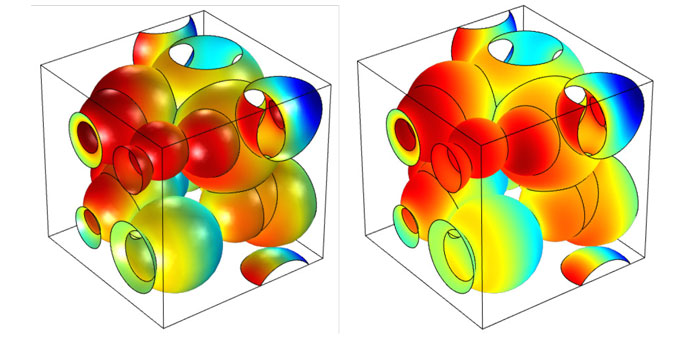
Marziye Mirbagheri and Reghan Hill at McGill University applied the model of Albaalbaki and Hill to solid spheres and spherical cavities to investigate the impact of pore size and porosity on moisture transport. With nano-sized pores, they proposed that gas-phase diffusion could be hindered by the small mean-free path, so that the overall permeability could be controlled by surface diffusion. Their research is published in Chemical Engineering Science.
The authors adopted the Albaalbaki-Hill boundary value problem to furnish the effective diffusivity of arrays of spherical particles and cavities. To test the selected model, which the authors solved using the equation-based-modeling and physics-building capabilities of Comsol Multiphysics, they compared numerical results for a cubic arrangement of spheres with a self-consistent approximation for dilute random sphere packings. The relative contributions of surface and gas diffusion to the overall permeability were examined, under conditions where the pores were small enough to position the gas in the Knudsen regime.
Surface diffusion was found to be important for nanostructured porous media, owing to the resistance from gas-phase diffusion in the Knudsen regime. In the continuum analysis, the intrinsic gas diffusivity was prescribed using literature correlations of effective diffusivities from molecular simulations, which Mirbagheri and Hill then applied to computations of continuum void diffusion in the sphere and cavity arrangements.
Mirbagheri and Hill then used calculations that coupled gas diffusion to surface adsorption and diffusion, to analyze the importance of pore shape and size on gas, surface, and overall permeability. They decomposed the gas and surface fluxes into secondary and primary components. The contribution of the primary component depended only on the pore geometry, whereas the secondary component reflected pore geometry, tracer mobility and tracer thermodynamics.
The study found that permeability was controlled by surface diffusion at porosities below the solid percolation limit for the solid sphere arrangements. However, for spherical cavities, permeability was limited by surface diffusion at porosities between the void and solid percolation limits.

.
Reference
Marziye Mirbagheri, Reghan J. Hill. Diffusion in sphere and spherical-cavity arrays with interacting gas and surface phases. Chemical Engineering Science, volume 160 (2017), pages 419–427.
Go To Chemical Engineering Science