 Advances in Engineering Advances in Engineering features breaking research judged by Advances in Engineering advisory team to be of key importance in the Engineering field. Papers are selected from over 10,000 published each week from most peer reviewed journals.

Significance Statement
A detailed simulation campaign based on high fidelity LES and DNS was performed to investigate the effect of hemispherical roughness elements on fully developed turbulent flow between parallel plates. Variations in the shear Reynolds number (Reτ=180-400), element height (k+=10-20), element spacing (s+/k+=2-6) and distribution pattern (regular square lattice vs. random pattern) were explored to assess their effect on the friction factor, mean velocity and turbulent stresses profiles. The present LES/DNS study differs from the abundant published works, centering on large sharp-edged roughness obstructions (k+=40-100), in that it deals with the transitional roughness regime, where the Reynolds number is relatively high (for a DNS), and the roughness elements are small and of round shape, and could thus be randomly distributed. Such a situation is relevant to various energy systems such as fossil boilers and nuclear reactors, in which vapor bubbles are attached to the wall in subcooled flow boiling and effectively behave like small (<100 μm), near-hemispherical, roughness elements. In such cases, using the laws of smooth wall channel flow would give an under-prediction of the friction factor.
Overall the DNS results show a clear separation between the inner wall-layer, which is affected by the presence of the roughness elements, and the outer layer, which remains relatively unaffected. Roughness element height has a strong effect on the friction factor and on the mean velocity profile. The friction factor increases proportionally to the roughness element height, while the mean velocity profile shifts downward proportionally to the roughness element height. The type of roughness dealt with here also affects the turbulent stresses. In particular, the study reveals that the presence of roughness elements of this shape promotes locally the instantaneous flow motion in the lateral direction in the wall layer, which was found to cause a transfer of energy from the streamwise Reynolds stress to the lateral component; the wall-normal stress component, however, remains unaffected regardless of the roughness height or arrangement. Consequently, the shape of the turbulent kinetic energy profile changes, featuring a lower peak value and forward shift away from the wall as compared to the smooth channel case.
Element spacing changes the point of re-attachment of the boundary layer downstream of an element; at low spacing, recirculation cells spanning the gap between adjacent elements appear. However, for given element height, spacing has a relatively weak effect on friction factor and mean velocity profile, which is somewhat surprising, given the previous results for channels with two-dimensional ribs reported in the literature. Finally, a random distribution pattern of the elements does not affect either the friction factor or the mean velocity appreciably




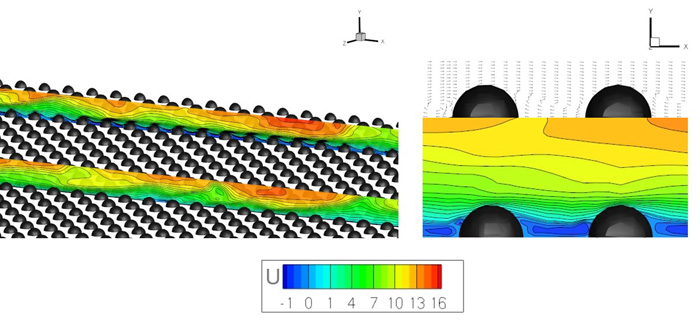
Figure
(Left) Instantaneous streamwise velocity contours for slices at the hemispheres crest and in between hemispheres.
(Right) Instantaneous velocity contours at a slice in the middle of the hemispheres. The recirculation regions in between the hemispheres can be clearly seen.
Journal Reference
D. Chatzikyriakou1, J. Buongiorno1, D. Caviezel2, D. Lakehal1, 2
1 Massachusetts Institute of Technology, 77 Massachusetts Avenue, Cambridge, MA 02139, USA
2 ASCOMP GmbH, Zurich, Switzerland
Direct Numerical Simulations (DNS) and Large Eddy Simulations (LES) were performed for fully-developed turbulent flow in channels with smooth walls and walls featuring hemispherical roughness elements at shear Reynolds numbers Reτ = 180 and 400, with the goal of studying the effect of these roughness elements on the wall-layer structure and on the friction factor. The LES and DNS approaches were verified first by comparison with existing DNS databases for smooth walls. Then, a parametric study for the hemispherical roughness elements was conducted, including the effects of shear Reynolds number, normalized roughness height (k+ = 10–20) and relative roughness spacing (s+/k+ = 2–6). The sensitivity study also included the effect of distribution pattern (regular square lattice vs. random pattern) of the roughness elements on the walls. The hemispherical roughness elements generate turbulence, thus increasing the friction factor with respect to the smooth-wall case, and causing a downward shift in the mean velocity profiles. The simulations revealed that the friction factor decreases with increasing Reynolds number and roughness spacing, and increases strongly with increasing roughness height. The effect of random element distribution on friction factor and mean velocities is however weak. In all cases, there is a clear cut between the inner layer near the wall, which is affected by the presence of the roughness elements, and the outer layer, which remains relatively unaffected. The study reveals that the presence of roughness elements of this shape promotes locally the instantaneous flow motion in the lateral direction in the wall layer, causing a transfer of energy from the streamwise Reynolds stress to the lateral component. The study indicates also that the coherent structures developing in the wall layer are rather similar to the smooth case but are lifted up by almost a constant wall-unit shift y+ (∼10–15), which, interestingly, corresponds to the relative roughness k+ = 10.
Go To International Journal of Heat and Fluid Flow