 Advances in Engineering Advances in Engineering features breaking research judged by Advances in Engineering advisory team to be of key importance in the Engineering field. Papers are selected from over 10,000 published each week from most peer reviewed journals.

Phys. Rev. Lett. 111, 247603 – Published 11 December 2013.
E. K. H. Salje1, O. Aktas1, M. A. Carpenter1, V. V. Laguta2, and J. F. Scott3.
1 Department of Earth Sciences, University of Cambridge, Downing Street, Cambridge CB2 3EQ, United Kingdom.
2 Institute of Physics AS CR, Cukrovarnicka 10, 16200 Prague, Czech Republic.
3 Department of Physics, University of Cambridge, Cambridge CB3 0HE, United Kingdom.
ABSTRACT
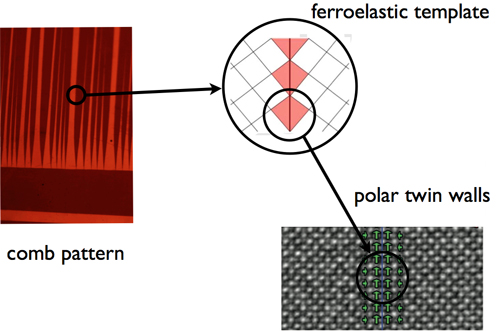
Resonant piezoelectric spectroscopy shows polar resonances in paraelectric SrTiO3 at temperatures below 80 K. These resonances become strong at T<40 K. The resonances are induced by weak electric fields and lead to standing mechanical waves in the sample. This piezoelectric response does not exist in paraelastic SrTiO3 nor at temperatures just below the ferroelastic phase transition. The interpretation of the resonances is related to ferroelastic twin walls which become polar at low temperatures in close analogy with the known behavior of CaTiO3.SrTiO3 is different from CaTiO3, however, because the wall polarity is thermally induced; i.e., there exists a small temperature range well below the ferroelastic transition point at 105 K where polarity appears on cooling. As the walls are atomistically thin, this transition has the hallmarks of a two-dimensional phase transition restrained to the twin boundaries rather than a classic bulk phase transition.