Advances in Engineering Advances in Engineering features breaking research judged by Advances in Engineering advisory team to be of key importance in the Engineering field. Papers are selected from over 10,000 published each week from most peer reviewed journals.

Significance Statement
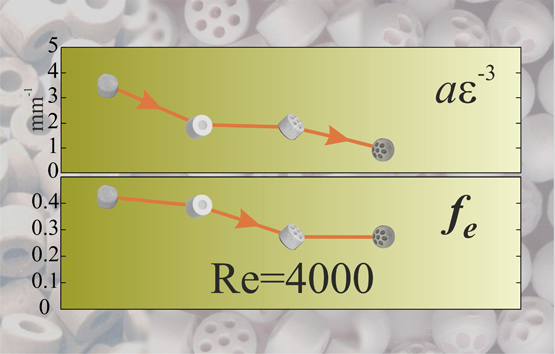
During the last hundred years, the shapes of industrial catalysts were changed dramatically, from irregular broken particles to specially formed regular granules of sophisticated appearance. The pressure drop across fixed beds of such granules is by far less than of irregular ones, thanks to essentially lower values of both bed parameter aε-3 (ais the specific bed surface area; ε is the bed porosity) and drag factor fe. It is especially essential for processes runningat low pressures.
The drag factors for beds of granules of various shapes can differ by an order of magnitude. So the widely known universal expressions are valid now in form only, but their parameters are specific for groups of similar shapes.
Nevertheless, it turns that the trends in the drag factor vs Reynolds numbers are similar for the wide variety of granule shapes. Moreover, a possible relationship between the drag factor and the number of channels in a granule can help in designing some innovating catalyst shapes
.
Chemical Engineering Journal, Volume 238, 15 February 2014, Pages 27–30.
V.L. Hartmann.
Moskovskaya Str. 1, Novomoskovsk, Tula Region 301664, Russia.
Abstract
In this paper, we consider a way to obtain expressions to calculate the pressure drop across fixed beds of granules with a wide variety of shapes, including some shapes developed recently. It is shown that (a) the trends in drag factor versus Reynolds number are similar, and (b) the granule shape types studied form groups with similar shapes and close values of the drag factor. Fitting of experimental data sets for the pressure drop using exponential expressions with a common exponent for the drag factor allows us to obtain general equations for groups of similar granule shapes. In particular, the results indicate the effect of the number of channels in a granule on the drag factor.