Advances in Engineering Advances in Engineering features breaking research judged by Advances in Engineering advisory team to be of key importance in the Engineering field. Papers are selected from over 10,000 published each week from most peer reviewed journals.

Significance
The conversation around sustainable energy storage has shifted in recent years, with growing pressure to identify solutions that are not just efficient but also inherently safer and more practical to implement at scale. While there’s little question that lithium-ion batteries have enabled huge leaps in technology—think portable electronics, electric vehicles, and now even stationary storage—the safety risks tied to their use of flammable organic electrolytes have lingered in the background, although various safety measures have been taken to ensure the product. In large installations, even a small chance of thermal runaway is something that’s hard to ignore. This is probably why there’s renewed curiosity about aqueous lithium-ion batteries. On paper, water-based electrolytes offer a reassuring alternative: they’re non-flammable, typically more environmentally benign, and often simpler to manufacture. For anyone working in battery labs, that’s an attractive proposition, at least until you come face-to-face with the electrochemical realities. The big one is water’s limited voltage window. It starts to break down—producing hydrogen and oxygen gas—at just over 1.2 volts, which severely restricts how much energy you can actually store and retrieve. To get around this, researchers have been experimenting with “water-in-salt” electrolytes. These push the boundaries a bit, essentially crowding out the water with so much salt that its reactivity drops. It works to a point—the voltage window expands, and energy density gets a needed boost—but it comes at the price of complexity, high costs, and, ironically, often sluggish ionic movement. In other words, you solve one problem but inherit a handful of new ones. There’s also the question of thick electrodes. If you want a battery that’s truly competitive for grid-scale storage, you can’t get by with paper-thin electrodes. Unfortunately, thick electrodes paired with low-conductivity electrolytes tend to suffer from slow ion transport and performance drops. It’s a practical hurdle that has kept many aqueous systems confined to the realm of academic prototypes.
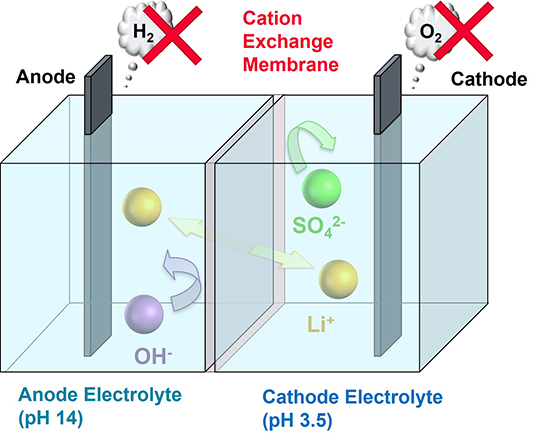
To this account, new research paper published in Journal of Energy Storage and conducted by Dr. Takumi Hiasa, Aika Ochi, Ryuhei Matsumoto, Dr. Koichiro Hinokuma from the Murata Manufacturing Co., Ltd. in Japan, the researchers used two separate aqueous electrolytes—each carefully adjusted in pH and composition—split by a cation-exchange membrane. This way, each electrode can operate in an environment that suits it best, while the membrane keeps the chemistries apart but still lets lithium ions migrate. It’s a simple idea on the surface, but one with far-reaching implications for the future of aqueous battery design. First, the research team developed two distinct aqueous solutions—an alkaline one for the anode, containing a mixture of lithium and potassium hydroxides, and a mildly acidic formulation for the cathode, primarily based on lithium sulfate and phosphate salts. These weren’t just arbitrarily selected; each was tailored to the specific electrochemical environment needed at its respective electrode and was designed to prevent mixing with each other. To separate the two, they used a perfluorosulfonated cation-exchange membrane with excellent chemical resilience, and they spent time characterizing how these electrolytes behaved when paired across the membrane. They finally found a combination that met all these requirements— both the pH and ionic conductivity remained impressively stable as well as conductivity readings exceeded 70 mS/cm on the cathode side and were even higher for the anode. That’s well beyond what’s typically reported for water-in-salt systems, and it gave them a solid basis to move forward.
With the electrolytes dialed in, they turned their attention to the electrodes themselves. The cathodes were fairly conventional, using LiMn₂O₄ with an active material loading around 50–60 mg/cm². But the anode required a bit more finesse. They used nanostructured TiO₂ which is stable even in strongly basic environments and sintered it at high temperature to generate a stable oxide layer on the titanium current collector—this was key, because hydrogen evolution can quickly become a problem. When the full cells were finally assembled and tested at 15 mA/g, the results spoke volumes. The control setups—those with a single electrolyte—showed abysmal Coulombic efficiencies. In contrast, the dual-electrolyte system performed remarkably well, hitting 96% efficiency on the first cycle and exceeding 99% in subsequent ones. Moreover, the authors performed additional electrochemical analyses, including cyclic voltammetry and linear sweep measurements and confirmed that water decomposition was sufficiently suppressed along with both electrode reactions. There was even some evidence that potassium ions were moving through the membrane alongside lithium, which might be helping to preserve the overall charge balance. Even under higher-rate cycling at 75 mA/g, the voltage drop was modest, and the cell retained three-quarters of its initial capacity after 100 cycles. That’s not just promising—it’s a strong indication that this architecture is built for endurance.
In conclusion, for years, the conventional wisdom has been that the water stability window—rigidly capped around 1.23 volts—was an immovable constraint. Dr. Takumi Hiasa and colleagues showed successfully that by carefully engineering the local chemical environments around each electrode and keeping them isolated with a cation-selective membrane, that ceiling can, in effect, be raised. Reaching an operational voltage close to 2.8 V using entirely water-based electrolytes—not ultra-concentrated or hybridized with organics—is no small feat. And the fact that they managed this without compromising ionic conductivity is even more compelling. It suggests a shift away from exotic, cost-prohibitive systems and toward something genuinely scalable. Equally important, though perhaps less obvious at first glance, is the practicality of their design. This wasn’t a lab-scale proof-of-concept with wafer-thin electrodes and artificial test conditions. They used thick electrodes with high areal loadings—closer to what would actually be required in an industrial context. And these still performed well, even under relatively high current densities. That’s rare. Too often, promising aqueous systems collapse when scaled beyond the coin cell. Here, the architecture held up. For grid storage and other stationary applications, where cost, safety, and cycle life matter more than sheer energy density, this kind of robustness could be a game-changer. What makes the approach even more exciting is its flexibility. This isn’t a one-size-fits-all battery; it’s a platform that can be tuned by adjusting the chemistry on either side of the membrane. You can imagine designing versions optimized for longevity, others for high-rate performance, or low-cost backup storage. The modularity opens up design space that’s been mostly off-limits to aqueous systems until now. And critically, the dual-electrolyte strategy seems to help suppress gas evolution and pH drift—two issues that have dogged aqueous cells for decades.




Reference
Takumi Hiasa, Aika Ochi, Ryuhei Matsumoto, Koichiro Hinokuma, Aqueous lithium-ion battery of dual electrolytes separated by cation-exchange membrane with enhanced rate capability for thick electrodes, Journal of Energy Storage, Volume 99, Part B, 2024, 113366,