 Advances in Engineering Advances in Engineering features breaking research judged by Advances in Engineering advisory team to be of key importance in the Engineering field. Papers are selected from over 10,000 published each week from most peer reviewed journals.

Significance
Transition metal sulfides, particularly NiCo2S4, have gained significant attention for their potential as high-performance electrode materials in supercapacitors. Their properties, including high electrical conductivity, rich elemental valence distribution, and cost-effectiveness, make them attractive candidates for energy storage applications. To maximize their potential, research has focused on controlling their morphology and improving their electrochemical performance. Integration of these materials into a suitable current collector is crucial for achieving high-performance electrode materials.
In the quest for sustainable energy solutions, the development of efficient energy storage devices has become paramount. Supercapacitors (SCs) have emerged as promising candidates due to their ability to rapidly store and release energy, coupled with their durability. However, the widespread application of SCs has been limited by their low energy density and cycling stability. Addressing these limitations demands innovative strategies to enhance the performance of SC electrode materials. In a recent study published in the peer-reviewed Journal Electrochimica Acta by Dr. Ling Liu, Dr. Zhaojun Li, and Professor Hongyu Wang from Qinghai University, a novel dual regulation strategy has been proposed to improve the electrochemical performance of NiCo2S4 electrode materials for supercapacitors.
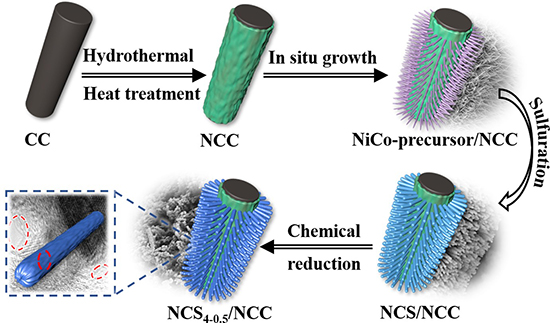
The study’s central innovation lies in the dual regulation strategy employed for enhancing the electrochemical performance of NiCo2S4 electrode materials. The authors proposed the introduction of nitrogen-doped carbon cloth (NCC) as a current collector and the incorporation of sulfur (S) vacancies in NiCo2S4 (NCS) electrode material. This strategy aimed to synergistically enhance the loading capacity, electroactive sites, and electrical conductivity of the integrated electrode material.
The research team fabricated N-doped carbon cloth (NCC) through a hydrothermal and heat treatment process, resulting in a nanosheet-like structure. The NCC exhibited enhanced surface properties and increased active sites, contributing to improved capacitance. The presence of nitrogen-functional groups in NCC led to increased hydrophilicity, reducing ion diffusion resistance. The NCC current collector was integrated with NCS, resulting in increased loading capacity and improved electrochemical performance.
The authors introduced S vacancies into NCS through a chemical reduction process using NaBH4 solution. This approach effectively modified the electronic and surface structure of NCS, creating more electroactive sites and increasing electrical conductivity. The study explored various NaBH4 concentrations to optimize S vacancies while maintaining the nanorod array structure. The introduction of S vacancies played a critical role in boosting the number of electroactive sites and improving electrical conductivity.
The synthesized NCS4–0.5/NCC integrated electrode material exhibited exceptional electrochemical performance. It demonstrated an ultra-high specific capacitance of 4075.89 mF cm^-2 at 1 mA cm^-2, showcasing the benefits of the dual regulation strategy. Additionally, the electrode material retained 83.74% of its initial capacitance even at a high current density of 50 mA cm^-2. Furthermore, the cycling stability was outstanding, with 80.03% retention of initial capacitance after 5000 charge-discharge cycles at 20 mA cm^-2.
When the authors conducted comparative analysis, it revealed the superiority of NCS4–0.5/NCC over other reported electrode materials, underscoring the effectiveness of the dual regulation strategy. The study’s success can be attributed to the synergistic effects of NCC as a current collector, NCS with enhanced S vacancies, and their combined impact on electrochemical properties. This novel approach offers a blueprint for designing supercapacitor electrode materials with remarkable electrochemical properties.
In conclusion, the new study introduces a dual regulation strategy for enhancing supercapacitor electrode materials. By integrating nitrogen-doped carbon cloth (NCC) as a current collector and introducing sulfur vacancies in NiCo2S4 (NCS) electrode material, the authors achieved remarkable improvements in loading capacity, electroactive sites, and electrical conductivity. The synergistic effects of this dual regulation strategy resulted in an integrated electrode material (NCS4–0.5/NCC) with exceptional electrochemical performance, demonstrating the promise of this innovative approach for advancing supercapacitor technology. The new research opens new avenues for the design and development of high-performance energy storage materials, contributing to the sustainable energy landscape.
Reference
Ling Liu, Zhaojun Li, Hongyu Wang. Dual regulation strategy to enhance the electrochemical performance of rich sulfur vacancies NiCo2S4 integrate electrode material for supercapacitors. Electrochimica Acta 441 (2023) 141819.
