Advances in Engineering Advances in Engineering features breaking research judged by Advances in Engineering advisory team to be of key importance in the Engineering field. Papers are selected from over 10,000 published each week from most peer reviewed journals.

Significance
Carbon fiber reinforced silicon carbide (C/SiC) composites are designed for demanding thermal-structural environments where low density, resistance to ultra-high temperature, and durability must be combined with reliable mechanical performance. Their mechanical response depends on more than the intrinsic properties of the carbon fibers and silicon carbide (SiC) matrix. Fiber-bundle architecture, interphase, residual thermal stresses, matrix cracking, interface debonding, and load transfer after damage initiation all contribute to the deformation and fracture process. Minicomposites provide a useful level of observation for this problem. They retain the essential fiber, interphase, and matrix interactions of ceramic matrix composites while allowing constitutive behavior to be studied with greater mechanical clarity than in a full composite component. For C/SiC systems, previous room-temperature studies had already shown that matrix crack density changes with tensile stress, that the pyrolytic carbon (PyC) interphase affects fiber pull-out and interface debonding, and that nonlinear deformation can accompany interface-related damage. Tensile curves of PyC-containing C/SiC minicomposites may also display “sawtooth” regions, where the load drops abruptly and then recovers during continued displacement-controlled loading. Ultra-high-temperature tensile behavior presents a distinct problem for ceramic matrix minicomposites. Although these materials are intended for thermal-structural service, their constitutive response under elevated-temperature loading remains insufficiently characterized, especially once matrix cracking and interfacial debonding begin to alter the local stress field. Direct strain measurement is difficult when a very small specimen is heated to ultra-high temperature, and the strain field is not uniform once matrix cracks and debonded zones appear. A meaningful constitutive description therefore has to account for both the experimental limitations of ultra-high-temperature tensile testing and the internal mechanics of a specimen whose load-bearing state changes locally whenever a new matrix crack forms.
In a recent research paper published in Journal of the American Ceramic Society by Mr. Siru Li, Mr. Zhiqi Ma, Ms. Jingwen Lv, and Research Fellow Tianbao Cheng from the College of Aerospace Engineering at Chongqing University developed an induction-heated tensile testing method for ceramic matrix minicomposites at temperatures up to 1800°C in argon. They also developed a constitutive model that calculates tensile stress–deformation behavior by tracking bonded zones, debonded zones, slip zones, reverse slip zones, crack history, thermal mismatch stresses, and temperature variation along the specimen. The technically distinct feature is the treatment of dynamic stress redistribution after matrix cracking, which allows the model to reproduce the nonlinear and “sawtooth” features observed experimentally. The method was applied to C/PyC/SiC minicomposite with a PyC interphase and SiC matrix infiltrated around carbon fiber bundle.
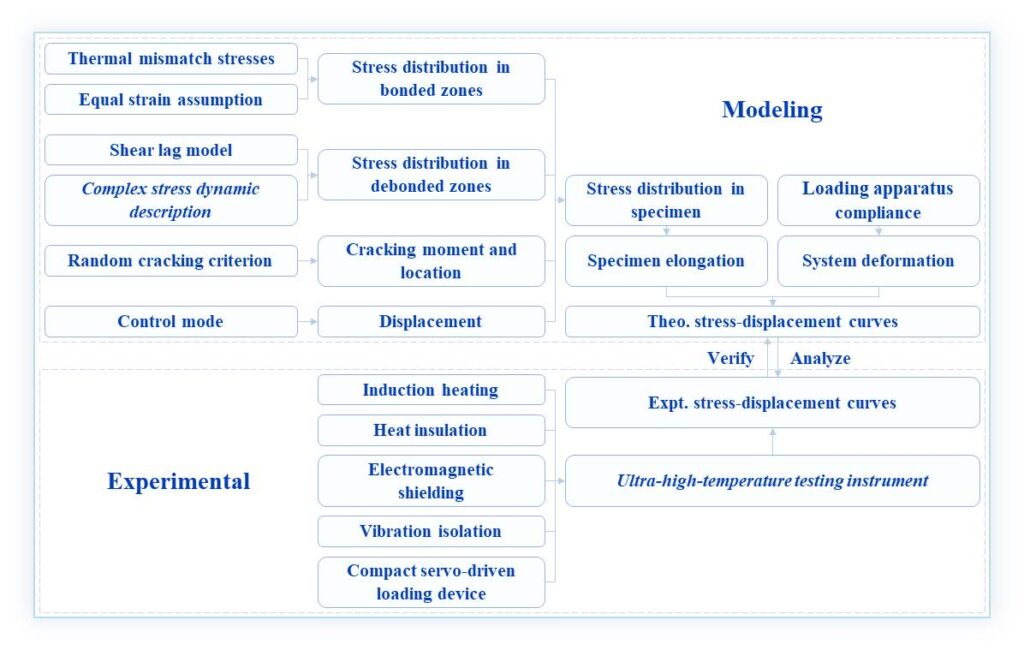
The team prepared C/PyC/SiC minicomposite by coating carbon-fiber bundle with a thin PyC interphase and then introducing the SiC matrix through chemical vapor infiltration process. They then tested the specimens in argon from room temperature to very high temperature using an induction-heating tensile system designed to maintain controlled heating while protecting the loading assembly from thermal, electromagnetic, and vibration effects. The arrangement combined a heated susceptor, thermal insulation, shielding, vibration absorber, and a compact servo-driven loading mechanism, which allowed tensile behavior to be monitored under elevated-temperature conditions. They tested multiple specimens at each temperature to examine the reproducibility of the stress–displacement response. Matrix cracking and debonded zones make deformation nonuniform, so the model incorporated loading-system compliance to relate the measured displacement-controlled response to internal cracking and load transfer.
The authors found that across the tested temperatures, the tensile curves first rose approximately linearly and then became distinctly nonlinear after the first matrix cracking. At the instant of matrix cracking, the displacement of the specimen ends remains effectively unchanged, but the new crack forces a local change in load sharing: the matrix cannot carry load at the crack, so the fiber bears the load there, and slip zones develop near the crack through interface shear transfer. That local rise in fiber stress increases the total elongation slightly; under displacement control, the applied load correspondingly drops. Reloading then continues until additional cracking occurs. Especially, when the new crack produces before the reverse slips are completely covered, multiple “slip zone-reverse slip zone-slip zone” presents in the debonded zones. The researchers developed model and noticed the minicomposite is separated into bonded and debonded zones. In bonded zones, the fiber and matrix deform according to an equal-strain assumption, with temperature-dependent moduli and thermal mismatch stresses included. In debonded regions, the model follows the stress on the fiber as it changes across slip zones, reverse slip zones, and newly formed slip zones. The history of matrix cracking is recorded because each debonded zone may have formed at a different applied stress, and adjacent debonded zones can interfere when cracks are close.
The calculated curves reproduced the main nonlinear form of the experimental stress–displacement response, including the “sawtooth” drops that are not represented when the dynamic stress evolution of debonded zones is omitted. Scanning electron microscopy of tested specimens confirmed matrix cracks roughly perpendicular to the tensile direction and distributed randomly along the minicomposites. The number of “sawtooth” features and the average crack density showed a positive correlation, supporting the interpretation that the “sawtooth” response is caused by matrix cracking.
The investigators noticed temperature altered the first matrix cracking stress in a systematic way and it increased from room temperature through intermediate elevated temperatures and then showed a slight reduction at 1800°C. The authors attributed the initial increase to the change in residual thermal stress in the matrix: tensile residual stress is largest at room temperature, decreases as temperature approaches the preparation temperature, and becomes compressive above that range because of thermal mismatch. The slight reduction at 1800°C was attributed to degradation of matrix performance. Parameter calculations further showed that increasing fiber volume fraction reduced the initial slope because the carbon fiber modulus is lower than that of the SiC matrix, promoted earlier matrix cracking through the associated change in matrix stress, and reduced the stress-drop magnitude. Higher interface shear stress shortened debonded zones and reduced the influence of those zones on the tensile response.
The findings of Research Fellow Tianbao Cheng and his graduate students are directly relevant to the engineering evaluation of C/SiC composites intended for ultra-high-temperature structural service. Components made from C/SiC systems may operate in environments where load, temperature, and damage evolution occur together rather than separately. For that reason, a constitutive description that can represent matrix cracking, interface debonding, slip-zone development, and temperature-dependent constituent properties and thermal residual stress is very valuable for interpreting how these materials carry load after the first damage event has occurred. The paper’s treatment of C/PyC/SiC minicomposites gives engineers a more detailed way to read tensile response under elevated-temperature conditions instead of relying only on final strength values or initial stiffness. One practical application is in the design and assessment of thermal structural components where local cracking does not immediately mean total loss of load-bearing capacity. The observed “sawtooth” response shows that each matrix crack changes the internal stress distribution, transfers load locally to the fibers, and then allows the specimen to continue carrying increasing load as reloading proceeds. In engineering terms, this helps distinguish crack initiation from progressive damage accumulation. That distinction matters when evaluating reliability, because a material may enter a nonlinear damage regime before final fracture, and the shape of that regime carries information about interfacial sliding, debonded-zone growth, and stress redistribution.
The results also support better use of minicomposite testing as an intermediate evaluation tool during ceramic matrix composite development. Full composite components contain more complex fiber architectures, but minicomposites expose the essential interaction between fiber, interphase, and matrix. By testing C/PyC/SiC minicomposites up to 1800°C in argon and modeling the resulting stress–displacement behavior, the study provides a route for assessing how interphase behavior and matrix cracking may influence larger composite systems. This is especially useful when comparing processing conditions, fiber volume fractions, or interface characteristics before moving to more expensive component-level testing. Indeed, the parameter analysis further indicates that fiber volume fraction and interface shear stress influence the degree of nonlinear deformation and the stress drops associated with matrix cracking, providing useful guidance for interpreting progressive damage in C/PyC/SiC minicomposites. Overall technical route for “dynamic” constitutive response of ceramic matrix minicomposites at ultra-high temperatures.

Reference
Li SR, Ma ZQ, Lv JW, Cheng TB. Constitutive behaviors of carbon fiber reinforced silicon carbide minicomposites at elevated temperatures. Journal of the American Ceramic Society, 109(1) (2026) e70245. doi: 10.1111/jace.70245.
Go to Journal of the American Ceramic Society