Advances in Engineering Advances in Engineering features breaking research judged by Advances in Engineering advisory team to be of key importance in the Engineering field. Papers are selected from over 10,000 published each week from most peer reviewed journals.

Significance Statement
Achieving high strength and high ductility (toughness) in steels at reduced costs has been of great interest to metallurgists in the steel industry. Ferrite grain refinement under dynamic transformation in thermomechanical controlled processes has been considered as one promising way to achieve this. Understanding the ferrite grain refinement mechanism is important for industrial production of ultrafine grained steels with excellent strength-ductility combination.
Lijia Zhao and colleagues have confirmed that dynamically transformed ferrite are deformed further during continuous deformation, leading to dynamic recrystallization, which differs from another school of thought focusing on the effect of deformation structure of austenite on the formation of ultrafine ferrite. Their work is now published in Advanced Engineering Materials.
It has been suggested that the feature of deformed austenite and the behavior of transformed ferrite during continuous deformation are the key to understand the formation mechanism of equiaxed ultrafine ferrite grains. Increased transformation kinetics at elevated temperatures in previous works hampers the investigation on the behavior of dynamically transformed ferrite grains hence making unknown the role of dynamic recrystallization in ferrite grain refinement.
The research team used machined cylindrical samples of 10Ni-0.1C (in wt.%) steel which were twelve and eight millimeters in height and diameter respectively. The kinetics of static transformation was retarded by adding 10% nickel so as to examine the microstructural evolution of transformed ferrite. The samples were austenitized, uniaxially compressed at various strain rates, and then water-quenched. Microstructure analysis of the samples was then conducted.
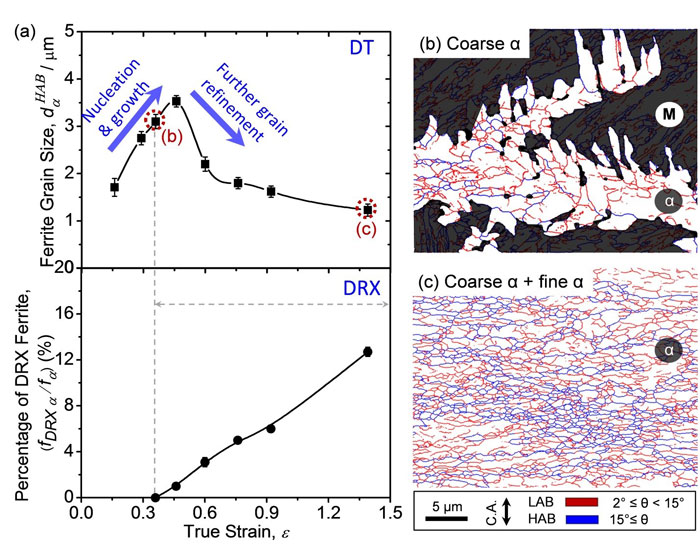
Hot-deformation to a strain of 0.11 resulted in the formation of nearly equiaxed fine grains of ferrite on prior austenite grain boundaries. At a strain of 0.29 low angle boundaries were observed in transformed ferrite with irregular grain morphology. The deformation by 0.60 strain resulted in the formation of equiaxed ultrafine ferrite grains with high-angle boundaries along the grain boundaries of coarse ferrite formed at early stages and being deformed.
The microstructure analysis showed growth of dynamically transformed ferrite grains and subsequent deformation after the nucleation and growth, and above a certain strain level equiaxed ultrafine ferrite grains developed. At first, the grain size increased after the nucleation but decreased above a certain strain level, suggesting that there was another grain refinement process taking place. This phenomenon was observed for the first time and was totally different from the conventional static ferrite transformation behavior.
The research team noted that there was an increase in apparent nucleation density at some level of straining, which corresponded with the decrease in ferrite grain size owing to dynamic transformation. Dislocations were stored in ferrite grains by deformation and a further increase in strain resulted in inhomogeneous deformation in the vicinity of the high-angle grain boundaries of formerly nucleated ferrite. This led to the formation of subgrains near the grain boundaries and the development of their misorientation, which enhanced the formation of equiaxed ultrafine ferrite grains surrounded by high-angle boundaries.
The initiation of dynamic recrystallization was enhanced through the plastic deformation which was highly concentrated in the soft transformed ferrite within microstructures composed of ferrite and austenite. This was further amplified by the large fraction of grain boundaries of the fine-grained ferrite formed by dynamic transformation.
The elevated strain rate, which resulted in a high density of stored defects, led to early dynamic recrystallization of dynamically transformed ferrite hence enhanced the formation of ultrafine ferrite grains. It was predicted that an increase in the strain rate would lead to early grain refinement making the dynamic recrystallization not easily noticeable which had been the reason for prolonged debates about dynamic recrystallization during dynamic transformation.
The study confirmed that dynamic recrystallization occurred in dynamically transformed ferrite as a result of grain size refinement by dynamic transformation and strain concentration to soft ferrite, which produced ultrafine grained structures showing excellent mechanical properties.




Reference
Lijia Zhao, Nokeun Park, Yanzhong Tian, Akinobu Shibata, and Nobuhiro Tsuji. Mechanism of Dynamic Formation of Ultrafine Ferrite Grains during High Temperature Processing in Steel. Advanced Engineering Materials 2017, 19, No. 3.
Go To Advanced Engineering Materials