 Advances in Engineering Advances in Engineering features breaking research judged by Advances in Engineering advisory team to be of key importance in the Engineering field. Papers are selected from over 10,000 published each week from most peer reviewed journals.

Significance
Presence of bubbles during solidification processing of materials affects the microstructure formation and mechanical properties of the solidified components. Technically, bubbles create Marangoni convection that, in turn, influences the growth of dendrites and their crystallographic orientation. It has already been established that the melt flow during solidification can either be forced convection caused, for example, by pouring of the melt or natural convection produced by the density difference within the liquid phase. To avoid natural convection and study the Marangoni convection induced by bubbles, experiments need to be carried out in the absence of gravity. The International Space Station provides the right environment for such experiments. Studying solidification processes under microgravity conditions can improve our fundamental understanding of the underlying physics.
The lattice Boltzmann method has been demonstrated to be an effective tool for simulation of multiphase flows, especially for transient no-slip boundary conditions. Although several multiphase lattice Boltzmann models have been developed already, most of them only work when the bubbles and the surrounding media have similar densities, precluding the simulation of practical cases such as gas bubbles interacting with a solidifying liquid.
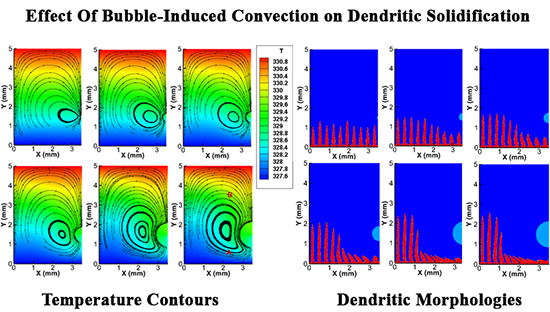
In this context, University of Akron researchers: Seyed Amin Nabavizadeh and Professor Sergio Felicelli together with Professor Mohsen Eshraghi from California State University, Los Angeles; Professor Surendra Tewari at Cleveland State University and Richard Grugel at the NASA-Marshall Space Flight Center in Huntsville looked carefully at the effect of bubble-induced Marangoni convection on dendrite growth. In particular, they attempted to answer the question of whether the induced Marangoni convection during solidification was strong enough to influence the dendritic morphologies. Their work is published in International Journal of Multiphase Flow.
In their work, a phase field – lattice Boltzmann model was developed to capture the bubble-dendrite interactions during solidification of binary alloys under microgravity conditions. The researchers employed the developed lattice Boltzmann method to solve both fluid flow and solute transport equations, while the finite difference method was used for the heat transfer equation. The solid/liquid interface was tracked by a cellular automaton model. After validating the model with several benchmark solutions, the Marangoni convection effects on dendrite growth and bubble dynamics were simulated in microgravity conditions.
The research team reported that Marangoni convection for larger bubbles can alter the morphology of dendrites, but the effects are negligible for smaller bubbles. Further, simulation results showed that the dendrites near a bubble have more branches and grow slower than the neighboring dendrites.
In summary, the study presented the development of a new hybrid phase field – lattice Boltzmann model that could successfully simulate high-density ratio multiphase flow, allowing simulations with real physical properties and comparison with experiments. Overall, the team studied the effect of thermocapillary motion on dendrite growth using a numerical model developed by combining different numerical methods.



Reference
Seyed Amin Nabavizadeh, Mohsen Eshraghi, Sergio D. Felicelli, Surendra N. Tewari, Richard N. Grugel. Effect of bubble-induced Marangoni convection on dendritic solidification. International Journal of Multiphase Flow, volume 116 (2019) page 137–152.
Go To International Journal of Multiphase Flow