Advances in Engineering Advances in Engineering features breaking research judged by Advances in Engineering advisory team to be of key importance in the Engineering field. Papers are selected from over 10,000 published each week from most peer reviewed journals.

Significance
Asphalt binders are highly susceptible to environmental factors such as heat and oxygen due to its intrinsic temperature sensitivity and aging susceptibility characteristics. Owing to the significant effects of these factors, modification of asphalt binders using various modifiers has been performed to improve the road performance of asphaltic binders. Among the available modifiers, nanomaterials exhibiting special nanoscale effects have been extensively researched. Typically, nanomaterials are classified according to the number of dimensions a material can reach in a nanoscale range and includes zero-, one- and two-dimensional nanomaterials. Recently, the concept of multi-scale nanocomposites composed of different dimensional nanomaterials was proposed to synthesize dimensional nanomaterials and enhance their synergistic improving effects on asphalt binders. Nevertheless, despite extensive research on improving the performance of asphalt binders using multi-scale nanocomposites, only a few studies have investigated the effects of multi-scale nanocomposites on asphalt binders. Moreover, discrepancies on the effects of multi-sale nanocomposites on asphalt binders and its mixtures need more clarifications.
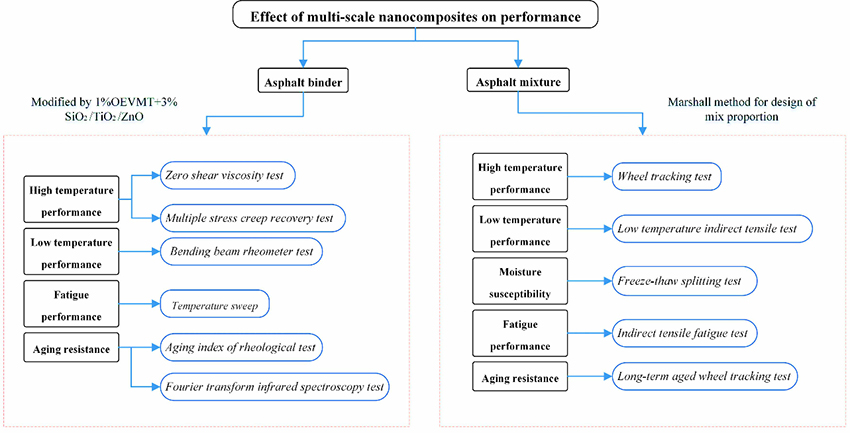
To this note, researchers at Hunan University: postgraduate student Junzhuo Wang, Chongzheng Zhu (PhD candidate) and led by Professor Henglong Zhang investigated the effects of multi-scale nanocomposites on asphalt binders and its mixtures. Specifically, the authors performed laboratory tests to determine the multi-scale nanocomposites modified asphalt mixture with the best performance. The main objective was to determine whether the improving effects of multi-scale nanocomposites on asphalt binders are the same as asphalt mixtures and whether they meet the required threshold for practical applications. Their research is currently published in the journal, Construction and Building Materials.
In their approach, the multi-scale nanocomposite comprised of a combination of one inorganic nanoparticle (either nano-SiO2, nano-Zond or nano-TiO2) and one typical layered silicate (OEVMT). The effects of three different multi-scale nanocomposites on asphalt binders and its mixtures were evaluated in terms of the low- and high-temperature, fatigue, moisture susceptibility and aging performance. Finally, effects on the binders and mixtures were separately evaluated and compared.
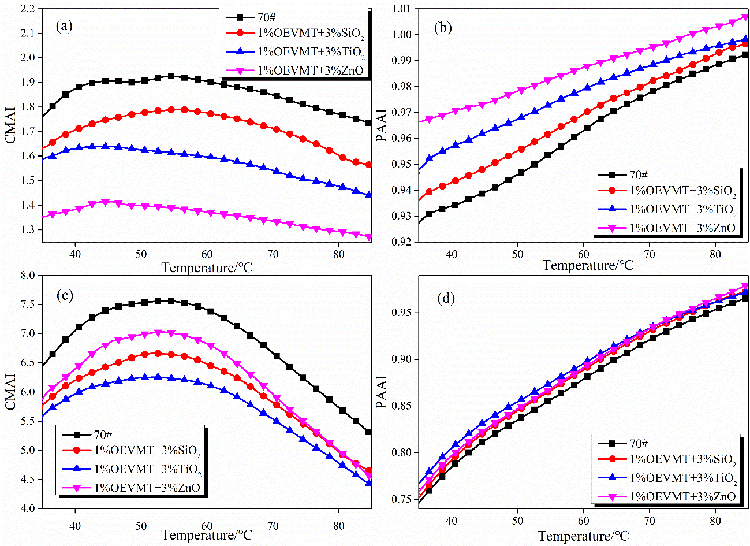
Results showed that the addition of multi-scale nanocomposites could distinctively enhance the low-temperature and the anti-aging performance of both asphalt binders and its mixtures. In contrast, the different multi-scale nanocomposites exhibited different effects on water damage resistance and high-temperature performance. This could be attributed to the influence of the addition of OEVMT. The authors found that the multi-scale nanocomposites could improve the fatigue life of the mixture. However, the limitations of the fatigue cracking parameters hindered the evaluation of the fatigue resistance of the asphalt binder. Compared to other multi-scale nanocomposites, a combination of 1% OEVMT and 3%ZnO modified asphalt and its mixture exhibited the best water damage resistance, fatigue and aging performance at both high and low temperatures.
In summary, the study examined the effects of multi-scale nanocomposites on the aging and mechanical properties of asphalt binders and its mixtures. Results showed that the multi-scale nanocomposites modified asphalt mixture could result in best road performance. Additionally, the optimal combination of 1% organic expanded vermiculite and 3% nano-zinc oxide demonstrated the best anti-aging, temperature and water damage resistance performance. Overall, the authors noted that the study would enhance the performance of asphalt binders and its mixtures.



Reference
Wang, J., Zhang, H., & Zhu, C. (2020). Effect of multi-scale nanocomposites on performance of asphalt binder and mixture. Construction and Building Materials, 243, 118307.