Advances in Engineering Advances in Engineering features breaking research judged by Advances in Engineering advisory team to be of key importance in the Engineering field. Papers are selected from over 10,000 published each week from most peer reviewed journals.

Significance
Micro-forming has become popular in terms of process, modeling, and material, as a micro-manufacturing method for scale production. Unfortunately, size effect has been identified to result in deviations in material and process performances with miniaturization, such as the increase of forming defects and decrease of forming limit and accuracy. Electrically-assisted forming that is a hybrid system applying electricity to metals during plastic deformation, has technical benefits such as improved formability, improved surface quality, reduced stringback, and enhanced geometric accuracy of parts. For that reason, applying electricity to assist in plastic micro-forming is a suitable approach for eliminating the size effect.
Several research works associated with electrically assisted forming are mainly based on the effect of electric pulse parameters on mechanical changes as well as microstructural evolutions of various metals. However, only a few of these focuse on grain size effect on electrically-induced softening behavior and specimen size effect on the electrically-assisted deformation behavior. In addition, most of these studies were conducted at macro-scale level instead of the meso/micro-scale level.
Researchers from Harbin Institute of Technology of China and Northwestern University of USA jointly investigated the effects of grain size and specimen size on the electrically-induced softening behavior in electrically-assisted micro-forming based on the combination of experimental as well as modeling methods. Their research work is published in journal, Materials & Design.
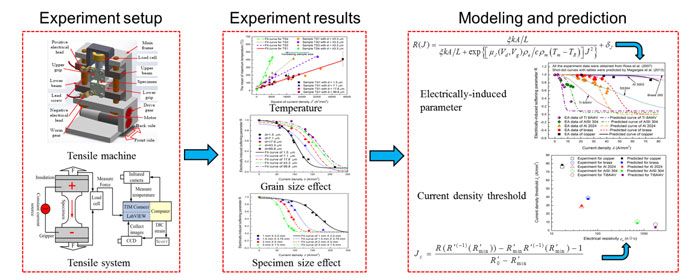
The authors conducted uniaxial micro-tension tests of AZ31 magnesium alloy samples exposed to varying current densities for a number of grain sizes as well as specimen sizes. They presented an approach to assess the effect of electric current on the decrease of tensile strength in electrically-assisted micro-tension, and this resulted in further characterization of the influence of grain and specimen sizes on the electrically-induced softening behavior of AZ31.
The research team then proposed a semi-empirical model of the electrically-induced softening behavior taking into account the size effect in electrically-assisted micro-tension in a bid to forecast the softening behaviors of about five engineering metals reference to a number of current densities during uniaxial tension.
The authors observed that the increasing rate of the average minimum temperature against the square of current density reduced with miniaturization, but remained unchanged with grain size. Electrically-induced softening parameter and the current density followed an inverse-S-shaped decay curve. The curve shifted to the lower and higher current density regions with the increase in specimen size and grain size, respectively.
The researchers observed that a lower current density was adequate for smaller grain sizes and larger sample sizes in order to realize higher softening effect. This indicated that grain number would be an important aspect affecting electrically-induced softening.
The authors used the size effects on electrically-induced softening to modify a semi-empirical softening function of current density that would be implemented to forecast the electrically-induced softening behaviors of five metals. The authors defined and formulated a current density threshold in electrically-induced tension based on semi-empirical softening function. The semi empirical softening function decreased with electrical resistivity and specimen size, and increased non-linearly with the grain size.





Reference
Xinwei Wang, Jie Xu, Debin Shan, Bin Guo, Jian Cao. Effects of specimen and grain size on electrically-induced softening behavior in uniaxial micro-tension of AZ31 magnesium alloy: Experiment and modeling. Materials & Design, volume 127 (2017), pages 134–143.
Go To Materials & Design