Advances in Engineering Advances in Engineering features breaking research judged by Advances in Engineering advisory team to be of key importance in the Engineering field. Papers are selected from over 10,000 published each week from most peer reviewed journals.

Significance Statement
Polymer nanocomposites are perfect for the fabrication of multifunctional materials extending the range of application of commodity plastics. In particular, conductive composites having carbon nanostructures can be applied to many fields as sensors, by using the piezoresistivity, where the variation of the electrical resistivity of the material is modified on application of strain. The team recognized the applications of these materials for strain movement sensors where sensitivity is one of the most important characteristics tailored by a broad range of parameters such as filler aspect ratio and loading, matrix type and film fabrication method.
Researchers led by Professor Humberto Palza from University of Chile carried out study on the piezoresistive behavior of two thermoplastic elastomer ethylene copolymers using either carbon nanotubes or graphite derivatives as fillers focusing on the effect of the polymer matrix and carbon nanostructure. The research work is published in the peer-reviewed journal, Polymer International.
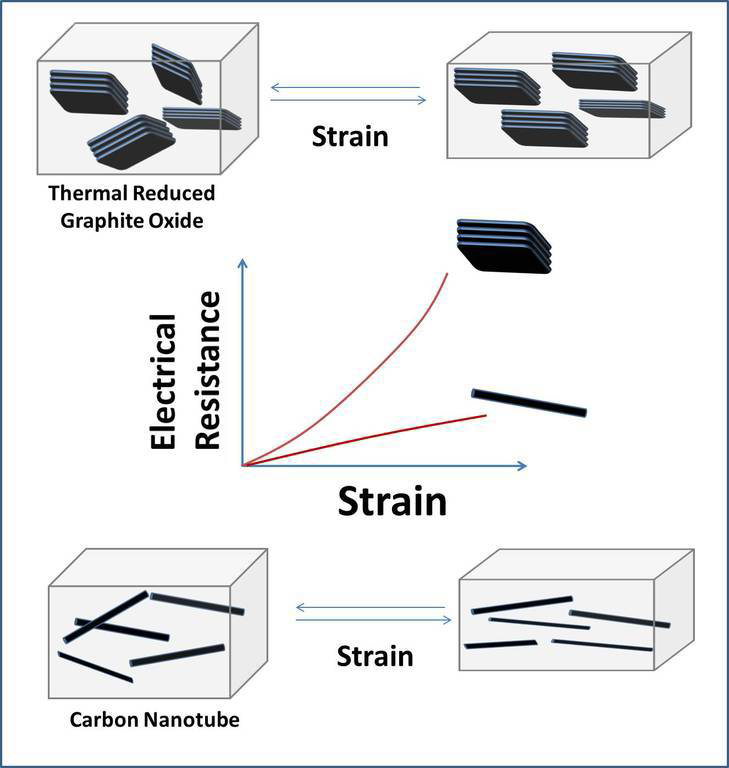
Two ethylene/1-butene thermoplastic elastomer copolymers were melt mixed with multiwalled carbon nanotubes or thermally reduced graphite oxide resulting in piezoresistive composite materials. They then analyzed the electrical behavior of the sensors by studying the effect of the polymer matrix, carbon nanostructure and filler concentration. To understand the experimental results, percolation theory using exclude volume concepts was applied to the experimental data.
The authors found that using thermally reduced graphite oxide as filler, the percolation transition increased compared with carbon nanotubes showing the relevance of the carbon nanostructure. The strain due to the application of deformation, disrupt the carbon nanotubes percolated network by increasing the average inter particle distance. The team also observed that, the polymer matrix and the filler concentration affect the sensitivity of the piezoresistive composites.
The research team said during their study, the stiffer matrix, with higher elastic modulus, transfers more of the stresses to the carbon nanotubes, this allow the interparticle distance to be affected more than in composites at the same strain.
According to the authors, the excluded volume theory for percolated systems verified their results as regard the effect of particle aspect ratio on the piezoresistive behavior of the composites.
This study successfully developed a method for designing polyethylene piezoresistive sensors with tailor made behavior by a proper of the polymer matrix, filler concentration and carbon nanoparticles.
This research states the advantage of grapheme derivatives and carbon nanotubes in controlling the electrical behavior of polymer elastomers, says Professor Humberto Palza.



Journal Reference
Humberto Palza, Cristhian Garzon and Mauricio Rojas, Elastomeric Ethylene Copolymers with Carbon Nanostructures Having Tailored Strain Sensor Behavior and their Interpretation Based on the Excluded Volume Theory, Polymer International 2016; 65: 1441–1448.
Departamento de Ingeniería Química y Biotecnología, Facultad de Ciencias Físicas y Matemáticas, Universidad de Chile.