 Advances in Engineering Advances in Engineering features breaking research judged by Advances in Engineering advisory team to be of key importance in the Engineering field. Papers are selected from over 10,000 published each week from most peer reviewed journals.

Significance
The oxidation of iron is one of the oldest chemical processes known to man. From the slow rusting of infrastructure to the rapid passivation of catalytic surfaces, the interaction between iron and oxygen has shaped both the durability of our materials and the limits of our energy systems. What may appear to the naked eye as a simple reddening of a metal surface hides, at the atomic scale, a remarkably intricate interplay of electronic structure, surface orientation, and dynamic environmental factors. For decades, scientists have tried to describe this process with increasing precision, yet much of the story remains elusive, particularly under conditions that more closely mimic real catalytic environments. One of the great barriers to progress has been methodological. Classic surface science techniques such as field ion microscopy and field emission microscopy provide striking visualizations of nanoscale surface structures but do not easily reveal the chemical identity of evolving species. Atom probe tomography, on the other hand, excels in chemical characterization but is usually performed under cryogenic conditions that freeze rather than follow reactions as they unfold. This has left researchers with an incomplete picture—either exquisite images without chemistry, or chemistry without the temporal resolution of real-time transformation. As a result, the fundamental pathways of iron oxidation, especially under non-equilibrium conditions, remain only partially understood. A second challenge arises from the fact that surface chemistry is never determined by structure alone. External forces, particularly electric fields, exert profound influence over how molecules approach, adsorb, and react on metallic surfaces. Strong fields can polarize molecules like O₂, alter adsorption energies, and even reshape orbital alignments, effectively rewriting the chemical “rules of engagement” at the interface. While scattered studies have hinted at these effects, there has been no systematic operando approach to directly observe how intense electric fields change the course of iron oxidation. Without such clarity, it is difficult to know whether fields accelerate corrosion, suppress it, or do something far more nuanced.
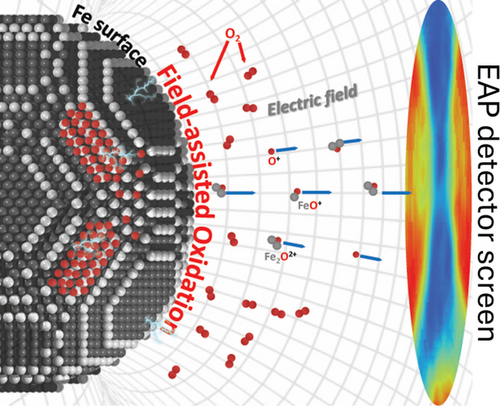
To this account, new research paper published in Angewandte Chemie International Edition and led by Dr. Sten Lambeets from the Pacific Northwest National Laboratory (PNNL) and Prof. Jean-Sabin McEwen from Washington State University. Naseeha Cardwell, Dr. Isaac Onyango, Mark G. Wirth, Eric Vo, Prof. Yong Wang, Prof. Pierre Gaspard, Prof. Cornelius F. Ivory, Dr. Daniel E Perea, Prof. Thierry Visart de Bocarmé contributed to the paper. The researchers developed an environmental atom probe (EAP) technique that allows iron oxidation to be monitored in real time under controlled oxygen pressures and strong applied electric fields. By combining this operando approach with density functional theory and microkinetic modeling, they revealed how electric fields not only accelerate the initial adsorption of oxygen but also suppress further oxide growth at later stages. This dual role highlights electric fields as powerful levers for dynamically controlling surface chemistry, turning a traditionally passive process into one that can be actively tuned.
The research team began by preparing pristine iron single crystals shaped into needle-like tips, each exposing a range of crystallographic facets. Using digital field ion microscopy, they mapped out these surfaces, distinguishing open and compact orientations that would later reveal very different reactivity. With this groundwork, they introduced oxygen at carefully controlled pressures, all while subjecting the specimens to electric fields of remarkable intensity, on the order of tens of volts per nanometer. The environmental atom probe setup allowed them not only to expose the iron to oxygen but also to follow, in real time, how atoms were incorporated into or removed from the surface. What emerged was a dynamic portrait of oxidation unfolding at the nanoscale, one in which the influence of electric fields was impossible to ignore.
At the earliest moments of exposure, oxygen began to attach preferentially to open facets such as Fe{112} and Fe{244}, whereas compact facets like Fe{011} and Fe{024} were far less willing to host the incoming atoms. The atom probe recorded oxygen not only as free ions but as fragments of iron oxides forming in situ, painting a picture of patchy, heterogeneous oxidation across the surface. Increasing the electric field strengthened this tendency. By polarizing the incoming oxygen molecules, the field seemed to guide them toward the surface more effectively, amplifying the rate at which the first oxides took shape. What looked, in the early stages, like a simple acceleration of corrosion was in fact a field-induced funneling of reactivity to specific regions of the crystal. The authors found that when the system edged closer to equilibrium, the very same fields that had initially boosted oxidation began to suppress it. Stronger electric fields reduced the binding strength of oxygen to the surface, and at the highest values, they even promoted field evaporation, stripping atoms away before a stable oxide could thicken. The atom probe captured this delicate balance: oxygen levels surged at first with higher fields but later plateaued or declined, revealing that electric fields acted as both catalysts and inhibitors depending on the stage of reaction. They also found that density functional theory calculations showed adsorption energies following a parabolic dependence on field strength, with positive fields especially effective at weakening oxygen’s grip on compact facets. When these predictions were folded into microkinetic simulations, the results mirrored the experimental maps with striking fidelity.
In conclusion, the research work of Dr. Sten Lambeets and colleagues demonstrated that intense electric fields can accelerate the early stages of oxide growth and later suppress further accumulation, this study shows that corrosion and catalysis may not be passive outcomes of environment alone. Instead, they can be actively steered by external forces. This insight challenges the conventional view of oxidation as a fixed trajectory and introduces the possibility of designing materials that respond dynamically to their surroundings. For catalysis, the implications are profound. Iron and related transition metals are central to sustainable energy strategies, particularly in reactions like the hydrodeoxygenation of bio-oils, where surface oxidation often disables the catalyst before it can deliver its full potential. If electric fields can be tuned to limit oxide buildup without entirely halting surface activity, they may become a new tool for prolonging catalyst lifetimes and optimizing performance under mild conditions. Rather than simply adding promoters or coatings to resist oxidation, engineers could use fields as invisible switches, adjusting them in real time to favor desired outcomes. Moreover, the relevance extends equally to corrosion science. Infrastructure failure due to rust carries enormous economic and environmental costs, and the ability to use fields to slow or even reverse oxide growth could open unexpected strategies for extending the durability of steel and other iron-based materials. Although the work of the authors is primarily fundamental, it establishes a proof of principle that controlling oxidation is not only a matter of chemistry but also of physics and embraces the interplay between electrons, fields, and atoms, entirely new approaches to corrosion protection may be envisioned.


Reference
Lambeets SV, Cardwell N, Onyango I, Wirth MG, Vo E, Wang Y, Gaspard P, Ivory CF, Perea DE, Visart de Bocarmé T, McEwen JS. Elucidating the Role of Electric Fields in Fe Oxidation via an Environmental Atom Probe. Angew Chem Int Ed Engl. 2025 ;64(18):e202423434. doi: 10.1002/anie.202423434.
