 Advances in Engineering Advances in Engineering features breaking research judged by Advances in Engineering advisory team to be of key importance in the Engineering field. Papers are selected from over 10,000 published each week from most peer reviewed journals.

Significance
Climate change is a major challenge to humanity and while cleaner energy remains an important solution, it’s no longer enough. Reducing emissions, though critical won’t singlehandedly keep us beneath the 1.5 °C or even 2 °C thresholds. With CO₂ levels in the atmosphere now well past 420 ppm, the conversation has turned toward removing carbon that’s already there. Technologies like direct air capture (DAC) and industrial CO₂ scrubbing have moved from fringe ideas to essential components of serious climate strategy. Yet, despite decades of innovation, most carbon capture solutions are still tangled in technical limitations, cost concerns, or environmental compromises that prevent them from scaling effectively. Many existing approaches are, frankly, difficult to work with. Amine-based solvents, for instance, are widely used in post-combustion capture, but they degrade over time, require significant energy for regeneration, and pose corrosion challenges. Solid sorbents such as metal-organic frameworks or porous carbons offer tunable surfaces, yet their performance often drops off in real-world environments where moisture or competing gases are present. And then there are high-temperature systems like calcium looping—technically clever, but operationally burdensome. They involve calcining solids at nearly 1,000°C and managing large flows of slurry or powder, which complicates logistics and inflates energy use. Another layer of difficulty is that many systems work best with CO₂-rich gas streams. That’s fine for industrial exhaust, but DAC faces a tougher challenge—capturing CO₂ from air, where concentrations are vanishingly low. The physics alone make this a costly undertaking unless the system is unusually efficient and durable. And when real-world emissions bring in impurities like SOₓ or NOₓ, many capture chemistries falter or require complex pre-treatment steps.
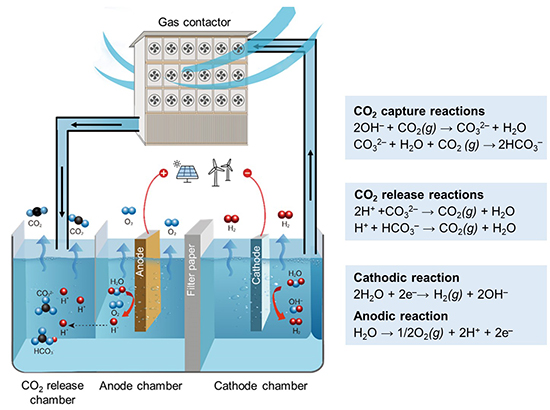
Given these intertwined challenges, a new research paper published in ChemSusChem and conducted by Dr. Jiayin Zhou and Professor Xiaofei Guan from the ShanghaiTech University, describes a system built from first principles—one centered around electrochemistry. Their approach taps into something elegant: the natural pH split generated during water electrolysis and by this created a membrane-free, closed-loop process that captures and releases CO₂ without forming solids or needing high-temperature regeneration.
To translate their concept of a cleaner, less complicated CO₂ capture method into practice, Zhou and Guan devised a deliberately streamlined electrochemical system. At its core was a three-chamber cell that operated on the principles of water electrolysis. As current passed through, the cathode environment became strongly alkaline while the anolyte turned acidic, establishing a sharp and stable pH gradient. That gradient, rather than any added reagent or membrane, became the functional driver of the entire capture process. In place of costly ion-exchange membranes, they used simple porous filter papers to moderate ion flow—an understated design choice that simplified both construction and operation. To assess chemical durability, the authors ran the system with sodium sulfate, chosen for its inertness and compatibility. Across more than 40 hours of electrolysis, cyclic voltammetry and impedance spectroscopy revealed no evidence of electrolyte degradation or undesirable side reactions—an encouraging sign that the system’s internal chemistry could hold up under sustained operation. The team next turned to practical CO₂ capture. Using air with ambient levels of carbon dioxide (roughly 420 ppm), they initiated a series of discrete absorption and desorption cycles. Each cycle began with the alkaline solution from the cathode chamber being transferred into a gas-contacting reactor. There, the solution absorbed CO₂ until its basicity dropped. At that point, it was pumped into the acidic chamber, where CO₂ was cleanly released as a concentrated gas. This setup proved highly efficient, with capture rates exceeding 90% whenever the pH stayed above 12. Even more telling, the performance held steady across multiple cycles. The voltage remained consistent, and the pH split between chambers didn’t show the typical drift that often plagues electrochemical systems during extended runs. To further probe robustness, they transitioned to continuous operation. For 36 hours straight, the system cycled fresh catholyte into the absorption zone while spent solution moved toward CO₂ release. The capture efficiency stayed above 93%, and the power requirements remained stable—strong indicators of long-term reliability. When challenged with simulated flue gas containing 16% CO₂, the system didn’t falter. In fact, hydroxide utilization improved noticeably, with the energy efficiency for CO2 capture climbing beyond 17%. That’s particularly notable for a setup that sidesteps membranes, high-temperature steps, and solid waste formation. Lastly, they considered real-world pollutants. Based on solubility behavior and known electrochemical pathways, they reasoned that contaminants like SOₓ and NOₓ would either remain dissolved or be neutralized in situ. Critically, none of these species appeared likely to interfere with the core CO₂ cycling—a promising sign for real-world application.
What’s striking about Zhou and Guan’s contribution isn’t simply the data—although the numbers are impressive—but rather the shift in mindset it represents for carbon capture. Instead of optimizing within the constraints of conventional systems, they’ve chosen to rethink the problem from a chemical first-principles perspective. Their design strips away unnecessary complexity and leans on something often overlooked: the inherent pH separation produced during water electrolysis. With this simple electrochemical mechanism, they’ve managed to construct a closed-loop system that does away with membranes, high-temperature steps, and solid sorbents. It’s clean in both concept and execution. In practice and another major advantage is the system performs well under both ambient and elevated CO₂ concentrations, maintaining capture efficiencies above 90% without the need for recalibration or intervention. That reliability—paired with low material loss and minimal fouling—could open up applications beyond the confines of centralized power plants. It’s easy to imagine scaled-down versions running in modular units or decentralized facilities, especially in places where infrastructure is limited or non-existent. The added bonus of producing hydrogen and oxygen during operation also introduces a kind of energetic circularity that’s rare in this space. Another detail worth emphasizing is how well the system tolerates the kinds of impurities that normally spell trouble. Flue gas is messy—it’s full of SOₓ, NOₓ, and water vapor—and many existing capture technologies struggle or degrade in their presence. Here, Zhou and Guan’s approach shows real promise. Most interfering species are either rendered inert or converted into benign forms, meaning the system can likely operate without expensive pre-treatment steps. That’s not just a nice feature—it’s a real-world requirement.


Reference
Zhou J, Guan X. Closed-Loop and Precipitation-Free CO2 Capture Process Enabled by Electrochemical pH Gradient. ChemSusChem. 2025 Feb 16;18(4):e202401533. doi: 10.1002/cssc.202401533.
