 Advances in Engineering Advances in Engineering features breaking research judged by Advances in Engineering advisory team to be of key importance in the Engineering field. Papers are selected from over 10,000 published each week from most peer reviewed journals.

Significance
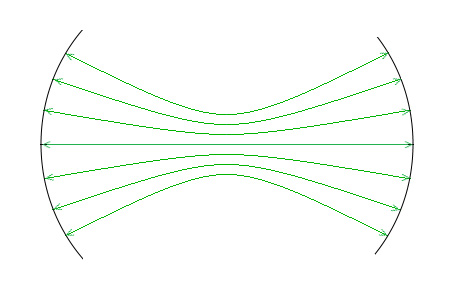
If the energy density of an electromagnetic wave propagates along a curved line, as the picture shows for the special case of a wave in an optical resonator, the questions arises, why follows the mass density, which according to E=mc² propagates with the wave, the energy density?
Considering this question leads to a new aspect how the photon can be assumed to be embedded into the electromagnetic wave.
Recent advancement in technology has seen the increasing design and fabrication of photon and electromagnetic device for various applications. These devices are judged based on their efficiency to suit a particular use. Therefore, the relationship between photon and electromagnetic wave has attracted significant attention of many researchers, and solutions have been provided within the framework of theoretical photonics.
Recently, Professor Konrad Altmann at LAS-CAD GmbH in Germany provided a new aspect concerning the relation between photon and electromagnetic by considering the question why the energy and the mass density of an electromagnetic wave are propagating in the same direction, even if the energy density propagates along a curved line as the picture shows for the special case of a wave in an optical resonator. Therefore, if a particle of relativistic mass propagating with the electromagnetic wave is assumed to represent a quantum of energy, its propagation should be described by the Poynting vector. On the other hand, if the particle is considered to represent a real particle of mass, its propagation should be described by Newton’s first law, and therefore, should not change its propagation direction, if no force is exerted on it. Therefore, the question arises, why does the propagating relativistic mass density follow the pro¬pagating energy density? This consideration leads to a contradiction between fundamental physical laws:
- Theory of relativity (E=mc²),
- Newton’s first law,
- Maxwell’s equations.
In this context it shall be stressed that this contradiction not only concerns the modes in an optical resonator but furthermore concerns any electromagnetic wave.
To solve this problem, Konrad Altmann made the assumption has that a transverse force is exerted on the mass density and in consequence on the photons which forces them to follow the propagating energy density. In his work published in the research journal, Optics Express, Konrad Altmann derived a mathematical expression for this force by considering the infinitesimal change of the direction of the Poynting vector versus an infinitesimal propagation step of the phase front of the electromagnetic wave. From this result he concluded that the photon is moving within a transverse potential which is obtained by integrating the negative value of the expression obtained for the force along the curvature of the phase front. Based on this result he furthermore concluded that the transverse motion of the photon is described by a Schrödinger equation like the motion of the electron except for the difference that the mass of the electron is replaced by the relativistic mass of the photon. This conclusion implies the surprising result that the Schrödinger equation also seems to hold for a particle which has no rest mass.
In case of Gaussian waves the obtained Schrödinger equation transforms into the Schrödinger equation of the 2-D harmonic oscillator This result has been used to compare the probability density of the photon, represented by the squared absolute squares of the eigenfunctions of the Schrödinger equation, with the result obtained by the use of wave optics for the normalized local intensity of a Gaussian wave. This comparison provided full agreement between both quantities. Additionally, it could be shown that also the Gouy phase could be computed within this new theoretical approach in full agreement with wave optics. Both results deliver important verifications of this new theoretical approach.
In this way Konrad Altmann could show, how the photon can be assumed to be embedded with its relativistic mass as a particle into the electromagnetic wave. This provides a new approach concerning the understanding of photonics, and may be of future use for more efficient design and fabrication of photonics devices and systems.

Reference
Altmann, K. (2018). Embedding the photon with its relativistic mass as a particle into the electromagnetic wave. Optics Express, 26(2), 1375.
Go To Optics Express