Advances in Engineering Advances in Engineering features breaking research judged by Advances in Engineering advisory team to be of key importance in the Engineering field. Papers are selected from over 10,000 published each week from most peer reviewed journals.

Significance
Climate change, whether caused by natural or human activities, has detrimental impacts on the ecosystem and communities. Climate change is a relatively complex issue, as its impacts on different socioeconomic sectors are interrelated. Nevertheless, a common consensus is that developing novel innovative technologies and behavioral changes is important in alleviating the consequences of climate change. For instance, creating a sustainable economy and transitioning from fossil fuels to more clean energy technologies have received considerable global support, becoming the focus of both county-specific and international climate change response policies.
Accelerating sustainability and the transition to clean energy economy can only be achieved through intensive research and development (R&D). For a long time, public research funding has played an indispensable role in knowledge generation and industrial revolutions aimed at meeting societal needs. Current shifts and trends in climate change policies and research priorities are used to determine potential technological innovations that can meet these needs and drive rapid adoption of climate change-responsive technologies. Thus, exploring the categories and extent of funded research is essential as it could lead to more effective and objective-driven research.
While the debate around climate change focuses on climate action and mitigation funding, it makes no substantive contributions to the appropriate R&D required to address the inherent socioeconomic problems created by existing energy systems. Different climate change mitigation strategies like wind and solar energy, transportation electrification and reforestation are widely researched because they have proved effective in addressing the impact of climate change. Moreover, mission and innovative-driven R&D would play a fundamental role in creating an era of inclusive sustainability and economic growth.
In a new paper published in the peer-reviewed journal, Renewable and Sustainable Energy Reviews, Dr. Abbas AbdulRafiu, Professor Benjamin Sovacool and Dr. Chux Daniels from the University of Sussex, Science Policy Research Unit (SPRU) explored the global public research funding trends, topical themes and notable gaps across the domains of climate change, industrial decarbonization, energy and transport between 1990 and 2020. They analyzed the contributions of funded research in evoking and shaping awareness and response in generating new innovative technologies and realizing just-transitions. A critical examination of public research programs across the largest global funders, including countries, the most funded projects, funded amounts and top awarded disciplines were presented. A total of 153,202 projects funded by 154 research councils across 17 countries, including the European Union, were examined. Specifically, 1000 representative projects with a combined budget of $2.268 billion, some running till 2026, were analyzed in detail. Their results revealed an asymmetric distribution of climate change and energy research funding, with most of it concentrated within the United Kingdom (40%), United States (11%) and European Commission (27%). Other countries like Japan, China and India receive little funds, while developing countries hardly receive funds for such research.
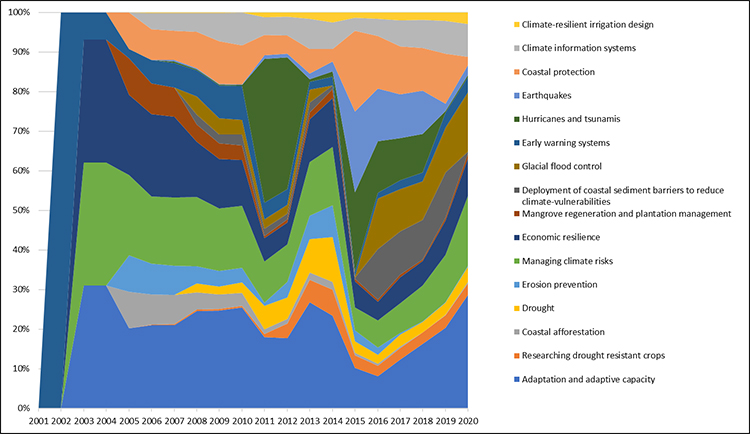
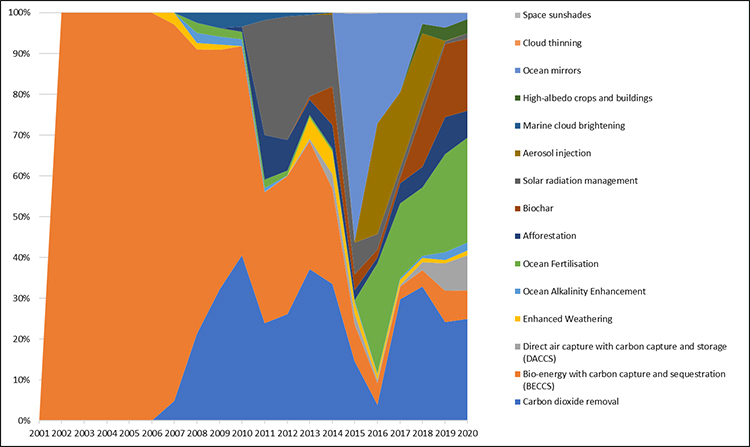
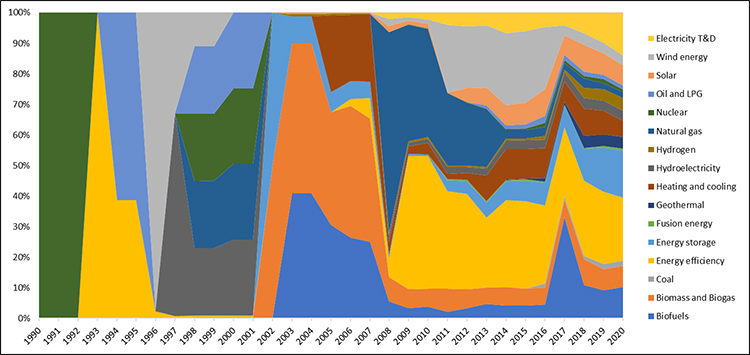
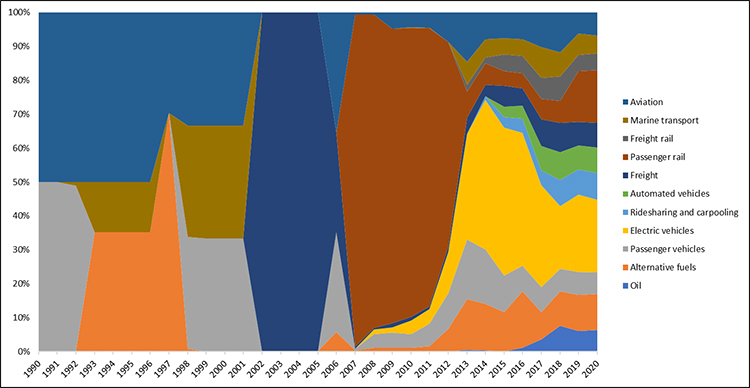
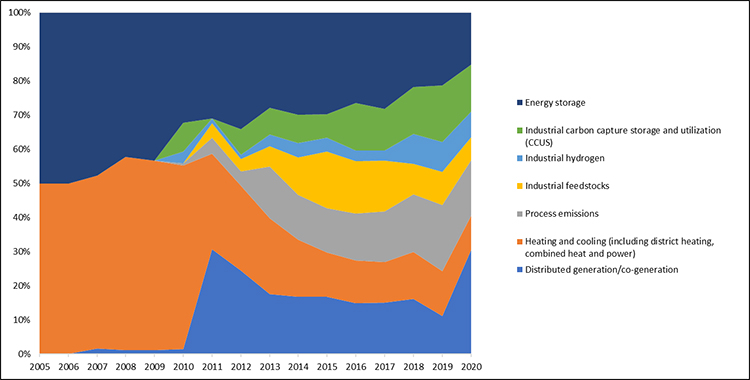
The most funded area is climate change adaptation research, while the most funded technologies revolve around specific topics of climate resilience, managing climate risks, energy efficiency, energy storage, climate information systems, solar energy and carbon dioxide removal. Climate change adaptation, energy systems, transport and mobility and industrial decarbonization and climate engineering projects received funding of 36%, 28%, 13% and 12%, respectively. The mostly funded disciplines are relatively diverse, with social sciences receiving funding amounts almost equal to engineering. Also, other disciplines like arts, humanities and life sciences are reportedly receiving meaningful funding. Most of the funded projects were identified as transdisciplinary, although not all funding promotes exclusivity.
In summary, an analysis of the role of global public research funding patterns across topics related to climate change for a period of 30 years was reported. The findings identified not only the most researched topics but also under-researched topics, some of which are worthy of exploration. The study revealed emerging gaps in research topics and data quality. In a statement to Advances in Engineering, first author Dr. Abbas AbdulRafiu explained their study will help streamline and promote accountability, transparency and inclusivity in public research funding of climate change.

Reference
AbdulRafiu, A., Sovacool, B. K., & Daniels, C. (2022). The dynamics of global public research funding on climate change, energy, transport, and industrial decarbonisation. Renewable and Sustainable Energy Reviews, 162, 112420.