Advances in Engineering Advances in Engineering features breaking research judged by Advances in Engineering advisory team to be of key importance in the Engineering field. Papers are selected from over 10,000 published each week from most peer reviewed journals.

Significance
Proton-conducting ceramic electrolytes based on perovskite oxides have emerged as central materials in the development of electrochemical energy technologies operating at intermediate temperatures. Among these, acceptor-doped barium zirconate stands out for its exceptional chemical stability and intrinsically high bulk proton conductivity, properties that make it attractive for protonic ceramic fuel cells and electrolysers. Yet, despite its theoretical promise, barium zirconate has seen limited implementation in practical devices. The reasons for this discrepancy lie not in its idealized defect chemistry, but in the complex materials processing conditions required to fabricate dense, high-performance electrolytes compatible with functional electrodes. Nickel plays a paradoxical role in this context. On the one hand, Ni is indispensable as a hydrogen electrocatalyst in composite electrodes and as a sintering aid that enables densification of refractory zirconate ceramics at accessible temperatures. On the other hand, decades of empirical observations have shown that even small amounts of Ni dramatically suppress proton uptake and conductivity in barium zirconate-based electrolytes. This degradation persists even when Ni remains within its solubility limit and no secondary phases are detected, suggesting that conventional explanations based solely on phase segregation or acceptor depletion are insufficient. The fundamental challenge, therefore, is to reconcile the essential technological role of Ni with its seemingly universal detrimental impact on hydration behavior. Prior studies have established that Ni substitutes on the perovskite B-site and predominantly adopts a trivalent oxidation state, which in principle should act as an acceptor and enhance proton uptake. The fact that the opposite is observed points to more subtle mechanisms operating at the atomic scale, likely involving defect interactions, local lattice distortions, and non-random distributions of dopants that escape detection by average structural probes. To this end, new research paper published in Journal of the American Chemical Society and conducted by Yabing Wen, Andreas Rosnes, Bo Jiang, Professor Øystein Prytz, Professor Truls Norby, Professor Reidar Haugsrud and Professor Jonathan Polfus from the University of Oslo in Norway, the researchers developed a unified defect-chemical model that explicitly incorporates nickel-induced point defect clustering and antiphase boundary formation in Yb-doped barium zirconate. By combining atomic-resolution imaging with density functional theory, they identified trapped oxygen vacancies within Yb–Ni clusters as the primary cause of suppressed proton uptake. They further demonstrated that excess B-site stoichiometry drives acceptor-rich antiphase boundaries, compounding the loss of active protonic defects.
The research team prepared BaZr₀.₈Yb₀.₂O₃₋δ with carefully controlled additions of Ni, introduced either as equimolar BaNiO₂ or as NiO alone. This distinction proved critical, as it allowed the authors to separate effects arising from charge compensation and substitution from those caused by excess B-site cations. All samples were synthesized by solid-state reactive sintering under identical conditions, ensuring that observed differences could be attributed to defect chemistry rather than processing variability. The authors confirmed structural characterization that all compositions remained single-phase on the macroscopic scale, with synchrotron diffraction and pair distribution function analysis revealing only subtle differences in local bond distances. X-ray absorption spectroscopy established that Ni predominantly adopts a trivalent state, validating its treatment as an acceptor in subsequent defect models. Yet thermogravimetric measurements told a markedly different story: the hydration saturation limit decreased systematically with increasing Ni content, and the suppression was significantly stronger when Ni was introduced as NiO rather than BaNiO₂. Moreover, the authors turned to atomic-resolution scanning transmission electron microscopy. By exploiting the strong contrast between Yb, Ni, and Zr on specific crystallographic zone axes, they directly visualized non-random arrangements of dopants. These images revealed the presence of nanoscale Yb–Ni point defect clusters in which Ni-rich columns consistently appeared adjacent to Yb-rich ones. Quantitative analysis showed that the local occupancies within these clusters far exceeded what would be expected from a random distribution, providing unambiguous evidence of defect association. They demonstrated using density functional theory that oxygen vacancies are strongly bound within Yb–Ni clusters, with binding energies approaching one electronvolt. While isolated oxygen vacancies readily hydrate to form mobile protons, vacancies trapped in these clusters exhibit significantly less favorable hydration enthalpies. As a result, they remain effectively inert under operating conditions, contributing neither to proton concentration nor to transport. According to the authors, the study further revealed a second, independent mechanism when Ni was added as NiO. Excess B-site cations were accommodated through the formation of extended antiphase boundaries, observed directly by high-resolution imaging and confirmed by spectroscopic signatures. These planar defects were strongly enriched in Yb, effectively sequestering acceptors away from the bulk lattice. The combined effect of vacancy trapping within Yb–Ni clusters and acceptor depletion at antiphase boundaries led to a near-doubling of the reduction in effective acceptor concentration compared with stoichiometrically balanced Ni addition.
In conclusion, the new work by University of Oslo scientists redefine how sintering additives are understood in proton-conducting perovskite electrolytes which are important in proton-conducting ceramics. Rather than treating nickel as a uniformly distributed acceptor whose effects can be captured by average stoichiometry, the authors demonstrate that Ni fundamentally reshapes the defect landscape through highly localized, energetically stabilized configurations. In doing so, the study explains why even trace amounts of Ni can negate the intrinsic advantages of barium zirconate electrolytes. Additionally, the identification of Yb–Ni point defect clusters introduces a previously unrecognized mechanism by which proton uptake is suppressed through their immobilization which clarifies why conventional defect-chemical models and assume random distributions and fully active vacancies, systematically overestimate proton concentrations in Ni-containing systems. By explicitly accounting for trapped, non-hydrating vacancies, the authors reconcile thermodynamic predictions with experimental hydration data across multiple compositions. Furthermore, the discovery of Ni-induced antiphase boundaries as extended sinks for acceptor dopants because these defects operate on a different length scale but with equally severe consequences, reducing the effective acceptor population in the bulk and potentially disrupting percolation pathways for proton transport. The coexistence of point defect clustering and planar defect formation highlights the multiscale nature of defect interactions in real ceramic electrolytes, where atomic-scale energetics and mesoscale structural accommodation are tightly coupled. We believe the implications are profound and the findings suggest that the long-standing trade-off between sinterability and electrochemical performance in barium zirconate is not inevitable, but rather a consequence of uncontrolled defect engineering. Strategies that limit Ni diffusion, alter its local coordination environment, or replace it with alternative sintering aids could preserve densification benefits while avoiding hydration suppression. More broadly, the work provides a transferable framework for analyzing dopant–dopant interactions in complex oxides, extending well beyond proton conductors.
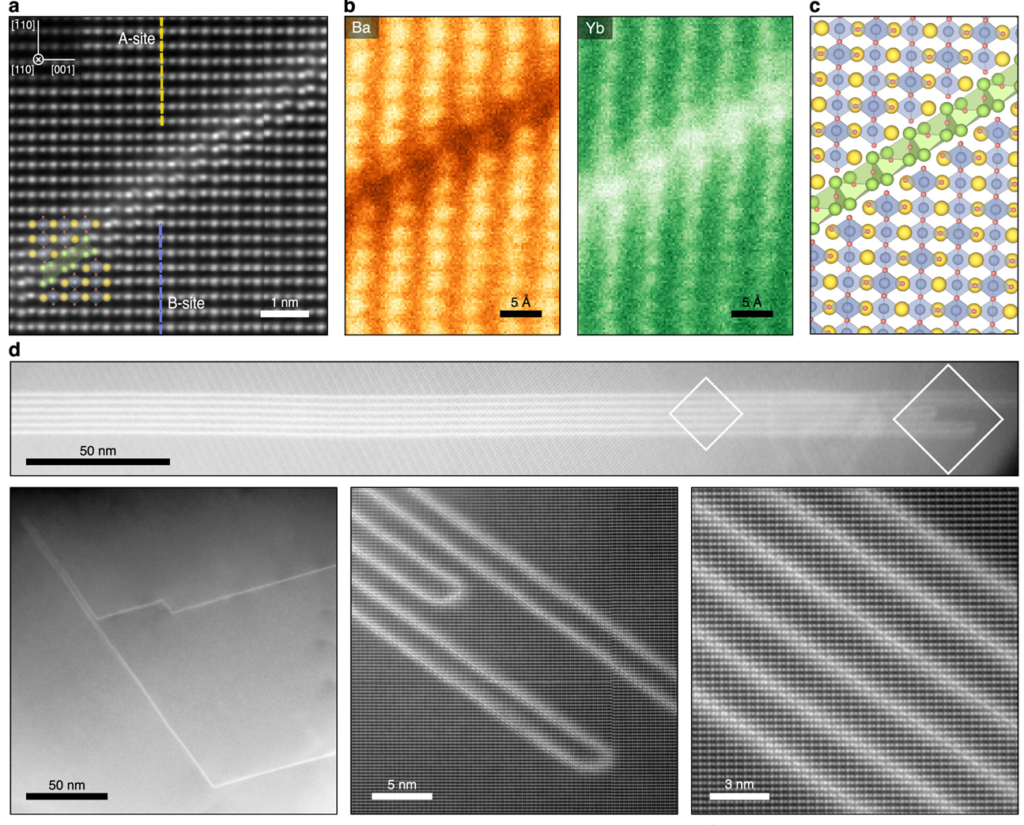
Figure Legend: Nickel-induced formation of APBs in BZYb20-5NiO. Image credit: J Am Chem Soc. 2026 Jan 14;148(1):379-387. doi: 10.1021/jacs.5c13935.



Reference
Wen Y, Rosnes A, Jiang B, Prytz Ø, Norby T, Haugsrud R, Polfus JM. Nickel-Induced Lattice Defects Limit Proton Uptake in Barium Zirconate Electrolytes. J Am Chem Soc. 2026 Jan 14;148(1):379-387. doi: 10.1021/jacs.5c13935.