Advances in Engineering Advances in Engineering features breaking research judged by Advances in Engineering advisory team to be of key importance in the Engineering field. Papers are selected from over 10,000 published each week from most peer reviewed journals.

Significance
The prevalence of bone diseases is going to increase significantly as the population ages. In the United States, the number of people age 65 and older is expected to triple to 86 million by 2050, while the number age 85 and older will increase to 20 million. these demographic changes could triple the number of hip fractures. Tissue engineering and regenerative medicine is promising new innovative approaches for de novo skeletal tissue formation in an attempt to address the unmet need for bone augmentation and skeletal repair. These approaches seek to harness stem cells, innovative scaffolds and biomaterials to create, ideally, robust, reproducible and enhanced bone formation strategies to improve the quality of life for an ageing population.
Technically, bone tissue engineering approach utilizes biocompatible biomaterials, which simulate the microenvironment in the body, and stimulate bone regeneration. Bone has two major components: organic collagen fibers and inorganic hydroxyapatite (HAP), which makes up about 60 percent of bone. Bisphosphonates (BPs) are compounds which are used clinically for bone disorders because of their high affinity for calcium ions. Previously, the synthesis of cross-linked poly (styryl bisphosphonate) nanoparticles (poly (StBP) NPs) was reported to demonstrate a strong affinity for calcium ions. To date, this approach has been advanced but still the need for better bone tissue engineering calls for more research.
On this account, researchers at The Institute of Nanotechnology and Advanced Materials at Bar-Ilan University in Israel: Dr. Hanna Steinmetz, Dr. Elisheva Sason, Dr. Tammy Lublin-Tennenbaum and led by Professor Shlomo Margel used the recently reported BP nanoparticles for the synthesis of new durable cross-linked poly(StBP) thin coatings on corona-treated polypropylene films by means of a simple method of UV-curing. The researchers also developed a simple process of coating BP nanoparticles onto polypropylene (PP) films to promote HAP growth. Their work is currently published in the research journal, Applied Surface Science.
To produce the coatings, poly (StBP) nanoparticles were mixed with the crosslinking monomer poly (ethylene glycol) dimethacrylate and the photoinitiator N-phenyl glycine, then spread onto corona-treated PP films using a Mayer rod, followed by a photo-polymerization reaction, then UV-cured. The coatings were characterized using a variety of advanced techniques including XPS, AFM, FIB, and water contact angle goniometry. Eventually, the wettability, durability, and optical properties of the coatings were studied.
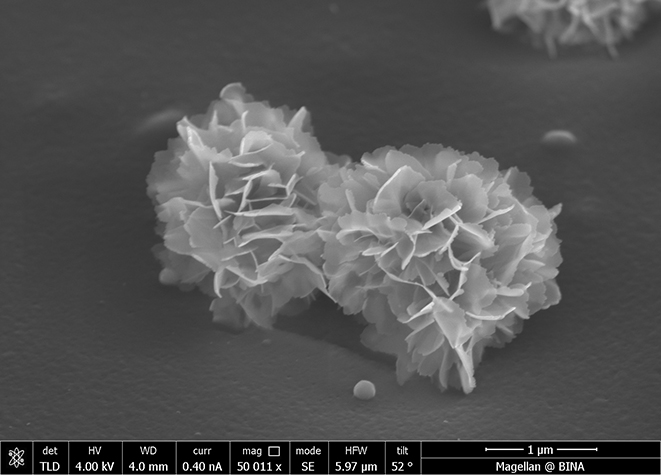
The authors reported that the poly (StBP) films were found to be durable, and exhibited optical properties (haze, transmission and clarity) similar to those of the corona-treated PP film. In addition, growth of HAP flower-like crystals on the surface of the poly (StBP) films was observed by HR-SEM. The [Ca]/[P] molar ratio of the HAP coating was calculated using EDS analysis. On the other hand, HAP did not grow on the corona-treated PP and poly (PEGDA) films, which served as controls.
In summary, the study presented the synthesis of new cross-linked poly (StBP) thin coatings of specific thickness by spreading a mixture of cross-linking monomer poly (ethylene glycol) dimethacrylate, photo-initiator N-phenyl glycine, and poly (styryl bisphosphonate) nanoparticles onto corona-treated PP films, followed by UV-curing. Remarkably, it was reported that HAP flower-like crystals grew on the surface of the coated films but not on the control films, indicating that the poly (StBP) coating may be a good candidate for use in bone tissue engineering. In a statement to Advances in Engineering, Professor Shlomo Margel highlighted that the poly (StBP) coatings on PP films they developed may find use in various bone tissue engineering applications. Nonetheless, he also pointed out that the ability of the poly (StBP) coatings to stimulate bone regeneration in vitro and then in vivo ought to be examined in future.


Reference
Hanna P. Steinmetz, Elisheva Sason, Tammy Lublin-Tennenbaum, Shlomo Margel. Engineering of new durable cross-linked poly (styryl bisphosphonate) thin coatings onto polypropylene films for biomedical applications. Applied Surface Science, volume 508 (2020) 145171.