Advances in Engineering Advances in Engineering features breaking research judged by Advances in Engineering advisory team to be of key importance in the Engineering field. Papers are selected from over 10,000 published each week from most peer reviewed journals.

Significance
Water interactions on metal oxides such as perovskites is a hot research topic. Besides being useful in understanding the basic aspects of the interactions, like the influence of surface modification (dopant, oxygen vacancy and/or edge) on the catalytic performance, it has significant implications in different applications, including hydrogen production and photocatalytic environment cleaning. Generally, the interactions between water and metal oxides can be classified from simple molecular or dissociative adsorption. Unfortunately, some fundamental aspects and underlying mechanisms of the water process are poorly understood. This necessitates the need for realistic models for describing the underlying chemical and physical processes involved in the interaction between waster and metal oxides.
Water adsorption on SrTiO3 perovskites is a promising approach for enhancing molecular hydrogen formation even at low quantum efficiency. Perovskites are easy to dope, and the nature of doping exhibit a strong influence on their adsorption mechanisms and their catalytic performances. For example, recent research revealed that doping SrTiO3 with cations could significantly improve water splitting performance, boosting the hydrogen conversion efficiency. Water adsorption on SrTiO3 has been extensively studied in the literature, both theoretically and experimentally. Unfortunately, most studies are based on ideal surfaces comprising oxygen vacancies as the only defects while ignoring the influence of other defects, which exhibits considerable influence on the adsorption and reactivity mechanisms. Interestingly, the shortcomings can be addressed by rationalizing the water adsorption o SrTiO3 via realistic models.
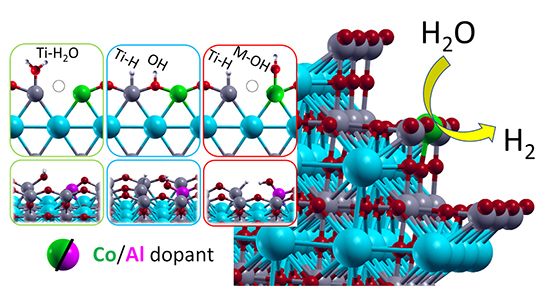
On this account, Dr. Silvia Carlotto from Università degli Studi di Padova investigated the water adsorption properties on more realistic SrTiO3 systems. Specifically, density functional calculations were performed to study the influence of the dopants (Al, Co, Cu), structural defects ((edges/steps), and oxygen vacancies, on the adsorption of water and formation of hydrogen in the Al, Co and Cu doped SrTiO3 (1 0 0) perovskite stepped surface. Three different water-surface interaction models were modeled, considering the effects of the defects, for clean and reduced steps. Whereas one model involved molecular adsorption, the other two entailed dissociative processes. The stability of the molecular and dissociative adsorbates in the presence of the defects and dopants was discussed in detail. The research work is published in the journal, Applied Surface Science.
The author observed that the dopants and the oxygen vacancies exhibited a remarkable influence on the stability of the adsorbates. The stabilities of the dissociative and molecular adsorbates also changed radically in the presence of structural defectivities. The dopants also reduced the costs associated with the oxygen vacancy. Notably, the copper dopant minimized the cost more than the cobalt and aluminum dopants. In the clean step, the author observed that the structure consisting of two hydroxyl groups exhibited high stability for all the steps while the dissociative adsorption was more stable than its molecular counterpart. On the other hand, the molecular adsorption was more stable for cobalt dopant in the reduced step.
In summary, Dr. Silvia Carlotto performed a DFT study on water interaction on stepped SrTiO3 (1 0 0) surface containing metal dopants, oxygen vacancy, and structural defectivity. Results demonstrated the influence of the oxygen vacancy and dopant on one adsorption stabilization with respect to another. This was further justified by the hydrogen formation process, considering that the reduced step was the initial commencing point of the formation mechanism. Results showed that the water interaction and dissociation on ideal surfaces could not be fully transferred on more realistic models. Therefore, Dr. Carlotto explained her study was more relevant for investigating water processes on models closer to materials subjected to standard experimental conditions.

Reference
Carlotto, S. (2020). The role of the dopant and structural defects on the water absorption and on the H2 formation in the Al, Co and Cu doped SrTiO3 perovskite steps. Applied Surface Science, 527, 146850.