Advances in Engineering Advances in Engineering features breaking research judged by Advances in Engineering advisory team to be of key importance in the Engineering field. Papers are selected from over 10,000 published each week from most peer reviewed journals.

Significance
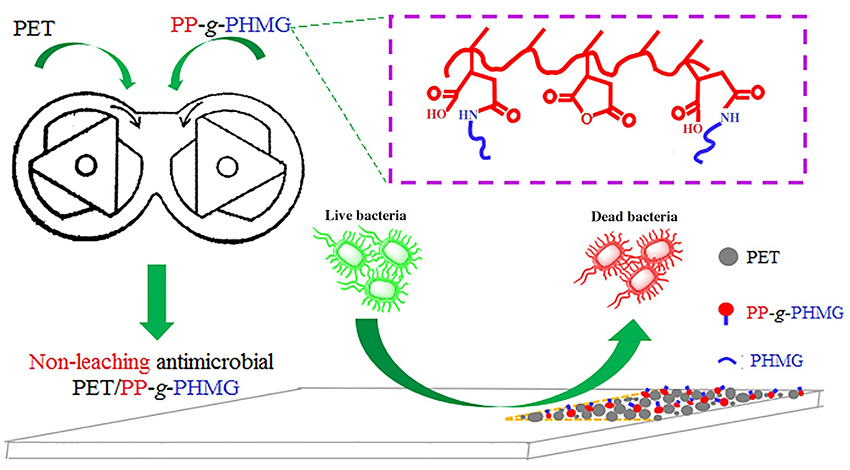
Antimicrobial poly (ethylene terephthalate) (PET) materials are widely used in several industrial applications owing to their excellent chemical and mechanical properties. Due to their considerable interest in both industrial and academic fields, various reports have documented the three commonly used fabrication methods including chemical modification, blending and surface treatment. Whereas chemical modification is tasked with the prevention of leaching antimicrobial components, the method is costly, complicated and environmentally unfriendly. Consequently, the leaching of the antimicrobial components evident in the surface coating method is yet to be addressed. However, findings in recent research have revealed that facile melting blending through PET and nonleaching antimicrobial polymers such as polypropylene grafted poly (hexamethylene guanidine) (PP-g-PHMG) exhibit high potential of achieving desirable cost-effective and nonleaching characteristics.
To this end, Wei Cao, Dafu Wei, Anna Zheng and Yong Guan from the East China University of Science and Technology developed cost-effective antimicrobial PET materials with enhanced nonleaching properties for large-scale industrial applications. These materials were prepared by melt blending the PET with PP-g-PHMG. The antimicrobial properties and nonleaching performance of such materials were therefore verified. The work is currently published in the European Polymer Journal.
In the study, the antimicrobial activities of the purified PET/PP-g-PHMG with different PHMG content was evaluated using Staphylococcus aureus and Escherichia coli bacteria. The authors noted the incapability of pure PET to deactivate the two bacteria. However, the antibacterial rates increase with the gradual increase in the PHMG content. As such, the material surface exhibited excellent antimicrobial properties reaching 98% and 99.9% for E. coli and S. aureus respectively. This was attributed to a combined effort between the difference in the PET matrix and PP-g-PHMG compatibility as well as the induced heterogenous repulsive crystallization effect.
On the other hand, the nonleaching performance of the as-prepared PET materials was validated based on the inhibition zone test. Specifically, the diameters of the inhibition zones were measured to determine the antimicrobial capacity. For PET/PHMG films, a small inhibition ring was observed. This was, however, not the case with PET/PP-g-PHMG due to the increase in the nonleaching characteristics. According to the authors, this could be related to the potential chemical bonding between the PET and PP-g-PHMG as a result of the anhydride group present.
In summary, East China University of Science and Technology scientists successfully developed a far better processing method for antimicrobial PET materials. Specifically, they achieved the desired objectives of excellent antimicrobial activities, significantly enhance nonleaching performance and environmental consciousness thus offering an alternative preparation method. Therefore, the paper findings will promote cost-effective and large-scale industrial processing of nonleaching antimicrobial PET materials. This would surely increase their industrial output considering their promising potential application in PET engineering and packaging materials.



Reference
Cao, W., Wei, D., Zheng, A., & Guan, Y. (2019). Surface enrichment and nonleaching antimicrobial performance of polypropylene grafted poly (hexamethylene guanidine) (PP-g-PHMG) in poly (ethylene terephthalate)/PP-g-PHMG. European Polymer Journal, 118, 231-238.