Advances in Engineering Advances in Engineering features breaking research judged by Advances in Engineering advisory team to be of key importance in the Engineering field. Papers are selected from over 10,000 published each week from most peer reviewed journals.

Significance
Two-dimensional covalent organic frameworks (2D-COFs) with their large π-conjugated structures and multilayer π−π stacking, have emerged as promising materials for soft photothermal actuators due to their high energy conversion efficiencies and structural advantages. However, their widespread application has been hindered by synthesis challenges, particularly the production of COFs as microcrystalline powders which exhibit limited dispersibility in water. This limitation significantly impacts the processability and application range of COFs in aqueous environments and for device fabrication. To address the limitations posed by conventional COF synthesis methods, a new study published in ACS Applied Materials & Interfaces and conducted by Dr. Guinan Chen, Dr. Liangjun Chen, Nanjun Li, Jiahao Li, Minchu Huang, Chengtao Gong, and led by Professor Yongwu Peng from the Zhejiang University of Technology, the researchers synthesized innovative water-based COF inks and applied these inks to fabricate hybrid COF films for photothermal actuators.
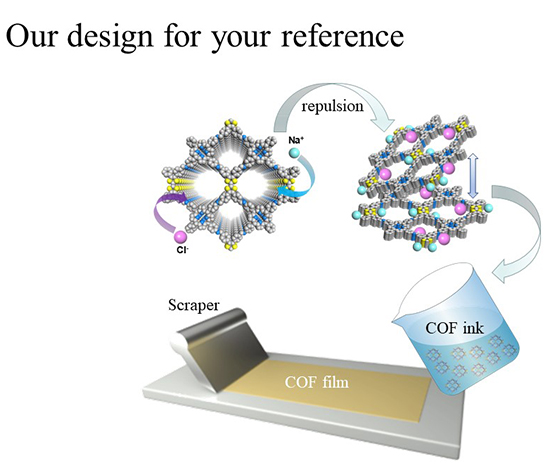
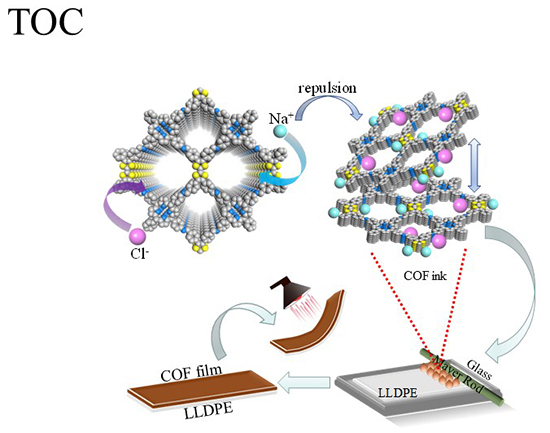
The team synthesized two distinct COFs, referred to as TTA-COF and Por-COF, using a co-condensation method. For TTA-COF, they combined 4,4′,4″,4‴-(porphyrin-5,10,15,20-tetrayl)-tetrabenzaldehyde (TFPP) and 4,4′,4″,4‴-([2,2′-bi(1,3-dithiolylidene)]-4,4′,5,5′-tetrayl)-tetraaniline (TTA) in a mixed solvent of N,N-dimethylacetamide, mesitylene, and acetic acid, heated the mixture to 120 °C for three days. Por-COF was synthesized in a similar manner using TFPP and p-phenylenediamine (PPD). To overcome the limited dispersibility of COFs in water, the researchers introduced a novel approach by adjusting the surface potential of COF powders through the adsorption of ionic species (Na+ and Cl−). This was achieved by immersing the synthesized COFs in NaCl solutions, followed by sonication and centrifugation to ensure the adsorption of ions onto the COF surfaces.
The authors conducted extensive characterization to confirm the successful synthesis and modification of COFs. They employed advanced analytical techniques such as Fourier Transform Infrared Spectroscopy, Solid-State Nuclear Magnetic Resonance, Powder X-Ray Diffraction, Scanning Electron Microscopy, Transmission Electron Microscopy, and Thermogravimetric Analysis. These analyses verified the chemical structure, crystallinity, thermal stability, and morphological features of the COFs, as well as the effective adsorption of ions for improved water dispersibility. Moreover, using the water-based COF inks, the researchers prepared uniform hybrid COF films on linear low-density polyethylene (LLDPE) substrates through Mayer-rod coating. This process involved the addition of hydroxypropyl methyl cellulose to the COF ink to enhance adhesion to the substrate before coating. Furthermore, the hybrid COF/LLDPE films were then fabricated into photothermal actuators. The actuation performance was evaluated under near-infrared (NIR) light exposure. The researchers observed a rapid and reversible actuation response, with the actuators achieving a curvature of 2.35 cm−1 within 3 seconds of NIR irradiation, showcasing excellent photothermal conversion and actuation speed which indicates their high efficiency and potential for applications in devices requiring quick and precise movements, such as artificial muscles, switches, microsensors, and biomimetic devices. Moreover, the authors found that introducing Na+ and Cl− ions to the COF surface significantly improved the water dispersibility of COFs, and enabled the creation of stable water-based COF inks. Moreover, the novel COF ink formulation facilitated the fabrication of uniform and homogeneous COF films, which is essential for the consistent performance of photothermal actuators. They demonstrated COF-based photothermal actuators have a fast response to NIR light, significantly outperforming some existing materials in terms of actuation speed and efficiency. Indeed, the successful synthesis and application of water-based COF inks for photothermal actuators suggest potential for a wide range of applications beyond actuation, including sensors, artificial muscles, and biomimetic devices.
In conclusion, the work of Professor Yongwu Peng and his team represents a significant stride forward in the exploration and application of COFs. The development of water-based COF inks for the fabrication of efficient and environmentally friendly photothermal actuators has the advantage of broadening the scope of COF applications and also offers a sustainable and efficient solution to the challenges previously faced in COF synthesis and processing



Reference
Chen G, Chen L, Li N, Li J, Huang M, Gong C, Peng Y. Salt-Assisted Fabrication of a Water-Based Covalent Organic Framework Ink and Its Hybrid Films for Photothermal Actuators. ACS Appl Mater Interfaces. 2023;15(30):36804-36810. doi: 10.1021/acsami.3c06435.