Advances in Engineering Advances in Engineering features breaking research judged by Advances in Engineering advisory team to be of key importance in the Engineering field. Papers are selected from over 10,000 published each week from most peer reviewed journals.

Significance
Thermosets derive their dimensional stability from covalent networks that resist molecular flow under prolonged loading and elevated temperature. That same permanent connectivity, however, restricts how the material can be processed after curing and complicates its recovery at the end of service. Chemical deconstruction can break a thermoset into smaller molecular species, but rebuilding those fragments into a material with the original thermal and mechanical response requires more than bond cleavage alone. The regenerated network must recover the molecular architecture that originally controlled stiffness, toughness, creep resistance and stress dissipation.
Most recyclable thermoset designs retain dense covalent connectivity as the main source of mechanical integrity. Reversible bonds can permit reshaping or welding, although the mobility required for exchange may also allow time-dependent deformation. Cleavable comonomers offer another route by fragmenting a permanent network, but practical concentrations can produce relatively short oligomers, branched remnants or species carrying residual junctions. Reincorporating such fragments does not necessarily reproduce the strand lengths and network topology of the parent material. Molecular changes can therefore accumulate from one generation to the next even when the same broad chemistry is retained.
Chain entanglement provides a different basis for load transfer. Long polymer strands that interpenetrate one another can distribute stress and resist separation without requiring every mechanical constraint to be a covalent crosslink. Sparse junctions may then serve mainly to prevent the strands from escaping their entangled configuration. This concept has been established most clearly in soft networks, whereas glassy engineering polymers operate in a mechanically distinct regime. Their load-bearing response is commonly linked to high crosslink density, and the possibility of using entanglements as the dominant structural element has remained less developed.
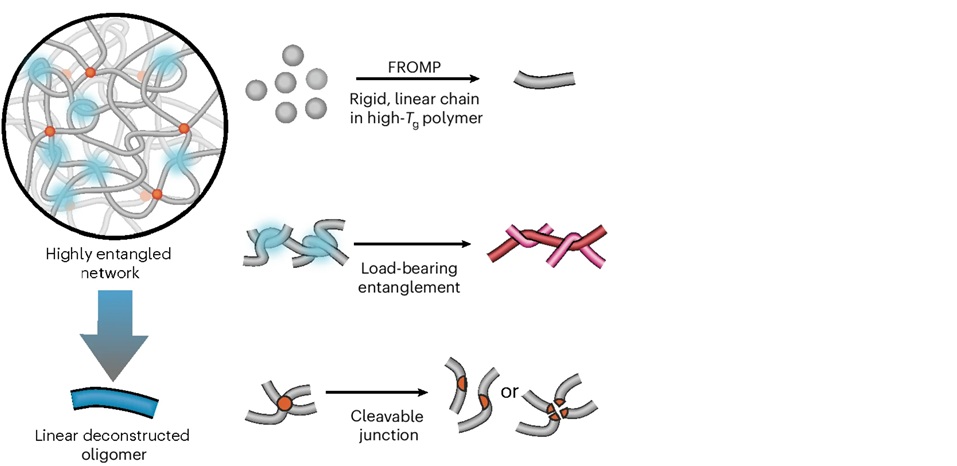
A regenerative thermoset based on this principle must satisfy several connected requirements. Its backbone must form long, rigid chains with enough entanglements to support substantial loads. A small junction population must suppress terminal flow without replacing the entangled strands as the principal mechanical framework. Cleavage must return soluble linear oligomers rather than permanently branched fragments, and those oligomers must retain sufficient length, mobility and chemical functionality to enter a newly formed network. The regeneration process must also preserve these features through repeated cycles. In a recently published research paper in Nature Materials, Zhenchuang Xu, Edgar Mejia, Tyler Price, Ignacio Arretche, Shuyi Zhang, Ruishi Lei, Valerie Chen, Hannah Liu, Shaofeng Huang, Boran Chen, Sameh Tawfick, Jeremiah Johnson, Nancy Sottos and Jeffrey Moore from the University of Illinois at Urbana-Champaign and the Massachusetts Institute of Technology examined whether glassy, high-temperature thermosets could be redesigned around this separation of roles: entangled chains carrying load and sparse, selectively cleavable junctions maintaining network connectivity.
The researchers first identified linear polymers capable of forming dense entanglement networks without chemical crosslinking. Solvent-free frontal ring-opening metathesis polymerization allowed them to generate the very long chains required for this purpose. Although both candidate monomers produced glassy polymers with high transition temperatures, their behaviour above the glass transition was quite different. Poly(methyl-oxybenzonorbornadiene) softened and began to flow, whereas p(exo-H₂DCPD) maintained a broad rubbery plateau, indicating that its long chains remained strongly constrained by entanglements.
Changing the molecular mass clarified the role of chain length. Shorter chains did not greatly alter the glass transition temperature, but they weakened and narrowed the rubbery plateau. The onset of segmental motion therefore remained similar, while the ability of the polymer to sustain an entangled network at higher temperatures declined. Stereochemistry offered another way to strengthen this response. The endo-enriched H₂DCPD polymer formed a slightly denser entanglement network and showed rubbery behaviour close to that of its chemically crosslinked counterpart over a substantial temperature range.
The authors performed creep testing which showed how strongly these physical constraints affected long-time deformation. The endo polymer resisted flow and recovered most of the applied strain, even though it contained no permanent crosslinks. Longer exo-H₂DCPD chains also produced much greater resistance to creep and better recovery than shorter chains. Dense entanglement did not prevent flow indefinitely, but it allowed the uncrosslinked polymers to behave much more like thermosets within the conditions examined. They also found same architecture improved resistance to fracture. The H₂DCPD polymers matched the stiffness of the crosslinked pDCPD thermoset, yet they could stretch much further before breaking and developed clear strain hardening at large deformation. Their fracture toughness was also comparable to, or greater than, that of the conventional thermoset. These results established that long, densely entangled chains could provide stiffness, toughness and creep resistance without relying on a densely crosslinked network.
The team observed at a recovered-oligomer content of 20 wt%, increasing oligomer length raised the glass transition temperature, strengthened the rubbery plateau and increased both the equilibrium modulus and the relaxing component of the modulus at 180 °C. These responses were consistent with greater chain friction and a larger population of mechanically effective entanglements. Room-temperature tensile properties remained similar at this loading because the network was largely frozen on the measurement timescale.
The investigators also noted differences became more pronounced as the recovered fraction increased and for instance at 30 wt%, networks containing 3.2 kDa oligomers fractured shortly after yielding, whereas those containing 8.5 kDa oligomers sustained extensive deformation. At 40 wt%, 14.5 kDa oligomers preserved ductility without terminal reactivation, but shorter 8.5 kDa chains required norbornene end-functionalization to recover substantial elongation. The governing condition was therefore not recovered content alone. Mechanical performance depended on whether the oligomers were long enough to form load-bearing entanglements and sufficiently integrated into the surrounding network. Oxidative stability imposed another molecular constraint. H₂DCPD-derived oligomers remained soluble and showed no detectable oxidation after ageing in air at 80 °C, unlike corresponding DCPD oligomers, which discoloured, oxidized and became insoluble. Within the more stable H₂DCPD system, networks containing 30 wt% reactivated oligomers retained essentially unchanged glass transition temperature, rubbery modulus, stiffness, strength and elongation through six generations. Their molecular-mass distributions also remained consistent after repeated deconstruction. The approach extended to an NBCPD-based thermoset with a glass transition temperature above 200 °C, although the rigid recovered oligomers became difficult to incorporate at the highest tested loading. This result places regeneration within a clear physical framework: cleavage chemistry permits recovery, but oligomer solubility, chain mobility and entanglement capacity determine how much recovered material can be used without altering mechanical response. The same architecture functioned in carbon-fibre composites and direct-ink-written structures. Composite deconstruction released soluble oligomers and intact carbon fibres that were reused in a second-generation material. Recovered oligomers also adjusted resin viscosity and shear-thinning behaviour, allowing printed structures containing up to 30 wt% recovered material while retaining frontal curing and shape fidelity.


Reference
Xu, Z., Mejia, E.B., Price, T.C. et al. Chain entanglements enable regeneration of high-performance thermosets. Nature Materials . (2026).