 Advances in Engineering Advances in Engineering features breaking research judged by Advances in Engineering advisory team to be of key importance in the Engineering field. Papers are selected from over 10,000 published each week from most peer reviewed journals.

Coal ash content is an important indicator of coal quality, especially in flotation processes where it helps operators evaluate mineral separation and adjust processing conditions. Conventional laboratory methods provide reliable measurements but can take more than an hour, making them less suitable when rapid information is needed during coal preparation.
One alternative is to estimate ash content from the chemical composition of coal. X-ray fluorescence (XRF) spectroscopy can measure inorganic constituents directly in coal samples without requiring combustion. The resulting data include oxides associated with mineral matter, such as silicon dioxide (SiO₂), aluminum oxide (Al₂O₃), calcium oxide (CaO), and iron oxide (Fe₂O₃). Machine learning can use the information to estimate ash content, although the choice of input variables has a considerable influence on model performance.
Selecting the most informative oxides can be difficult because the mineral composition of coal varies between samples. Some constituents are strongly associated with ash content, but these relationships are not always linear, and interactions between different components can affect their apparent importance. A variable that contributes substantially to one model may receive a different ranking in another. Including less informative inputs can also increase computational complexity without improving the estimates.
The limited amount of experimental data adds another challenge. Coal composition datasets often contain relatively few samples, and missing measurements can affect the accuracy of machine learning models. Estimating these missing values can improve the quality of the data, but the original relationships between chemical constituents need to be preserved. Another challenge is determining which oxides have the greatest influence on ash prediction and their importance can vary depending on the machine learning method used.
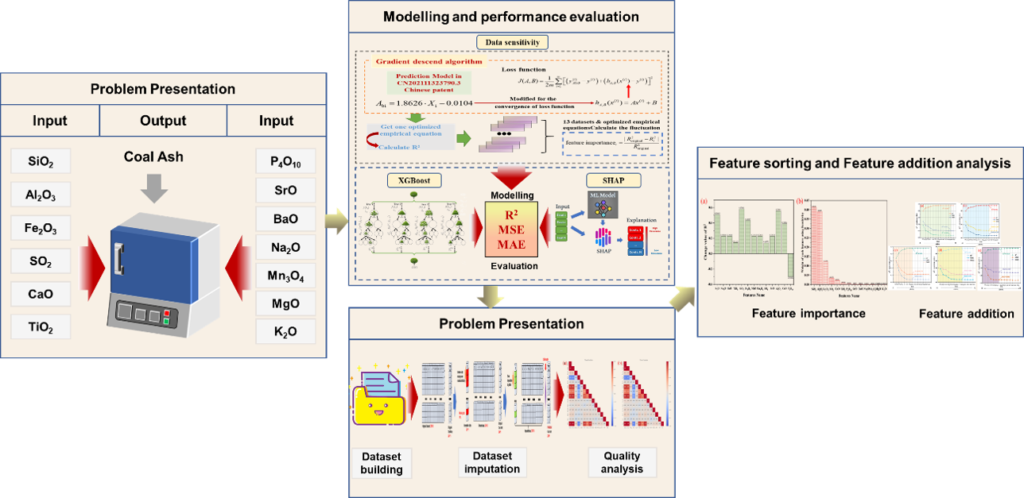
In a recent research paper published in Fuel, Dr. Ning Han, Dr. Yifei Li, Dr. Zhiyuan Zhang, Dr. Jiabao Gong, and Professor Yanfeng Li from China University of Mining and Technology developed a data sensitivity method to determine which coal oxides contribute most to ash estimation. Their approach combines generative adversarial networks (GANs) to reconstruct missing values with gradient descent to optimize an empirical equation. By introducing controlled changes to individual variables, they investigated how the resulting differences affected prediction accuracy.
Experiments and Findings
The investigation used 234 fine coal samples obtained from Datun Coal Power Group. XRF spectroscopy provided measurements of 13 oxide-related variables, which were analyzed alongside the experimentally determined ash content. An Extreme Gradient Boosting (XGBoost) model was initially trained using these data and showed strong agreement between estimated and measured values. This established a reference for examining the effects of changes to the input information.
The first part of the investigation focused on data reconstruction. The researchers compared three methods: GANs, multiple imputation, and random forest imputation. A GAN consists of two neural networks trained against one another. One generates synthetic data, and the other attempts to distinguish these values from actual observations. Through repeated training, the generator learns to reproduce patterns found in the experimental dataset.
The team assessed performance at different levels of missing data. GAN-based reconstruction generally provided the best balance of accuracy and stability, with a 10% missing-data rate selected for the subsequent analysis. The reconstructed dataset also retained the strong correlations between major oxides and ash content, especially for SiO₂ and Al₂O₃. The close agreement with the original measurements indicated that the statistical structure of the data was largely preserved.
The influence of each oxide was then evaluated separately. For this purpose, the researchers created a series of modified datasets by randomly removing 10% of the values for one variable at a time. After reconstructing the missing entries using the GAN, they applied the previously trained XGBoost model to obtain new ash estimates. Differences in the model outputs provided the information needed for the sensitivity assessment.
They used gradient descent to refine an existing empirical equation for calculating ash content. The algorithm progressively adjusted its coefficients to reduce errors between calculated and experimental values. The original equation had an R² of 0.3214, which indicates limited agreement with the measured data. Optimization improved its performance, and the adjusted equation was incorporated into the procedure for assigning importance values to the individual oxides.
Silicon dioxide and aluminum oxide emerged as the most influential constituents, followed by iron oxide, SO₂, and calcium oxide. The prominence of SiO₂ was consistent with the mineral composition of coal, where quartz and other silicates contribute substantially to the inorganic residue remaining after combustion. Aluminum-containing minerals also contribute to ash formation, helping explain the strong association between Al₂O₃ and the measured ash content.
To examine the reliability of the resulting rankings, the team compared their method with four established approaches: XGBoost, SHAP, random forest, and a multilayer perceptron neural network. All identified SiO₂ and Al₂O₃ as important, although their assessments of the other constituents differed. For example, XGBoost placed Al₂O₃ and Fe₂O₃ ahead of SiO₂. The data sensitivity method ranked SiO₂ first and assigned greater importance to SO₂ than several of the alternative approaches.
The researchers also tested how these rankings affected predictive performance by progressively adding variables to an XGBoost model in order of importance. Accuracy improved as more chemical information was included, but the gains became smaller after the most influential oxides had been incorporated. Using all 13 variables, the sensitivity-based approach achieved an R² of 0.9687. They also noticed it performed best when the accuracy obtained from progressively larger groups of inputs was compared across the five methods.
Engineering Significance
The research study by Professor Yanfeng Li and colleagues provides a way to assess the influence of chemical constituents by examining how changes in the available data affect model performance. This differs from approaches that derive feature importance primarily from the internal calculations of a trained algorithm. It offers an additional means of interpreting coal composition data, particularly when several constituents are strongly correlated.
Such correlations can make it difficult to separate the contributions of individual oxides. When two variables contain similar information, a prediction model may assign greater weight to one and less to the other. Examining the response to controlled changes helps clarify their relative influence and provides another basis for deciding which inputs are useful.
The comparison of feature rankings also has implications for developing more efficient coal quality models. Much of the information needed to estimate ash content was associated with a relatively small group of oxides, and adding lower-ranked variables produced diminishing improvements. This provides a basis for selecting chemical inputs according to their demonstrated contribution rather than including every available measurement.
Another useful aspect of the new method is its integration of data reconstruction with the refinement of an empirical equation. The approach of China University of Mining and Technology scientists connects changes in the chemical dataset with measurable differences in predictive performance, providing a quantitative basis for feature selection. It can support the development of coal ash estimation models using available experimental information.
The authors also identify opportunities to investigate how variations in raw material quality and environmental conditions influence data sensitivity. Extending the analysis to datasets representing a wider range of conditions could help establish how the identified chemical relationships vary between coal sources and operating environments.


Reference
Ning Han, Yifei Li, Zhiyuan Zhang, Jiabao Gong, Yanfeng Li, Based on generative adversarial networks combined with gradient descent-A new method for evaluating the importance of coal oxide characteristics, Fuel, Volume 410, 2026, 137947,