Advances in Engineering Advances in Engineering features breaking research judged by Advances in Engineering advisory team to be of key importance in the Engineering field. Papers are selected from over 10,000 published each week from most peer reviewed journals.

Significance
Today, environmental pollution has become a great threat to humanity. Environmental contaminants consist of both inorganic and organic substances. They exist in different states and properties that determine the removal methods. Therefore, the need to develop efficient methods to decontaminate the environment has attracted the attention of many researchers. To this note, sorption methods have been identified as potential solutions.
However, in the past decade, natural sorbents have been the main focus. For instance, sheep wool contains active sites that enhance its capabilities to sorb other substances. It is a keratin protein-based animal fibrous material. Several modifications such as physical, chemical and combined methods can be used to enhance the sorption properties of native wools. Chemical treatment introduces new functional groups that change the chemical structure of the wool. Chemical treatment procedures are generally environmental unfriendly due to the waste waters production necessarily. As such, irradiation of sheep wool with accelerated electron beam has been identified as a better alternative due to its tremendous advantages such as non-waste enhancement of the sorption active points. However, till this time little have been reported about the effects of the electron beam on wool.
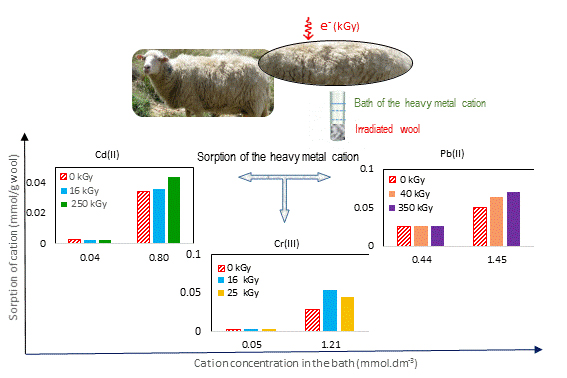
Researchers at Constantine the Philosopher University -Department of Chemistry in Nitra: Dr. Zuzana Hanzlíková, Dr. Jana Braniša, Professor Klaudia Jomová and Assistant Professor Mária Porubská in collaboration with Dr. Marko Fülöp and Dr. Peter Hybler at Slovak Medical University investigated the influence of irradiation of sheep wool by the accelerated electron beam on its structural variation and sorption properties. The sorption properties characteristics were examined after half-year of exposure through heavy metals including chromium(III), cadmium(II) and lead(II). Also, they investigated the effects of the sorption capacity of the irradiated sheep wool on the ion concentrations for all the samples. Eventually, they compared the sorption capacities of irradiated wool and non-irradiated ones. Their work is published in the journal, Separation and Purification Technology.
The authors observed a significant increase in the sorption capacity of chromium(III) of the irradiated wool samples than the non-irradiated sample up to 3.13 times more. This was attributed to the disruption of keratin disulphide bridges and oxidation of the related radicals up to cysteic acid. Consequently, they noted that the sorption capacity of both the irradiated wool and non-irradiated ones were almost equal up to a concentration level of 0.4 mmol.dm-3 for all the tested samples. However, beyond the above concentration, the sorption capacity of the irradiated wool increased significantly as compared to the non-irradiated wool. But the increase varied from one metal to another with Pb(II) and Cr(III) recording the highest and lowest reading respectively.
The study presents a more effective wool modifying technique using the electron beam irradiation. It is an inexpensive, renewable and environmental friendly that does not require the use of chemicals thus any resultant by-products. The residual humidity in the irradiated wool as a rich source of oxygen enhanced the sorption properties due to the quick formation of the cysteic acid resulting from the rapid S-oxidized species generation. Thus, it is a promising sorbent for the removal of various materials that can also be used in decontamination of the environment.




Reference
Hanzlíková, Z., Braniša, J., Jomová, K., Fülöp, M., Hybler, P., & Porubská, M. (2018). Electron beam irradiated sheep wool – Prospective sorbent for heavy metals in wastewater. Separation and Purification Technology, 193, 345-350.
Go To Separation and Purification Technology