 Advances in Engineering Advances in Engineering features breaking research judged by Advances in Engineering advisory team to be of key importance in the Engineering field. Papers are selected from over 10,000 published each week from most peer reviewed journals.

Significance Statement
Long-range interactions have been shown to influence adsorbate arrangements leading to subtle changes in energy. They play a vital role in quantitative description of reaction dynamics, stabilization of adsorbate superlattices and anomalous low prefactors determined from growth studies. They are also of importance to intermediate coverage as they cause a change in diffusion energy which decreases with increasing adsorbate separation and oscillates with half of the Fermi wavelength of the surface state.
Experimental studies conducted in determining the strength of long-range interaction for metallic and molecular adsorbates on several metallic fcc(111) surfaces using scanning tunneling microscopy has resulted to oscillatory distributions interpreted in terms of interaction between adsorbates pair only.
However, it has been suggested by He-spin echo measurements that pairwise interaction alone is not sufficient enough for long-range interactions full picture. Also fit at small adsorbates distances is less satisfactory than those at larger distances for all published scanning tunneling microscopy data, hence importance of high order term in the long-range interaction between adsorbates needs to be established.
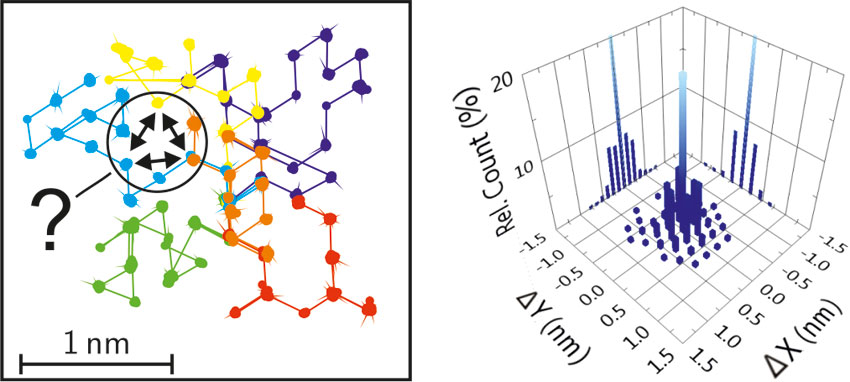
Dr. Christopher Zaum from the University of Hannover and Professor Karina Morgenstern from Ruhr-Universität Bochum investigated diffusion of carbon monoxide molecules on Cu(111) using time-lapsed scanning tunneling microscopy at a temperature range from 30 to 38 K. They could follow the motion of the same set of molecules for extended periods of times up to days in real space. They provided an evidence for the surface state mediated trio interaction between three adsorbates. The work is published in peer-reviewed journal, Nanoletters.
The authors performed the measurements with a home-built low-temperature scanning tunneling microscope in an ultrahigh-vacuum. After cleaning of Cu(111) by standard sputtering and annealing cycles, 0.005ML of carbon monoxide was deposited on the sample at 22K before being transferred into the scanning tunneling microscopy where measurements were performed between 30 and 38K.
The authors’ findings are applicable for all two-dimensional oscillatory long-range interactions that influence diffusion barriers and all molecules that scatter the surface state electrons. The research team hope results obtained in diffusion state can be extended to reaction and nucleation.

Journal Reference
Christopher Zaum1, Karina Morgenstern2. Experimental Evidence for a Three-Body Interaction between Diffusing CO Molecules, Nano Lett., 2016, 16 (5), pp 3001–3004.
[expand title=”Show Affiliations”]
- Leibniz Universität Hannover, Institut für Festkörperphysik, Appelstr. 2, D-30167 Hannover, Germany
- Ruhr-Universität Bochum, Lehrstuhl für Physikalische Chemie I, Universitätsstr. 150, D-44801 Bochum, Germany
[/expand]
Go To Nano Lett