 Advances in Engineering Advances in Engineering features breaking research judged by Advances in Engineering advisory team to be of key importance in the Engineering field. Papers are selected from over 10,000 published each week from most peer reviewed journals.

Significance
The recent discovery of high transition temperature in single-layer FeSe has paved the way for further research and analysis of Fe-based semiconductors. In most cases, these superconductors have multiple Fermi surfaces in the Brillouin zone that poses a great challenge in the identification of the sample density of states as well as explain the tunneling conductance line shape obtained through the scanning tunneling spectroscopy. Among the available tools for obtaining information on superconductors, scanning tunneling spectroscopy and angle-resolved photoemission spectroscopy are very prevalent. However, the proposed superconducting gaps produced by these two methods differ significantly as observe in both cuprate and Fe-based superconductors.
Despite being s-wave superconductor, the absence of s-wave density of states in the tunneling conductance have also attracted significant research attention. Additionally, effective theoretical treatment is required to combat the tunneling dynamics initiated by the strong on-site Coulomb repulsion. Therefore, the development of an effective solution approach to the aforementioned challenges is highly desirable.
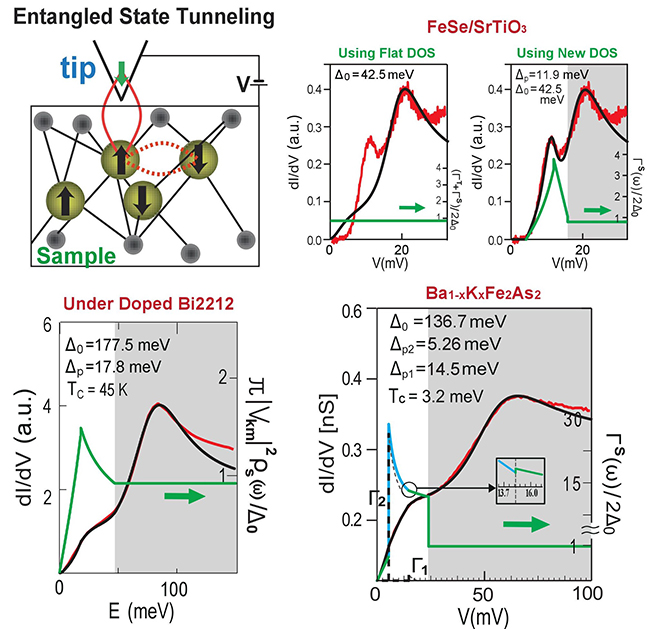
To this note, Professor Jongbae Hong from the Incheon National University, Research Institute of Basic Sciences analyzed the scanning tunneling spectroscopy for Fe-based superconductors. The sample density of states was explicitly obtained from existing scanning tunneling spectroscopy data after determining the contributions of different Fermi surfaces. In particular, the author explored Ba1-xKxFe2As2 and single-layer FeSe/scanning tunneling spectroscopy. The two data sets obtained from each of the materials were analyzed and compared to each other. The findings were further used in understanding the nature of the Fe-based superconductors. The research work is currently published in the journal, Journal of Physics: Condensed Matter.
The author confirmed that the interpretation of tunneling conductance that is assumed to be the sample density of states is indeed valid for materials without correlation effects. The obtained sample density of states extracted from the scanning tunneling spectroscopy was composed of two ordinally s-wave types. This data was noted to be consistent with the corresponding data from the angle-resolved photoemission spectroscopy. For a scanning tunneling spectroscopy of a correlated system where both the tip and sample are found within the coherent region, entangled state tunneling was adopted. This was explained through the construction of three different coherent processes; one consisting of two singlet co-tunneling, one with two spin-exchange resembling the Kondo coupling and the last one comprising of a spin-exchange and singlet co-tunneling.
Based on the Liouville approach that involved the determination of the complete set of operators, the ordinary s-wave density of states of the Fe-based superconductor Ba1-xKxFe2As2 was successfully extracted. Furthermore, the author observed that the major peak of the tunneling conductance was not related to the density of states but instead it depended on the effect of nonequilibrium coherent tunneling that comprised of the coherent spins in both the sample and the tip.
On the other hand, it was worth noting that since the sample density of states of a correlated superconductor was not prevalent in the scanning tunneling spectroscopy line shape, it would be more effective to develop a theoretical formula based on the tunneling conductance and the sample density of states to efficiently obtain the sample density of states from the tunneling data. The study by Professor Jongbae Hong provides insights that will pioneer further research on the Fe-based superconductors.

Reference
Hong, J. (2019). Analyzing scanning tunneling spectroscopy for Fe-based superconductors and extracting sample density of states. Journal of Physics: Condensed Matter, 31(37), 375602.
Go To Journal of Physics: Condensed Matter