Advances in Engineering Advances in Engineering features breaking research judged by Advances in Engineering advisory team to be of key importance in the Engineering field. Papers are selected from over 10,000 published each week from most peer reviewed journals.

Significance
Following recent developments and implementation of ultramicroelectrodes, tremendous advances have been achieved in electrochemical science over the last four decades. Ultramicroelectrodes are defined by having an active dimension on the micrometer size scale.
Their small size makes them extremely versatile for mechanistic and analytical electrochemical studies. The small size leads to a non-planar, convergent type mass-transport process, producing steady-state, time-independent, current compared to that of semi-infinite planar diffusion (linear diffusion) in conventional-sized electrodes. Another advantage of the small size is that the electrode capacitance is reduced, a change that allows variation in the potential of the ultramicroelectrodes on a sub-microsecond time scale – thereby making ultramicroelectrodes suitable devices to investigate fast heterogeneous kinetics.
Overall, the great success of ultramicroelectrodes has inevitably led to commercialization by several companies that specialize in electrochemical apparatus. However, the high cost and small selection of diameters of commercial electrodes still present significant limitation in their adoption.
In this view, Dr. Hadi Khani a research associate at the University of Texas at Austin, Texas, and Professor David Wipf at the Mississippi State University, Mississippi developed a facile method to easily construct nanometer and micrometer size electrodes and pH ultramicroelectrodes. Their study was motivated by a desire to develop a simple, inexpensive, and reproducible laboratory-based method capable of producing many ultramicroelectrodes. These carbon-fiber based ultramicroelectrodes can be used in voltammetric, amperometric, and potentiometric (pH) techniques. Their work is currently published in Journal of The Electrochemical Society.
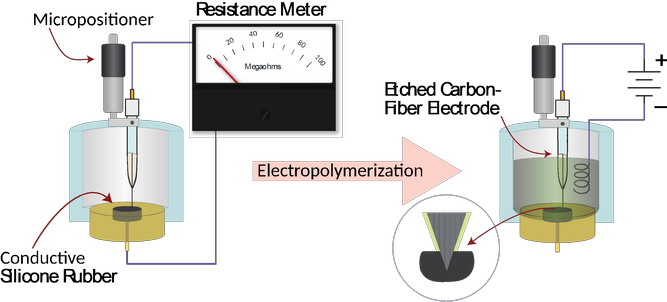
The key to the method is the so-called “tip-protection method”. Construction of the ultramicroelectrodes proceeded by epoxy-sealing a 7-micrometer diameter carbon-fiber filament within a pulled-glass capillary, electrochemical etching of the protruding carbon fiber into a conical tip, and insulating the protruding fiber by electropolymerized poly(oxyphenylene) while the conical tip was protected within a conductive silicon rubber membrane. The conductive rubber provides a sensitive detection of how deep the tip is embedded, a critical aspect of reproducibility.
“We had previously tried the tip-protection method using other polymers, even hot-melt glue, but it was difficult to reliably make the small tips we desired.” said Professor David O. Wipf in a statement to Advances in Engineering. “One day, I saw an advertisement for conductive rubber and I knew we had the solution to our problem”
Next, the carbon fiber ultramicroelectrodes were characterized by cyclic voltammetry and successfully employed as an amperometric scanning electrochemical microscopy tip to analyze the species that are chemically or electrochemically generated at the substrate of interest. The tips are also easily modified into pH sensitive electrodes by electrochemically depositing a thin film of iridium oxide on their surface.
The carbon fiber ultramicroelectrodes were reproducibly constructed with a tip radius of less than one micrometer. Additionally, the prepared carbon fiber ultramicroelectrodes were successfully used as a scanning electrochemical microscopy tip to examine the “crystal structure orientation-OER electrocatalytic activity” relationship of iridium/iridium oxide catalysts. Pleasingly, the scanning electrochemical microscopy results demonstrated that iridium oxide-coated Ir (001) crystallite had a higher catalytic activity toward oxygen evolution reaction compared to that grown on Ir (111) plane.
Overall, a facile, reliable, cost effective, and high-yield procedure to construct ultramicroelectrodes and pH ultramicroelectrodes for electrochemistry studies at small scales was presented. Basically, a new approach to protect the tip of an etched-carbon fiber during electro-polymerization of an insulating coating was fabricated. Altogether, Khani-Wipf designed pH ultramicroelectrode tips will be well-suited for scanning electrochemical microscopy studies requiring high-resolution pH imaging.



Reference
Hadi Khani, David O. Wipf. Fabrication of Tip-Protected Polymer-Coated Carbon-Fiber Ultramicroelectrodes and pH Ultramicroelectrodes. Journal of The Electrochemical Society, volume 166 (8), page B673-B679 (2019).
Go To Journal of The Electrochemical Society