Advances in Engineering Advances in Engineering features breaking research judged by Advances in Engineering advisory team to be of key importance in the Engineering field. Papers are selected from over 10,000 published each week from most peer reviewed journals.

Significance
Often, when laboratory-sized processes are to be scaled up for industrial purposes, high performance often meets the challenges of material purity and microstructure homogeneity due to reaction dynamics. Consequently, the extremely intricate processes for fabricating the desired target materials usually become a time-consuming affair which is a bad premise for any industry. Case and point, the peritectic reaction of skutterudite-based thermoelectric materials. Immense efforts have been put into this issue over the past 20 years; where as a result, the ZT values for the n-type and p-type have gone up to 1.7 and 1.06, respectively. Additionally, great progress has been reported in skutterudite-based TE device technology. Normally, filled skutterudite materials are fabricated through annealing, melting and sintering processes. Each of these processes has its pros and cons. Over the years, it has been seen that the volatilization of elemental antimony and the complex equipment required for the commonly utilized melting spinning method still limit its practical application in industry. Therefore, it is imperative that a novel synthesis method suitable for industrial-level massive fabrication of skutterudite thermoelectric materials be developed.
Recently, a team of researchers led by Professor Lidong Chen from the State Key Laboratory of High-Performance Ceramics and Superfine Microstructure, Shanghai Institute of Ceramics, Chinese Academy of Sciences developed a rapid fabrication technique that combined scanning laser melting and spark plasma sintering to synthesize bulk n-type and p-type filled skutterudites. Specifically, they purposed to adopt the scanning laser melting method to inhibit the peritectic segregation of Cobalt-Antimony precursor phases. Their work is currently published in the research journal, Journal of Materials Chemistry A.
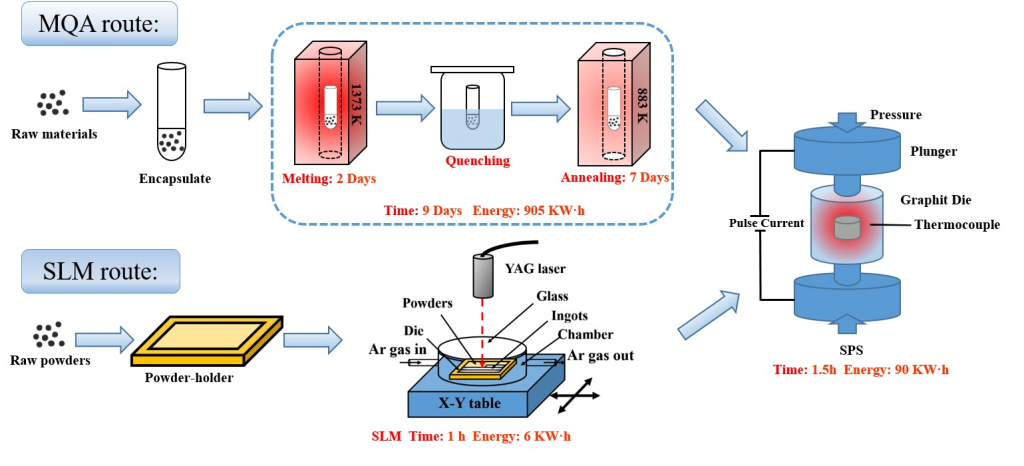
In brief, the research method employed entailed the utilization of scanning laser melting and spark plasma sintering processes for the fabrication of unfilled cobalt tri-antimonide skutterudite and a series of filled skutterudites. Powder samples of various substances were prepared and placed in a chamber filled with argon flowing gas. Subsequently, the powder layer was melted using a laser beam. Lastly, they characterized the thermoelectric properties of the samples, after a series of investigations involving scanning electron microscopy, powder X-ray diffraction and energy dispersive spectrometry among others.
The authors observed that owing to the reduced peritectic segregation size of precursor resultants, the solid reaction could be accomplished by annealing in only 6 minutes by either spark plasma sintering or HP process. Moreover, they noted that as a consequence of reducing the annealing time, the fabrication period for a batch of samples was significantly reduced from 9 days, when using the conventional method, to less than 1 hour.
In summary, their study presented the successful synthesis of high-performance n-type and p-type filled skutterudites using a rapid processing method that combined scanning laser melting and spark plasma sintering. Altogether Professor Lidong Chen and the research team revealed that a combination of the two techniques had great advantages in terms of cost effectiveness and low fabrication durations, and therefore is expected to be applied to large-scale fabrication of filled skutterudites and other thermoelectric materials.


Reference
Fan Chen, Ruiheng Liu, Zheng Yao, Yunfei Xing, Shengqiang Bai, Lidong Chen. Scanning laser melting for rapid and massive fabrication of filled skutterudites with high thermoelectric performance. Journal of Materials Chemistry A, 2018, volume 6, page 6772.
Go To Journal of Materials Chemistry A