Advances in Engineering Advances in Engineering features breaking research judged by Advances in Engineering advisory team to be of key importance in the Engineering field. Papers are selected from over 10,000 published each week from most peer reviewed journals.

Significance Statement
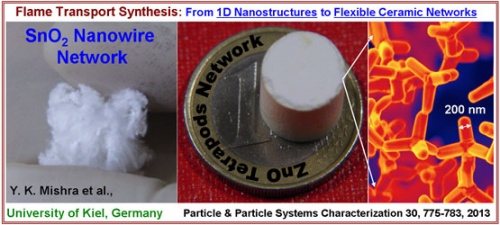
Three dimensional (3D), porous, mechanically flexible, electrically conducting, high temperature stable and light-weight ceramic materials are potential candidates for various important applications ranging from biomedical engineering to space technologies. Y. K. Mishra* and co-workers have recently introduced a simple and novel flame transport synthesis (FTS) technique (Particle & Particle Systems Characterization 30, 2013, 775-783) which enables versatile fabrication of different metal oxide nano-microstructures and their three dimensional macroscopic interconnected networks in a very cost-effective manner. These highly porous networks built from interconnected nano-microstructures on one hand exhibit the nanoscale physical and chemical properties from metal oxides nanostructures and on the other hand they are very easy to handle because of macroscopic dimensions. 3D networks with desired porosities (up to 99%) can be easily fabricated by varying the density and accordingly their elastic modulus can be tailored in rubber elastic regime i.e., from sub-kPa to several MPa. Depending upon the requirement, desired sizes and shapes of 3D networks with appropriate porosities are easily possible by this flame transport synthesis technique for various applications. FTS method and it’s variant offer versatile synthesis of metal oxide structures in various forms ranging from 1D nanostructures to macroscopic 3D interconnected networks. ZnO nano-microstructures grown by flame transport synthesis approach have already shown promising antiviral applications against herpes simplex viruses type 1 and 2 (Antiviral Research 92, 2011, 305-312 & Antiviral Research 96, 2012, 363-375) and exhibit low level of cytotoxicity (PLoS ONE 9, 2014, e84983). ZnO tetrapod structures have found potential utilizations in the directions of joining the un-joinable polymers (Advanced Materials 24, 2012, 5676-5680) and designing the self-reporting composites (Advanced Materials 25, 2013, 1342-1347) including several others. Using burner approach of flame transport synthesis, a ZnO tetrapods network based UV photodetector has been recently fabricated which demonstrated very fast photodetection response (Advanced Materials 26, 2014, 1541-1550). The 3D interconnected ZnO tetrapod networks were utilized to grow a carbon based material known as AEROGRAPHITE (Advanced Materials 24, 2012, 3486-3490) which was having world record for the lowest density materials in the year 2012 and still one of the least dense materials. Several applications of metal oxide nano-microstructure and their interconnected networks prepared by flame transport synthesis approach are under progress. Flame transport synthesis technique and it approach are described in the Particle & Particle Systems Characterization article (DOI: 10.1002/ppsc.201300197) at the following link
For more details, please contact Dr. Yogendra Kumar Mishra ([email protected]) / Prof. Dr. Rainer Adelung ([email protected]) at University of Kiel, Kiel, Germany.
Journal Reference
Particle & Particle Systems Characterization, Volume 30, Issue 9, pages 775–783, 2013.
Yogendra K. Mishra, Soren Kaps, Arnim Schuchardt, Ingo Paulowicz, Xin Jin, Dawit Gedamu, Stefan Freitag, Maria Claus, Sebastian Wille, Alexander Kovalev, Stanislav N. Gorb, Rainer Adelung.
Institute for Materials Science, Functional Nanomaterials, University of Kiel, Kiel, Germany and
Universitätsklinikum Schleswig-Holstein – Campus Kiel, Klinik für Zahnärztliche Prothetik, Propädeutik und Werkstoffkunde, Kiel, Germany and
Functional Morphology and Biomechanics, Department of Zoology, University of Kiel, Kiel, Germany
Abstract
Flexible, electrically conducting, high temperature stable ceramics with very high porosities are fabricated from interpenetrated metal oxide nano-microstructures in a versatile manner in a novel flame transport synthesis approach. The Young’s modulus of these networks can be tuned from wool type to rubber like based on the density, type and interconnections of the building blocks. Semiconducting behavior allows multifunctional applications like the electrical readout of the mechanical history.
© 2013 WILEY-VCH Verlag GmbH & Co. KGaA, Weinheim