Advances in Engineering Advances in Engineering features breaking research judged by Advances in Engineering advisory team to be of key importance in the Engineering field. Papers are selected from over 10,000 published each week from most peer reviewed journals.

Significance Statement
Compositional gradient materials are polymers materials with a continuous composition gradient along their dimensions in which their gradients provide outstanding mechanical or chemical properties such as controlled damping, wear resistance and electrical properties. Standard process of manufacturing compositional gradient material is either material science or 3D printing.
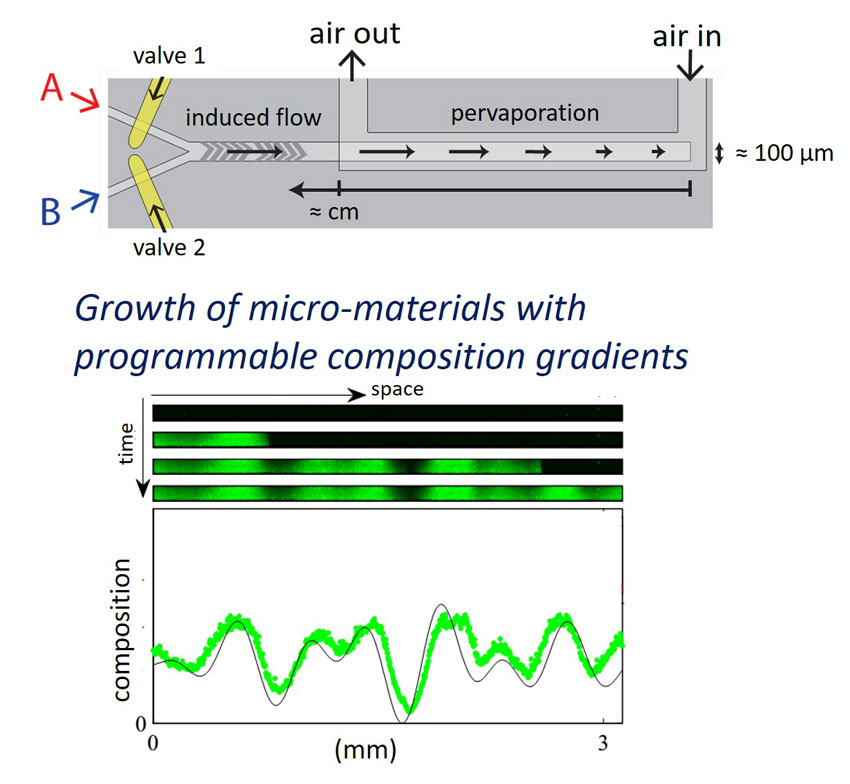
Researchers led by Dr. Jean-Baptiste Salmon from the joint laboratory LOF between Solvay, CNRS and University of Bordeaux (Pessac, France) produced a combination of microfluidic pervaporation and use of monolithic micro-fabricated valves commonly known as quake valves to make compositional gradient micro-materials (CG μMs) with gradients along their longest dimension (1cm). ) The study is published in Lab Chip,
Considerably fewer techniques were developed to fabricate compositional gradient micro-materials. The most promising method of fabricating compositional gradient micro-materials is microfluidics as it appears to be an excellent control of transport phenomena provided at small scale. The techniques approached by researchers to fabricate compositional gradient micro-materials were photo- or thermal-cross-linkable pre-polymers with gradients of different components ranging from molecules to cells in which their ingenious micro-fluidic platform uses control of hydrodynamic dispersion at small scales to obtain gradients using alternating flows in microfluidic channels. Other techniques used by researchers are fabrication of multi-gradient hydrogels layer-by-layer which opens the way of fascinating investigation of cell behaviors with tailored 3D microenvironments, generating gradients in pore-polymer solutions micro-flowing in specific networks of micro-channels followed by in situ photo-polymerization to freeze the gradient.
Microfluidic pervaporation, a mature technique used to grow microscale materials with precise shape imparted by microfluidic mold (10 x 100μm2) obtains dense assemblies of nanoparticles starting from dilute dispersions and composites starting from polymer solutions opening the way to applications ranging from optical meta-materials to organic electronics.
In their study, the authors considered multilayer soft lithography in combination of both use of quake valve and pervaporation within the same chip. The device used is a two layer poly (dimethylsiloxane) PDMS system sealed by glass side previously coated by a thin poly (dimethylsiloxane) layer. Pervaporation continuously pumps solvent from fluidic reservoirs of aqueous dilute solutions from tubes inserted into poly (dimethylsiloxane) up to the tip of channel at flow rate of 3-4nLmin-1. Within the upper layer of the chip, two dead ends channels filled with inert oil were used to deform the poly(dimethylsiloxane) membrane and thus closes the fluidic inlets underneath using computer-controlled pressure sources PA and PB.
Laval et al. (2016) fabricated the microfluidic devices using multilayer soft lithography techniques, quake valves were actuated using solenoid valves operating at a pressure of 1bar with closure pressure of manufactured valves at 600mbar. Aqueous solutions and dispersions were used to fully illustrate the opportunities offered by the technique to make gradients within materials ranging from packed beds of colloids to polymer extended images (12mmx150μm) using inverted microscope coupled to a motorized stage synchronizer with an image acquisition device used to observe the growth of materials within the whole channel at a high spatial resolution coupled with fluorescent profiles.
Results from fluorescent profile display superimposed with pressure signal PA(t) and PB(t) indicated perfect agreement between actuation of the valves and composition along materials suggesting that fabrication of a barcode is rather straight forward with such materials.
With values actuated at a frequency of 1/т= 0.25Hz, result showed final material superimposed with r(t) which has been re-scaled along the x-axis follows a given temporal modulation generated using control software which shows good agreement between temporal modulations r(t) and fluorescent profile demonstrating that continuous composition gradients can also be embedded within the colloidal structure. This regime enables growing material to be enriched with a dilute dispersion whose composition varies continuously with time along with temporal modulations r(t).
Results from gradients within polymer materials also demonstrated good agreement between spatial profile and the measured one demonstrating that programmable continuous gradients can also be embedded within materials which grow non-linearly along the channel.
Fluorescent images also showed similar result but with increasing frequency of spatial modulations of expected concentration gradients from 3 to 12 sinusoids over length LO12mm. Despite the exponential slowdown of growth, Laval et al. (2016) method makes it possible to correctly obtain expected gradients without any noticeable widening or narrowing of sinusoids along materials.
This technique provides innovative applications in realm of organic electronics micro-electro-mechanical system or even bioengineering.

Journal Reference
Laval, C. Bouchaudy, A. Salmon, J. Fabrication of Microscale Materials with Programmable composition gradients. Lab Chip, 2016, Volume 16, pp 1234-1242.
CNRS, Solvay, LOF, UMR 5258, Univ. Bordeaux, F-33600 Pessac, France. [email protected].
Go To Lab Chip