 Advances in Engineering Advances in Engineering features breaking research judged by Advances in Engineering advisory team to be of key importance in the Engineering field. Papers are selected from over 10,000 published each week from most peer reviewed journals.

Significance
Adequate and reliable supply of clean water is critical in enhancing public health and preventing potential threats of contracting infections. Unfortunately, nearly a third of the global population has no access to an adequate supply of clean water, according to a report by the United Nations. Additionally, many groundwater sources worldwide are contaminated with arsenic, and the long-term consumption of arsenic-contaminated water is detrimental to human health. Therefore, to ensure safe and clean drinking water, the World Health Organization, in collaboration with various policymakers, has imposed a maximum arsenic contamination level of 10 µg/L.
Different water treatment methods are widely used to purify water and remove toxic substances. Generally, arsenite in natural waters exists in two main forms, namely, arsenate [As(V)] and arsenite [As(III)]. Their distribution is highly dependent on the redox potential and water pH. Arsenate can be efficiently removed from water using various conventional water treatment methods such as ion exchange and coagulation. On the other hand, the removal of arsenite, which is neutral at typical pH values of natural waters, has remained a great challenge. This can be attributed to its hydrophilic properties and the lack of electrostatic interactions with absorbents. This means that when oxidized to arsenate, arsenite can be effectively adsorbed from water. However, oxidative treatments have inherent challenges, including their complexity and the production of toxic byproducts, that limit their practical application in the purification of drinking water.
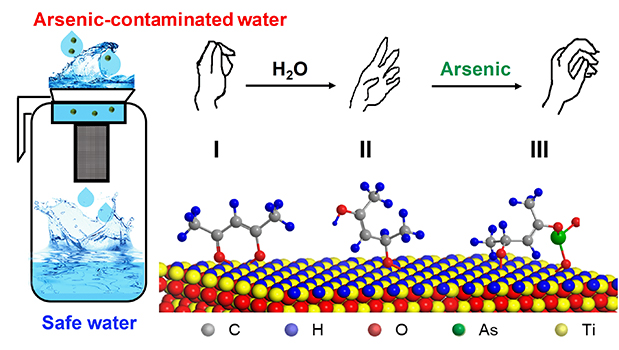
Decentralized systems based on the point of use treatment have been identified as a promising alternative to domestic water purification at the household level to address the limited water treatment infrastructure challenge. On this account, Nanjing University researchers: Mr. Chen Zhang, Professor Bingdang Wu, Professor Bingcai Pan and Professor Shujuan Zhang, together with Professor Joseph Pignatello from The Connecticut Agricultural Experiment Station, New Haven presented an efficient and feasible method for treating arsenic-contaminated groundwater without the need for any pre-treatments. In particular, they fabricated a titanium xerogel (TAX) and evaluated its arsenite removal ability. The original research article is currently published in the Chemical Engineering Journal.
In their approach, the TAX was fabricated via a classical sol-gel process. It comprises anchored acetylacetone molecules and several surface hydroxyl groups, that serve as arsenic capturing sites. Isothermal fixed-bed adsorption systems employing TAX were used to evaluate their performance in absorbing arsenite. The effects of humic substances and natural ions on arsenite adsorption were also investigated. Finally, the feasibility of the resultant TAX was evaluated by comparing its performance with two commercially available nanocomposites.
The authors observed that the fabricated xerogel exhibited high arsenic adsorption capacity over a wide pH range without the need for pe-treatment. At a pH of 7.0, adsorption of 306 mg/g arsenate and 254 mg/g arsenite were recorded. Compared with the commonly used metal and resin-based composites, TAX achieved ten times greater performance for removing arsenic in groundwater. A significant decrease in the bed arsenite concentration from 200 µg/L to less than 10 µg/L was archived in 6000-bed volumes. Adsorption rates can be enhanced by increasing the exposure surface. In addition, TAX successfully removed heavy metal ions from arsenic-contaminated groundwater and exhibited remarkable antibacterial activity towards Escherichia coli.
In summary, the development of a titanium xerogel method for the efficiently treating arsenic-contaminated groundwater without pre-treatments was reported. This approach addressed most of the challenges and limitations associated with oxidative treatments. Due to its remarkable performance and attributes, TAX is a promising adsorbent for the purification of arsenic-contaminated groundwater at the household level. According to the authors, the proposed new method is highly effective for use in arsenic-contaminated areas that lack adequate water treatment infrastructure.
Reference
Zhang, C., Wu, B., Pan, B., Zhang, S., & Pignatello, J. (2020). Deep removal of arsenite from water with no need for pre-oxidation or in-line oxidation. Chemical Engineering Journal, 401, 126046.
