Advances in Engineering Advances in Engineering features breaking research judged by Advances in Engineering advisory team to be of key importance in the Engineering field. Papers are selected from over 10,000 published each week from most peer reviewed journals.

Significance Statement
In order to increase energy efficiency from solar, scientists have discovered that photocatalytic conversion of carbon dioxide into useful hydrocarbons can definitely serve as an alternative source for the optimum derivation of energy while considering reduction of greenhouse gases impacts.
The technology involved in photocatalytic conversion can also be applied in production of hydrogen gas from water, removal and disinfection of contaminants from water, and extraction of polyaromatic hydrocarbons from crude oil amongst others. Despite those benefits, the existence of low energy efficiency, reduced chemical activity and low selectivity of catalyst coupled with its high cost remains a bane to the use of this technology.
Due to the fact that the photocatalytic conversion process depends on the functionality of catalyst to develop free radicals as a result of creating electron-hole pairs, certain metallic binary films in oxide form have shown improvement in photocatalytic conversion efficiency.
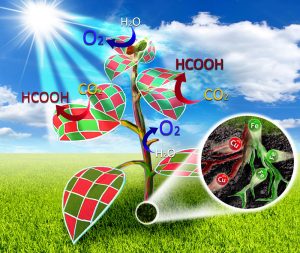
Professor Hyunwoong Park and his PhD student Unseock Kang at Kyungpook National University in South Korea published an article in Journal of Materials Chemistry A (Featured in the front cover position), where a synthesized photocatalyst CuFeO2/CuO composite was developed for the selective production of liquid formate from carbon dioxide under application of simulated solar light.
Following the fabrication of the photocatalytic system, the sample electrodes were wired to a platinum foil in aqueous bicarbonate solution. They also made use of nuclear magnetic resonance to observe the conversion process of carbon dioxide to formate. The CuFeO2/CuO photocatalyst was characterized and a time-resolved photoluminescence analysis was implemented.
The authors compared the water-based electrodeposition solvent for copper and iron samples to the previously reported DMSO-based electrodeposition solvent. The former displayed larger photocurrents, better conductivity and better dimensional structure compared to the latter.
When the simulated solar light was applied on the CuFeO2/CuO photocatalyst, energy efficiency of liquid formate from carbon dioxide was approximately 1% but decreased later when observed in a day. They also discovered that without the addition of wired platinum plate, efficiency of formate products reduced drastically, confirming the essence of the wired transfer holes from the photocatalyst during electron transfer of carbon dioxide. Results from the nuclear magnetic resonance experiments also confirmed the production of formate from quantitative analysis of H13CO2– as time progressed.
Evolution of oxygen was also confirmed during irradiation. However, production of formate was approximately twice as high as oxygen. No evolution of oxygen occurred when CuFeO2, CuO or Cu2O was used. Likewise, little formation of formate occurred in the single component materials.
Results from the time-resolved photoluminescence lifetime images also indicated short electron transfer in nanoseconds for the compared samples. However, the synthesis CuFeO2/CuO composites favored charge transfer.
The durability of CuFeO2/CuO composite when studied showed that for a period of 17 days, formate was produced at 35 µm per day, but at the same period, based rates evolution of formate decreased afterwards likewise its cell voltage as well. From additional results, the photocatalytic activity of CuFeO2/CuO decreased as a result of reduction of copper states in the synthesized compound.
However, the authors maintained the photocatalytic activity of CuFeO2/CuO composites by making use of an annealing process (650°C for 3 h). Annealing of the photocatalyst resulted in oxidation of copper states which resulted to attainment of the as-synthesized CuFeO2/CuO. Similar production of formate was produced per week after the annealing process. The CuFeO2/CuO composites were also recyclable when observed for 35 days.
In this study the authors were able to develop an easy, low-cost and environmental friendly photocatalyst with an enhanced energy efficiency and selectivity towards production of formate, a useful hydrocarbon from carbon dioxide.


Acknowledgements
The authors are grateful to the Basic Science Research Program (2016R1A2B4007366), Korea and also the Korea CCS R&D Center (KCRC) (No.2014M1A8A1049354) for financial support
REFERENCE
Kang, U., Park, H. A Facile Synthesis of CuFeO2 and CuO Composite Photocatalyst Films for the Production of Liquid Formate from CO2 and Water over a Month, Journal of Materials Chemistry A, 5 (2017) 2123-2131.
- School of Energy Engineering, Kyungpook National University, Daegu 41566, Korea
- School of Civil, Architectural, Environmental, and Energy Engineering, Kyungpook National University, Daegu 41566, Korea
Go To Journal of Materials Chemistry A