 Advances in Engineering Advances in Engineering features breaking research judged by Advances in Engineering advisory team to be of key importance in the Engineering field. Papers are selected from over 10,000 published each week from most peer reviewed journals.

Significance Statement
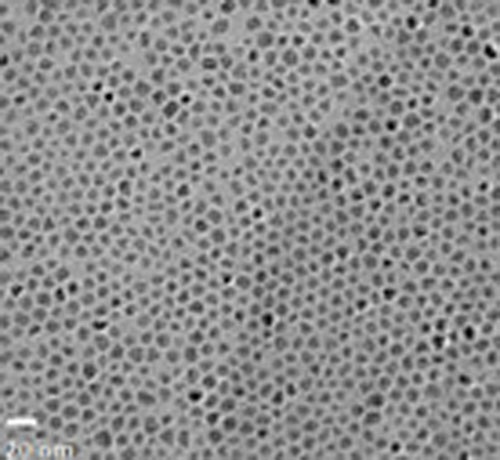
Figure Legend: TEM image of Germanium Nanoparticles
Journal Reference
Chem. Mater., 2013, 25 (8), pp 1416–1422.
Elayaraja Muthuswamy , Andrew S. Iskandar ,Marlene M. Amador , and Susan M. Kauzlarich.
Department of Chemistry, University of California, One Shields Ave, Davis, California 95616, United States.
Abstract
A commercially viable colloidal synthetic method for germanium nanocrystals (NCs) is reported. Oleylamine serves as a solvent, a binding ligand, and a reducing agent in the synthesis. Reactions were carried out with microwave-assisted heating, and the results have been compared with those produced by conventional heating. Germanium iodides (GeI4, GeI2) were used as the Germanium precursor, and size control in the range of 4–11 nm was achieved by controlling the ratio of Ge4+/Ge2+ in the precursor mix. Longer reaction times and higher temperatures were also observed to have an effect on the nanocrystals size distribution. Microwave heating resulted in crystalline particles at lower temperatures than conventional resistive heating as observed with many other nanocrystals systems. The reported approach for germanium nanocrystals preparation avoids the use of strong reducing agents (LiAlH4, n-BuLi, NaBH4) and HF for etching and, thus, can be considered simple, safe, and amenable to industrial-level scale up. The as-prepared NCs are a stable dispersion (hexane or toluene) for weeks when stored under an inert atmosphere (N2/Ar). The stability of the colloidal dispersion was observed to be dependent on the nanocrystals size, with smaller nanocrystals exhibiting longer stability. On exposure to ambient conditions, oxidation occurs over a period of time and results in slow precipitation of the nanocrystals.
Copyright © 2012 American Chemical Society.
