Advances in Engineering Advances in Engineering features breaking research judged by Advances in Engineering advisory team to be of key importance in the Engineering field. Papers are selected from over 10,000 published each week from most peer reviewed journals.

Significance
Bubble columns and air-lift reactors have found many uses in biochemical, chemical and in oil and gas industries. Ideally, these devices serve to carry out e.g. gas-liquid chemical reactions and gas cleaning by absorption. Industries exploit these devices, with column diameters up to one meter, or even several meters, in diameter. Usually, gas is injected at the bottom of the column, via a simple sparger, to form bubbles that rise upwards through the liquid – individually or collectively, potentially coalescing and/or breaking up frequently, depending on, among other things, the presence of impurities or surface active agents: this is all part of the challenge of operating these devices. Bubble size determines the slip velocity of the bubbles and as a result, the mass transfer coefficient, while the bubble size distribution determines the stability of the column operation. Industry is interested to better understand, operate and control these devices by simulating the often heterogeneous and turbulent two-phase flow and the pertinent mixing by means of Computational Fluid Dynamics (CFD) technique. This is a challenge because of the many model assumptions needed to this purpose such as the daring assumption of a constant bubble size and the delicate choice of the value of this constant bubble size.
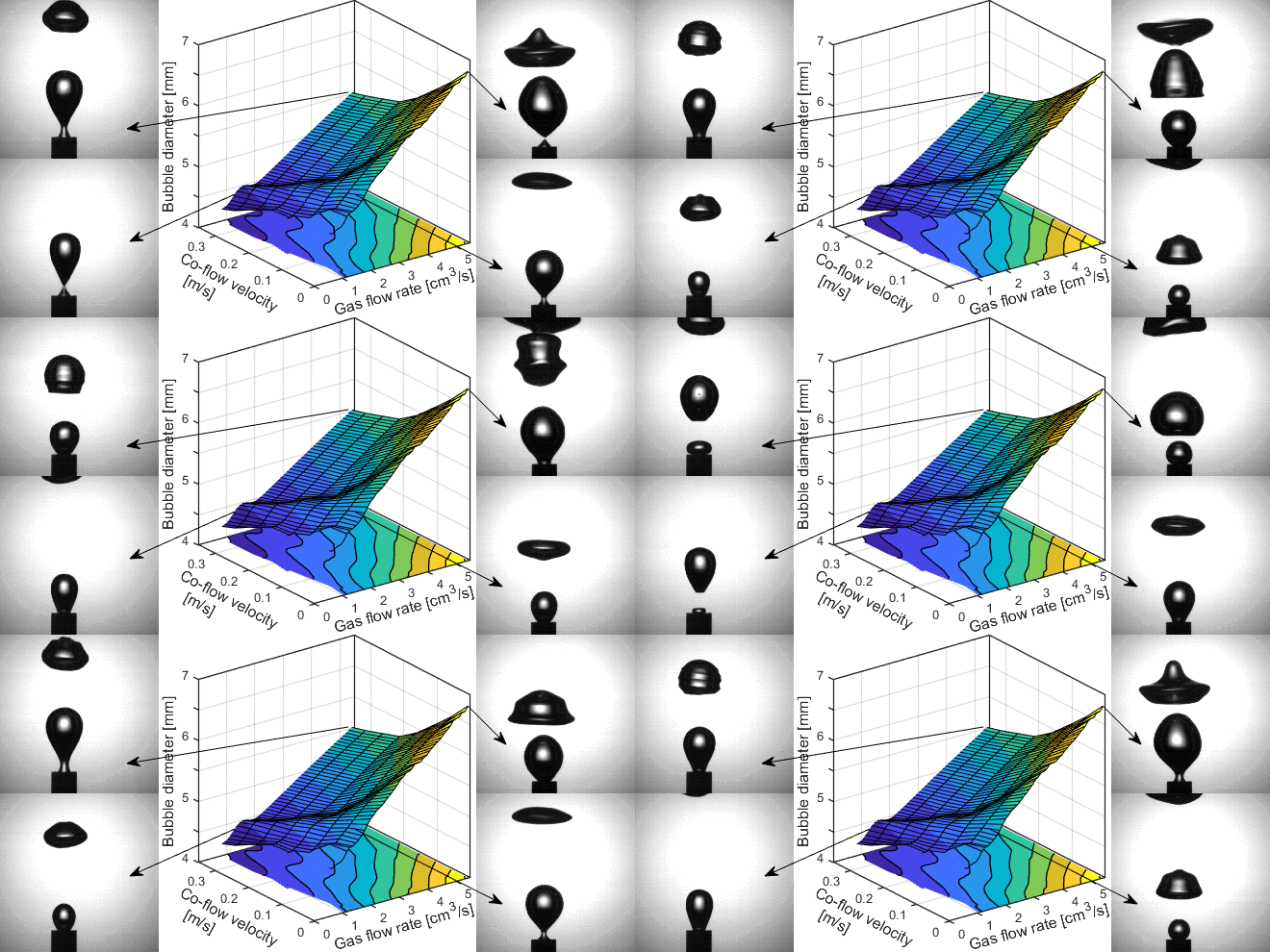
Therefore, collecting experimental data on the formation of bubbles, as uniform as doable and with a constant terminal velocity, is very welcome with the view of validating these simulations. To this end, two researchers from the Bernal Institute at the University of Limerick in Ireland: Professor Harry Van den Akker and Corné Muilwijk (PhD candidate) investigated bubbling for a wide range of gas and liquid velocities, in a single-needle test set-up. Their focus was how to improve beyond existing, often diverging, correlations on bubble formation without and with liquid co-flow. In addition, the researchers aimed at collecting data in regimes of higher gas flow rates and liquid co-flow velocities for fast continuous bubbling producing almost uniform bubbles. Their work is currently published in the research journal, Chemical Engineering Science.
Generally, the authors developed experiments on bubble formation from needles with and without liquid co-flow, carried out with needles in the range of 0:79 < dn < 2:06 mm, for gas flow rates up to 4.5 cm3/s per needle, and with liquid co-flow velocities up to 0.4 m/s. They obtained bubble sizes and frequencies by means of measuring an acoustic signal in the pressurized chamber upstream, which was validated by high-speed imaging analysis. Further, they report bubble contours, bubble growth curves and time return plots when analyzing the bubble formation process. The authors also concluded that literature correlations for the bubble formation in the presence of liquid co-flow poorly agreed with the data obtained in their work.
In summary, Van den Akker and Muilwijk performed detailed experiments to study the bubble formation process with and without liquid. Overall, in a statement to Advances in Engineering, Professor Van den Akker, the lead author, also emphasized that for the design of spargers, where a uniform bubble size distribution is requisite, it would be ideal to operate under constant flow conditions and to avoid intermittent bubbling and weeping, by arranging for a sufficiently large pressure drop over the sparger.
Reference
Corné Muilwijk, Harry E.A. Van den Akker. Experimental investigation on the bubble formation from needles with and without liquid co-flow. Chemical Engineering Science, volume 202 (2019) page 318–335.
Go To Chemical Engineering Science