Advances in Engineering Advances in Engineering features breaking research judged by Advances in Engineering advisory team to be of key importance in the Engineering field. Papers are selected from over 10,000 published each week from most peer reviewed journals.

Significance Statement
Additive manufacturing plays an important role in fabrication and also has the potential to fulfill demands for reducing the cost and time spent on designing-to-manufacturing via saving on raw materials and introducing a single step production process.
Selective laser melting is widely used in fabricating complex structures in various industries such as in aerospace and orthopedics applications. Nesma Aboulkhair and colleagues from the Centre for Additive Manufacturing at the University of Nottingham in the United Kingdom looked at the effect of surface quality as a factor influencing the fatigue behavior of selectively laser melted parts made from Al alloys and proposed heat treatment as an alternative to post process machining that would improve the fatigue performance. The recent work is now published in journal, Materials and Design.
To expand to the load bearing applications, the researchers suggested validating the selectively laser melted parts, focusing on both static and cyclic loading. Among their numerous studies in this field, they investigated the fatigue performance of selectively laser melted AlSi10Mg considering the effects of surface quality and heat treatment – independently and simultaneously – in this most recent study.
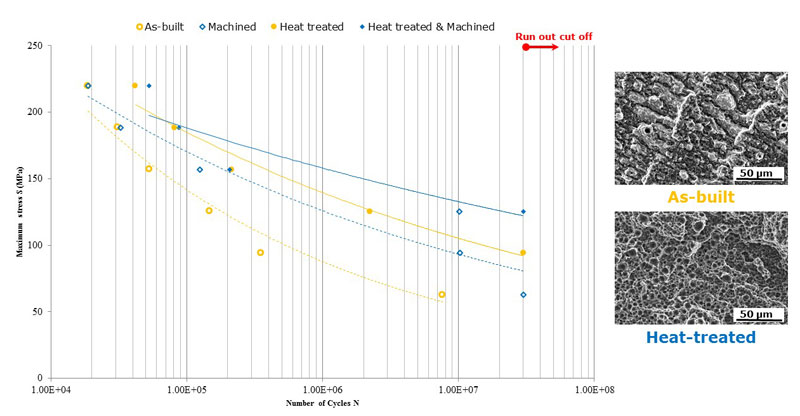
A Renishaw AM250 selectively laser melted machine was used to fabricate two batches of standard fatigue test specimens with reduced gauge sections and continuous radius of curvature between the grip ends. The team ensured that the process parameters used were optimized to produce parts with minimal porosity and a relatively small layer thickness was used to minimize surface defects and irregularities. They used optical microscopy to inspect the machine samples to ensure no cracks or undercuts, the fracture surfaces were also cross-sectioned along the normal plane, polished, etched, and microscopically imaged. The specimens were also cleaned with ethanol before testing to remove any surface dirt or oils. When they ran uniaxial fatigue tests, specimens were loaded until failure or until nominal fatigue life of 3 × 10⁷ was reached.
The authors observed that solely machining the samples could not improve the fatigue life at higher stress levels but an enhancement was achieved at the lower stress levels. Moreover, the heat treatment improved the fatigue performance of the material and failure under cyclic loading was found to originate at surface or sub-surface defects and propagated along the melt pool boundary. According to the authors, it was demonstrated that heat treatment only without surface machining yields better fatigue performance and doubles the fatigue life.
The method of heat treating and machining of the selectively laser melted AlSi10Mg actualized the authors’ aim of improving fatigue performance of selectively laser melted parts. The results of this study will be of interest for industrial sectors producing highly intricate, and functionally graded parts.





Journal Reference
Nesma T. Aboulkhair1,2, Ian Maskery1, Chris Tuck1, Ian Ashcroft1, Nicola M. Everitt2, Improving the Fatigue Behaviour of a Selectively Laser Melted Aluminium Alloy: Influence of Heat Treatment and Surface Quality, Materials and Design 104 (2016) 174 –182.
[expand title=”Show Affiliations”]- dditive Manufacturing and 3D Printing Research Group, Faculty of Engineering, University of Nottingham, Nottingham NG7 2RD, United Kingdom.
- Bioengineering Research Group, Faculty of Engineering, University of Nottingham, Nottingham NG7 2RD, United Kingdom.
Go To Materials & Design