Advances in Engineering Advances in Engineering features breaking research judged by Advances in Engineering advisory team to be of key importance in the Engineering field. Papers are selected from over 10,000 published each week from most peer reviewed journals.

Significance
Generally, various structural components and materials are susceptible to various failure modes. For instance, multiaxial stresses are among the main causes of materials failure. Therefore, regarding the continued technological advancement leading to the development of more advanced materials for specific applications, the development of more effective technologies for predicting and managing failures in materials is highly desirable. This can be achieved through proper understanding of the failure mechanisms, multiaxial fatigue properties of materials and associated influencing factors which will ensure the durability and safety of structural materials in a variety of environmental conditions. This will further ensure development and utilization of effective multiaxial high cycle fatigue testing instruments.
Scientists previously considered the possibility of using the multi-degree of freedom platforms for performing multiaxial fatigue tests considering the fact that they are effective for nanoscale positioning and high-pressure manipulation. Unfortunately, the application of high-frequency fatigue tests has remained a challenge due to the mechanical inertia induced by the reciprocating movement. Alternatively, studies have shown that most of the presently available piezoelectric components applications based on the fatigue tests are generally based on the impact tests, uniaxial tension, and compression. However, due to the continued development of multi-degree of freedom piezoelectric actuators, embracing the use of piezoelectric actuator on combined loading fatigue tests is inevitable. To this end, researchers have been looking for alternatives and have identified a three degree of freedom piezoelectric device as a promising solution.
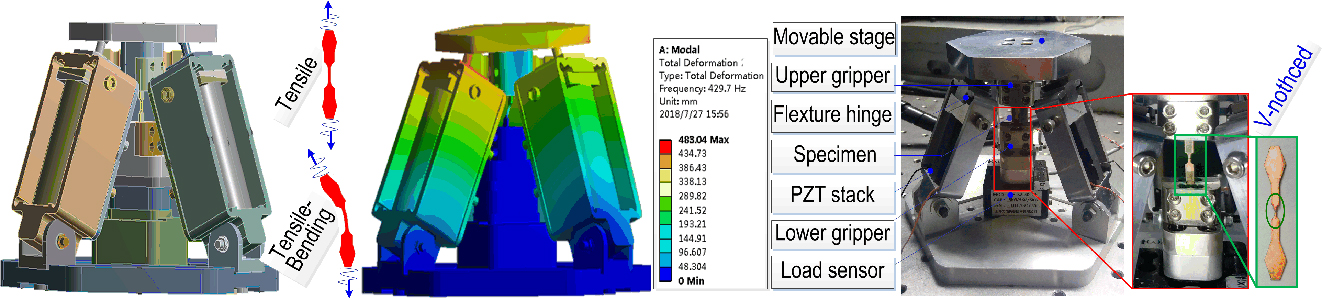
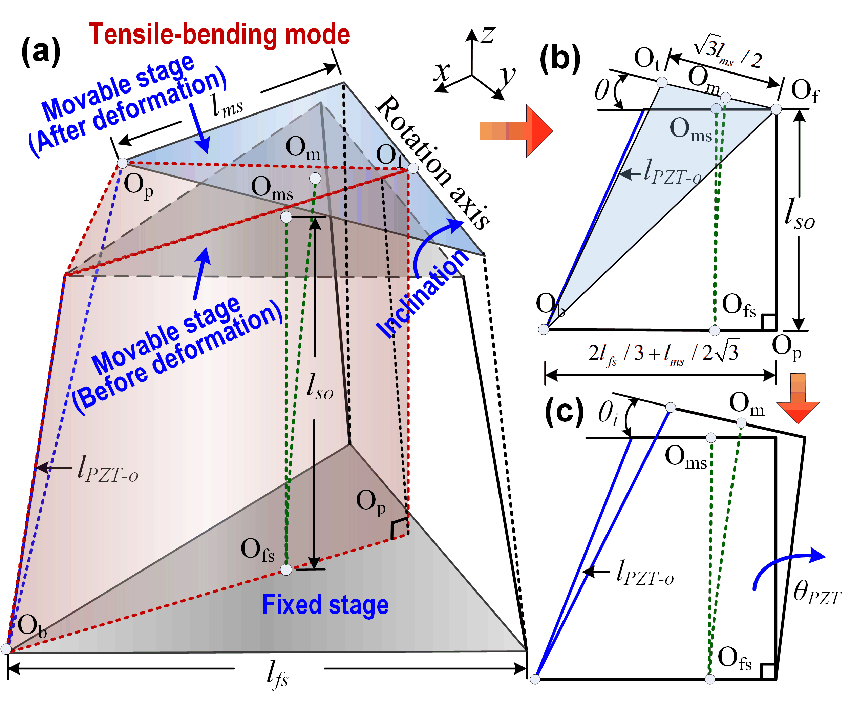
Recently, Jilin University researchers: Dr. Zhichao Ma, Xijie Du (MSc Candidate), Xiaoxi Ma (MSc candidate) Professor Hongwei Zhao, Professor Fu Zhang, and led by Professor Luquan Ren developed a three-degree freedom based miniature piezoelectric-driven fatigue device. Fundamentally, the developed device was an integration of two different fatigue testing functions: uniaxial tensile fatigue and tensile bending fatigue. This helped in determining the various parameters such as maximum load, tensile amplitudes, displacement and bending vector components for the combined fatigue loading effects. Furthermore, by describing the tensile bending loading principle, the author assessed the possibility of determining the vector component displacement along with the perpendicular directions as well as investigating the various anisotropic fatigue properties and their corresponding influence. The work is published in the journal, Review of Scientific Instruments.
From the experimental results, the authors observed that the reduction of fatigue life was as a result of the tensile bending combined stress while on the other hand, the displacement amplitude was decreased by the bending component. Consequently, an increase in the synchronous frequency and voltage amplitude enabled achievement of high-frequency tests which could not be achieved initially using the earlier developed models. This was attributed to the fact that they resulted in the frequency increment and stabilization respectively.
“The device can be used for research on fatigue test related to multiaxial mechanical-thermal coupling condition and could beneficial to guarantee the long-term safety of structural materials under complicated and changeable cyclic loading conditions” Said Dr. Zhichao Ma in a statement to Advances in Engineering.
In summary, the Chinese researchers demonstrated the effectiveness of a three-degree freedom piezoelectric actuator. To actualize their study, they accessed the displacement and fatigue life responses of combined fatigue loading modes. Interestingly, they recorded a maximum load and displacement amplitude of 16.9N/22.8µm and 3.3N/5.6µm respectively thus validating the accuracy of the developed actuator. Altogether, the study will pave the way for the advancement of various scientific measuring instruments.






Reference
Ma, Z., Du, X., Ma, X., Zhao, H., Zhang, F., & Ren, L. (2019). Fatigue device driven by a three degree of freedom tripodal piezoelectric actuator. Review of Scientific Instruments, 90(3), 036102.
Go To Review of Scientific Instruments